Most explanations of a binary plan stop at the first cycle: one leg has more volume than the other, the weaker leg is paid on, and the rest is “carried forward or flushed”. That last phrase hides the part that actually decides what members are paid and what your company owes. What happens to the volume that did not match? The answer changes the bonus in every later cycle. This guide follows one member through three cycles under three different rules, with every number shown.
It is written for people who run a binary plan business or are about to commission one, and for developers who have to build the commission engine. The numbers are for illustration only. They are not a recommendation for how to set your plan and not an expectation of what anyone will earn. Your own plan's rules decide your real results.
Quick answer: In a binary plan the pairing bonus is paid on matched volume, which is the smaller of the two legs. The unmatched volume on the stronger leg is either carried forward to the next cycle, flushed out (cleared), or limited by a cap on how much one member can be paid. In the example below, the same three cycles of sales produce three different totals under three different rules, which is why this setting should be a deliberate decision, and why you should test it in a demo before you sign.
The setup: one member, three cycles
Take one member with a left leg and a right leg. The plan pays a 10% pairing bonus on matched business volume (BV) at the end of each cycle. New volume that arrives in each cycle is:
| Cycle | New volume, left leg | New volume, right leg |
|---|---|---|
| Cycle 1 | 12,000 | 9,000 |
| Cycle 2 | 4,000 | 10,000 |
| Cycle 3 | 6,000 | 6,000 |
Matched volume means the smaller of the two legs after any carried volume is added. The bonus is 10% of that. Everything left on the stronger leg is the unmatched volume, and the rule decides what happens to it.
Rule A: carry-forward
With carry-forward, unmatched volume stays on its leg and is added to the next cycle's volume.
| Cycle | Left leg (with carry) | Right leg (with carry) | Matched volume | Bonus at 10% | Carried to next cycle |
|---|---|---|---|---|---|
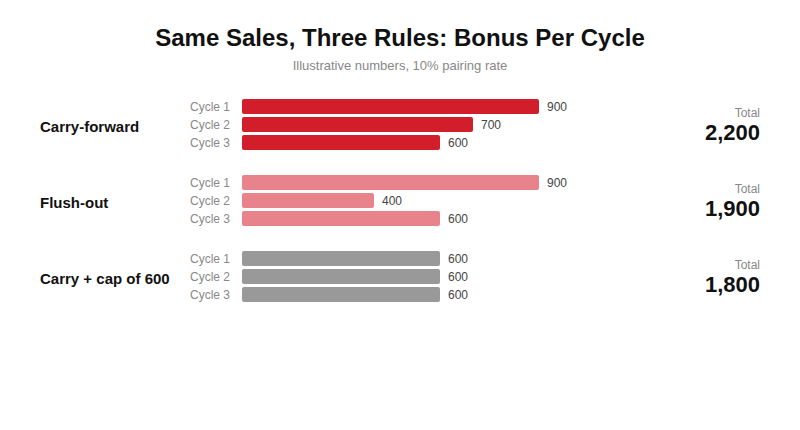
| Cycle 1 | 12,000 | 9,000 | 9,000 | 900 | 3,000 on the left |
| Cycle 2 | 3,000 + 4,000 = 7,000 | 10,000 | 7,000 | 700 | 3,000 on the right |
| Cycle 3 | 6,000 | 3,000 + 6,000 = 9,000 | 6,000 | 600 | 3,000 on the right |
| Total | 2,200 |
Notice what carry-forward does. In cycle 2 the right leg was the stronger one, yet the left leg's carried 3,000 helped match it. Volume that did not pay in cycle 1 still paid in cycle 2. Notice too that the carry moved from the left leg to the right leg as the stronger side changed. A system that stores one “carry” number without saying which leg it belongs to will get this wrong.
Rule B: flush-out
With flush-out, unmatched volume is cleared at the end of every cycle. Each cycle stands alone.
| Cycle | Left leg | Right leg | Matched volume | Bonus at 10% | Flushed (lost) |
|---|---|---|---|---|---|
| Cycle 1 | 12,000 | 9,000 | 9,000 | 900 | 3,000 |
| Cycle 2 | 4,000 | 10,000 | 4,000 | 400 | 6,000 |
| Cycle 3 | 6,000 | 6,000 | 6,000 | 600 | 0 |
| Total | 1,900 |
The same sales produce 1,900 instead of 2,200. Nothing is wrong with either calculation. They are different plans. Flush-out is simpler to explain and keeps the company's payout liability lower and more predictable. Carry-forward is friendlier to members who build one leg ahead of the other, because their effort is not wasted. Neither is a default, and members should be told which rule applies before they join.
Rule C: carry-forward with a cap
A cap limits how much one member can be paid in a cycle. It protects the company when a few members have very large legs. Suppose the same plan carries volume forward but caps the bonus at 600 per cycle, and volume above the cap is used up rather than carried (plans differ on this, and it needs to be written into the rules).
| Cycle | Matched volume | Bonus before cap | Bonus after cap (600) | Carried to next cycle |
|---|---|---|---|---|
| Cycle 1 | 9,000 | 900 | 600 | 3,000 on the left |
| Cycle 2 | 7,000 | 700 | 600 | 3,000 on the right |
| Cycle 3 | 6,000 | 600 | 600 | 3,000 on the right |
| Total | 2,200 | 1,800 |
Three details in a cap rule cause most arguments, so write them down: is the cap per cycle, per day or per week? Is it a cap on the bonus amount or on the matched volume? And is the volume above the cap used up, carried forward or flushed? Each answer gives a different result from the table above.
The three rules side by side
| Rule | Total over three cycles | What it favours | What to watch |
|---|---|---|---|
| Carry-forward | 2,200 | Members who build one leg ahead | Company liability builds up in carried volume |
| Flush-out | 1,900 | Simplicity and predictable payouts | Members may feel unmatched effort is wasted |
| Carry-forward with a cap | 1,800 | Limiting payout per member | Cap wording must be exact |
Variations your plan might use
- Carry with an expiry. Unmatched volume carries for a set number of cycles, then is cleared.
- Partial flush. A set share of the unmatched volume carries and the rest is cleared.
- Weak-leg carry only. Only one leg is allowed to carry volume.
- Pairing ratios other than 1:1. A 2:1 or 1:2 requirement changes what counts as a pair and what is left over.
- Cycle length. The same rules over daily, weekly or monthly cycles give different totals.
Our binary plan page lists the variations we build. If your plan uses a mix, the examples above still show how to check it: write down the rules, then calculate a few cycles by hand.
What your software has to get right
- Store carried volume per member, per leg, per cycle. It should be a ledger entry that you can see and audit, not a number that is overwritten.
- Apply the rules in a fixed order. Add carried volume, find the matched volume, apply the pairing rate, apply the cap, then calculate what carries. A different order gives different answers.
- Make a rerun safe. If a cycle is recalculated, the carried volume must be restored first. Otherwise the same volume is counted twice.
- Handle returns. If an order is returned, the volume has to be reversed, and later cycles that used it may need adjusting. Decide the policy before launch.
- Handle placement changes. Moving a member in the tree changes which leg volume sits on. See our guide to genealogy trees for why sponsor and placement need separate handling.
- Show it to the member. A member should see matched volume, carried volume and flushed volume for each cycle, so the bonus can be checked against the sales.
Test it in a demo with this example
You can use the numbers above to test any binary plan software. Set the pairing rate to 10% and the cycles to weekly. Enter the volumes for the three cycles. A correct system, set to carry-forward, should show bonuses of 900, 700 and 600, with a carried balance of 3,000 on the left after cycle 1 and 3,000 on the right after cycles 2 and 3. Switch to flush-out and the bonuses should become 900, 400 and 600. Add a cap of 600 and the first two should drop to 600. If the demo cannot be set up this way, or the carried volume is not visible, ask why. Our live demo is a good place to start.
Common mistakes
- Paying on total volume instead of on the weaker leg.
- Carrying matched volume as well as unmatched volume, so it pays twice.
- Using one carry balance for both legs.
- Letting the cap apply after rounding in some places and before in others.
- Not telling members the rule. Carry-forward or flush-out should be stated plainly in the plan document.
How we approach this
We build the binary rules around the plan you give us, whether that is carry-forward, flush-out, a cap or a mix, and we show the carried volume in the admin and member panels so every bonus can be traced. If you would like us to walk through your own rules with numbers like these, get in touch and tell us how you want the plan to pay.
Keep reading
- Genealogy trees explained — sponsor, placement and spillover.
- MLM compensation plans compared — where binary fits among the plan types.
- The buyer's checklist — including how to test your plan in a demo.
See the full range of MLM plans we build, or compare the software features.
Frequently Asked Questions
What is carry-forward in a binary MLM plan?
Carry-forward keeps the unmatched volume on the stronger leg and adds it to the next cycle, so it can be matched later. In the example above, 3,000 of unmatched left-leg volume from cycle 1 was matched against right-leg volume in cycle 2.
What is flush-out in a binary plan?
Flush-out clears any unmatched volume at the end of each cycle. Only volume that matches within the same cycle earns a bonus, so the next cycle starts from zero.
Is carry-forward better than flush-out?
Neither is better in general. Carry-forward rewards members who build one leg ahead, but it increases how much volume can pay later. Flush-out is simpler and more predictable for the company. The right choice depends on your plan and your members, and it should be stated clearly in the plan document.
How does a payout cap work in a binary plan?
A cap sets a maximum bonus a member can be paid in a cycle, or sometimes in a day or week. The plan must say whether volume above the cap is used up, carried forward or flushed, because each choice gives a different result.
Can MLM software handle different carry-forward rules?
Yes. A well-built commission engine lets you set carry-forward, flush-out, expiry, caps and pairing ratios as rules, stores the carried volume for each leg, and shows it to the member. Test it with a worked example before you buy.