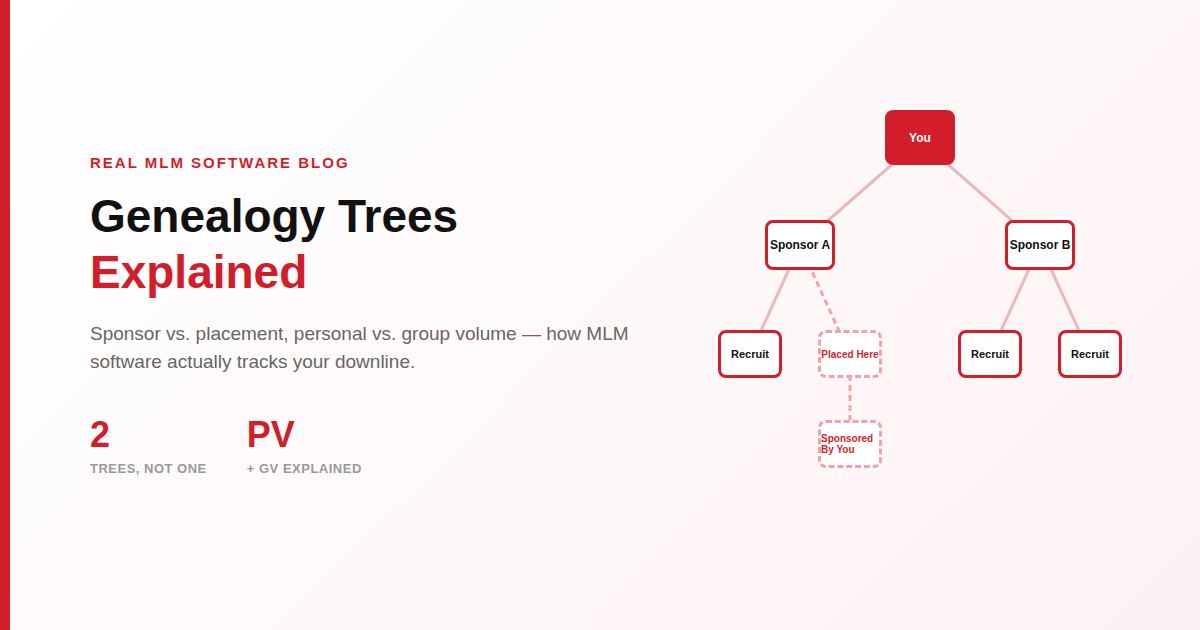
If you ask a distributor to explain their genealogy tree, most can point at their own upline and downline without much trouble. Ask them to explain the difference between their sponsor and their placement - two things that sound like they should be the same but often are not similar - and the confidence usually drops. That gap is worth closing, because it's exactly where commission disputes and "why this person is not in my downline" support tickets actually come from.
This is a plain walkthrough of how genealogy trees actually work, what they're built from, and the one distinction that trips up more distributors than anything else about MLM structure.
What a genealogy tree actually shows
At its simplest, a genealogy tree is a visual map of who's connected to whom in your organization. Every distributor is a node. Every line connecting two nodes represents a real relationship — someone sponsored someone else, or someone was placed under someone else. Follow the lines upward from any distributor and you find their upline. Follow them downward and you find their downline.
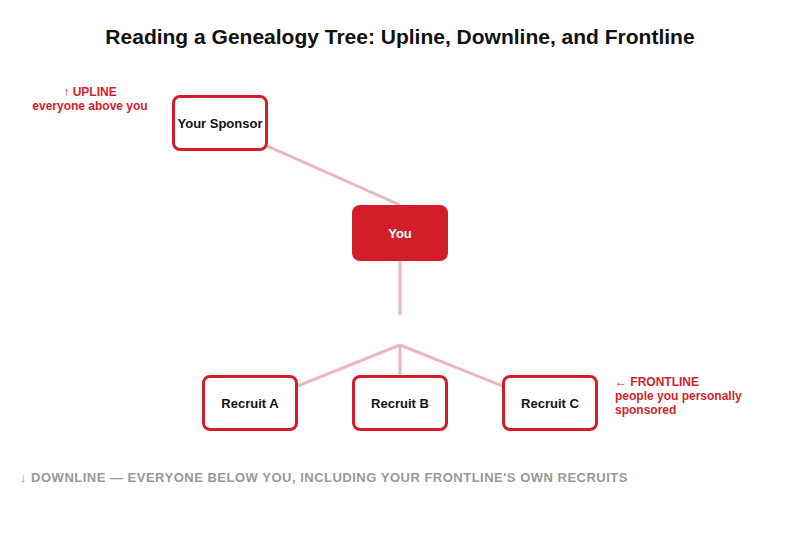
That's the concept in its simplest form. In practice, most compensation plans add a wrinkle that this simple picture doesn't capture: who recruited someone isn't always the same as where they end up sitting in the tree.
Sponsor tree vs. placement tree: the distinction that actually matters
Your sponsor is the person who personally recruited you - the relationship that usually determines who gets credit for bringing you into the business. Your placement is where you're actually positioned in the organizational structure - which can be a completely different spot, especially in plans that use spillover.
This happens constantly in Binary plans. Someone might personally sponsor five new recruits in a week. Rather than stacking all five directly under themselves, the system places some of them further down the tree — under other distributors who need support - while the sponsor relationship (and the credit for the recruitment) stays with the original recruiter. The person doing the recruiting and the person whose downline actually grows from it aren't always the same node.
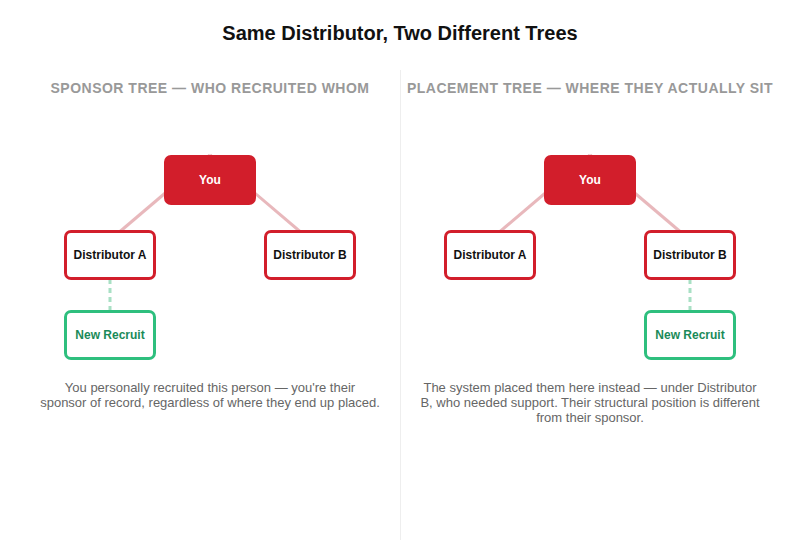
Software that only tracks one of these relationships — sponsor or placement, not both — will eventually produce a report that doesn't match what a distributor actually sees on their screen. Getting this distinction right isn't a nice-to-have; it's the difference between commission calculations people trust and ones they keep questioning.
How volume rolls up through the tree
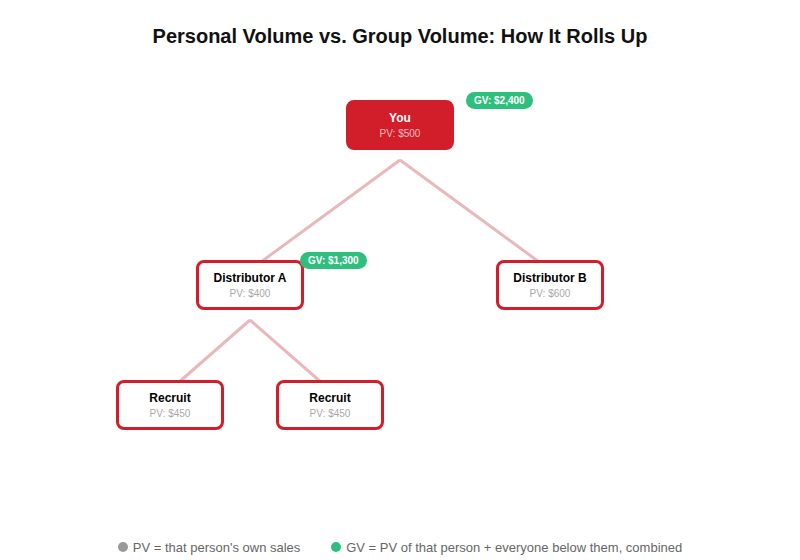
The other thing a genealogy tree needs to show clearly is volume — and specifically, the difference between what one person sold and what their whole team sold.
- Personal Volume (PV) — sales generated directly by one distributor, from their own customers or their own purchases.
- Group Volume (GV) — the combined sales volume of a distributor's entire downline, rolling up through every level beneath them.
Most rank advancements and many bonus structures depend on hitting thresholds in both — a minimum of personal volume to prove the distributor is actually selling, combined with a group volume target that reflects real team performance. A genealogy tree that only shows headcount, without volume rolling up visibly at each node, makes it much harder for a distributor to see why they qualified for a rank — or why they didn't.
What good genealogy software actually needs to do
Beyond just drawing the tree, a genealogy view that's actually useful day-to-day needs to:
- Show sponsor and placement as separate, clearly labeled relationships — not merge them into one
- Update in real time as new distributors join or move, not on a batch delay
- Display rank, status, and both PV and GV at each node without requiring a click into a separate profile
- Let admins search and drill down to any specific distributor's position quickly, especially in large networks
- Restrict who can actually move a distributor's placement — this should never be something a distributor can do to their own downline
How this fits into what we build
Genealogy tracking is a standard part of the MLM software we build — see our features page for the full list of what's included as standard. Because sponsor and placement relationships work differently depending on the compensation plan — spillover behaves one way in a Binary plan and doesn't really exist in a straightforward Unilevel plan — we build the genealogy logic around whichever plan you're actually running rather than a fixed template. See our full range of MLM Compensation Plans, or check out the live demo to see genealogy tracking in action before committing to anything.
Keep reading
- How to choose MLM software — a buyer's checklist.
- MLM vs affiliate software — why a team tree needs a different engine.
- MLM compensation plans compared — how the plan shapes the tree.
Explore our MLM software plans, or try the live demo.
Frequently Asked Questions
Can a distributor have a different sponsor and placement upline?
Yes — this is common in plans that use spillover, particularly Binary structures. The sponsor relationship (who gets credit for recruiting) and the placement position (where someone actually sits in the tree) can be different nodes entirely.
What's the difference between Personal Volume and Group Volume?
Personal Volume is sales generated directly by one distributor. Group Volume is the combined total from that distributor's entire downline. Most compensation plans require minimums in both to qualify for rank advancement or certain bonuses.
Can a distributor move themselves or their downline in the genealogy tree?
This should always be restricted to admin-level access. Allowing distributors to reposition their own placement or their downline's placement breaks the integrity of the commission structure the tree is built to support.
Does every compensation plan use spillover?
No. Spillover is a defining feature of plans like Binary, where structure width is limited and excess recruits need somewhere to go. Unilevel plans, which allow unlimited frontline width, generally don't need spillover at all — every recruit stays directly under their sponsor.