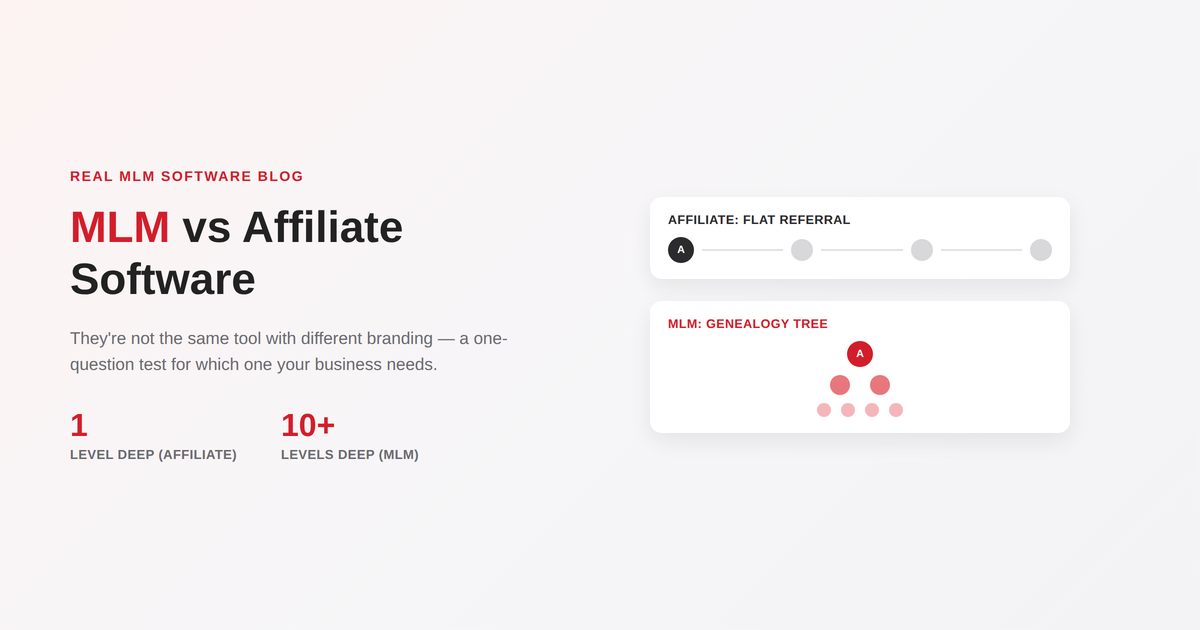
Search "MLM software vs affiliate software" and you'll mostly find articles explaining the difference between MLM and affiliate marketing as business models — recruitment versus referral, income disclosure rules, whether you have to "join" to earn. That's useful, but it's not quite the question a buyer evaluating software actually has. The business-model question and the software-architecture question are related, but they're not the same thing, and conflating them is exactly why vendor listings like "10 best MLM affiliate software" exist and confuse people further — that phrase is doing double duty for two genuinely different categories of tool.
The one-question test
Before any comparison table: does your commission structure pay people for recruiting other earners into a network, or does it only pay for direct sales a person personally generates? If it's the second one — a flat percentage per sale, paid only to the person who made the referral — you need affiliate software, and MLM software would be expensive overkill. If it's the first — people earn from their own sales and from the sales of people they recruited, several levels deep — you need MLM software, and affiliate software will hit a wall the moment your network grows past one level.
Why this is a software-architecture difference, not just a feature checklist
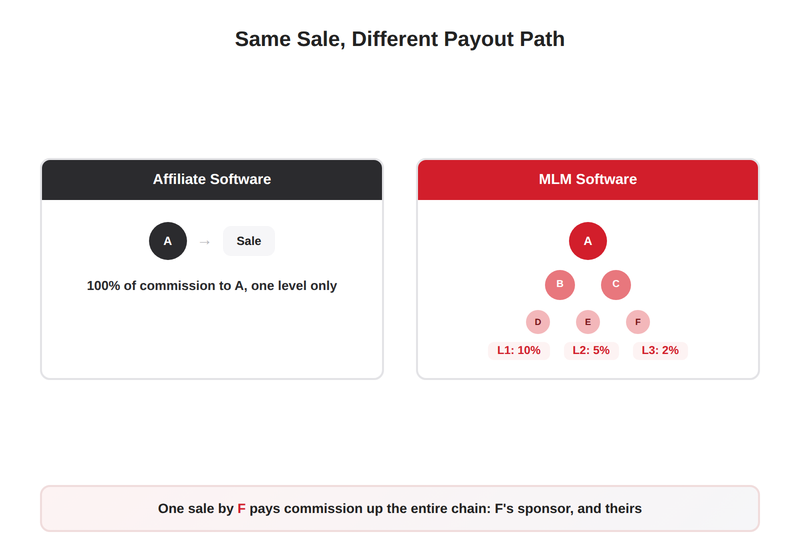
Affiliate software tracks a flat relationship: a referral link or code, a cookie or server-side click record, and a commission calculated for exactly one party when a sale closes. The underlying data model is a list — affiliate, sale, commission. Good affiliate platforms handle that relationship reliably across unlimited affiliates, but it's structurally one level deep per sale.
MLM software has to solve a different problem entirely: for every sale anywhere in the network, it has to resolve the entire upline chain — sometimes across 10 or more levels — apply a different commission percentage or rule at each level depending on the compensation plan type (binary, matrix, unilevel, generation), check rank qualifications that can change what a given distributor is even eligible to earn, and do this correctly for potentially thousands of transactions a day without ever producing a mismatched payout. That's a materially harder engineering problem than a flat affiliate lookup, which is why genuine MLM compensation engines take real specialized expertise to build correctly — a point we've made in detail in our guide to hiring an MLM software development company.
Side-by-side: what the two actually do differently
| Capability | Affiliate Software | MLM Software |
|---|---|---|
| Commission depth | One level — paid only to the direct referrer | Multiple levels — paid up the recruiting chain |
| Network visualization | Flat list of affiliates and their individual sales | Genealogy tree showing the full upline/downline structure |
| Compensation plan types | Typically one model: percentage-per-sale | Multiple structures supported: binary, matrix, unilevel, generation, and others |
| Rank/qualification logic | Not applicable — no ranks to qualify for | Central feature — rank advancement can change earning eligibility |
| Recruitment-based earning | Not supported — earnings tied strictly to personal sales | Core mechanic — earnings include recruits' network performance |
| Typical buyer | E-commerce brands, SaaS products running a referral or partner program | Direct-selling and network-marketing companies with a distributor model |
Where the confusion actually comes from
Part of the problem is that affiliate marketing and MLM genuinely do sit on a spectrum rather than two cleanly separate boxes. Some affiliate platforms added shallow multi-tier support — typically 2–3 levels — to let a SaaS company reward affiliates for recruiting sub-affiliates, and marketers started calling that "MLM affiliate software" because it technically pays more than one level. That's a real, useful feature, but it's not the same engineering depth as a compensation engine built for an 8-level genealogy tree with rank-based qualification rules. If a vendor's "MLM" feature is really a 2-level affiliate extension, your compensation plan will outgrow it fast if it's meant to be a genuine network-marketing structure rather than a referral-with-a-bonus-tier program.
Pick affiliate software if…
- You're compensating people strictly for sales they personally generate, with no recruitment component
- You don't need distributor ranks, genealogy trees, or multi-level payout logic now or in any planned future phase
- Your program is a marketing channel for an existing product business, not the business model itself
Pick MLM software if…
- People earn from the sales performance of others they've personally recruited, not just their own sales
- Your plan involves ranks, qualification thresholds, or a defined compensation structure (binary, matrix, unilevel, or similar)
- You need a genealogy tree to see and manage the actual shape of your distributor network
If you're past this question and ready to compare deployment and ownership options for MLM software specifically, our posts on cloud vs on-premise hosting and white-label vs custom platforms cover the decisions that come next. Not sure which category actually fits your compensation plan? Get in touch and describe how you want people to earn — that one detail is usually enough to tell us which direction you need.
Keep reading
- The buyer's checklist — once you know which type you need.
- SaaS vs licensed MLM software — how you pay and who owns the code.
- In-house vs outsourced development — who should build it.
Look at our custom MLM software page or the software features.
Frequently Asked Questions
Can affiliate software be used to run an MLM business?
Not a genuine one with meaningful depth. A handful of affiliate platforms support 2–3 commission tiers, which can work for a simple sub-affiliate bonus, but they lack genealogy visualization, rank qualification logic, and the compensation plan types (binary, matrix, generation) a real MLM structure needs.
Is MLM software more expensive than affiliate software?
Generally yes, because it solves a harder problem — resolving commissions across a multi-level network with rank logic is more complex to build and maintain than a flat, one-level affiliate calculation. The gap varies by vendor and plan complexity.
What does "MLM affiliate software" actually mean?
It's used inconsistently. Some vendors mean genuine MLM software with an affiliate-style tracking layer; others mean affiliate software with a shallow multi-tier add-on. Ask specifically how many commission levels it supports and whether it includes genealogy tree visualization and rank-based qualification before assuming either meaning.
Can I start with affiliate software and move to MLM software later?
Yes, and it's a reasonable path if you're not yet sure your compensation plan needs full multi-level depth. Be aware that migrating historical referral and sales data into a genealogy-based structure later takes planning — it's not a simple export-import.
Does MLM software include affiliate-style tracking too?
Yes — MLM software still needs to track individual referral links, sign-ups, and direct sales the way affiliate software does; it just builds multi-level commission resolution and genealogy management on top of that foundation, which affiliate software doesn't attempt.