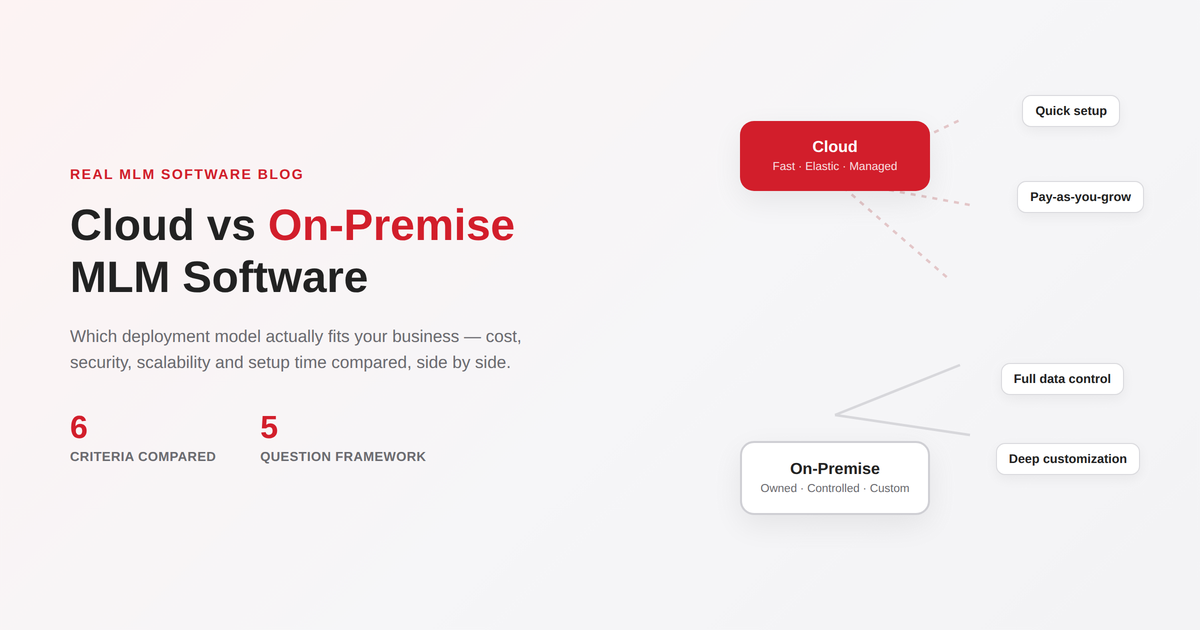
If you're evaluating MLM software, you'll eventually hit a decision that has nothing to do with compensation plans or genealogy trees: where does the software actually live?
Cloud-based MLM software runs on infrastructure your vendor manages, and you access it over the internet. On-premise MLM software runs on servers your company owns and controls, inside your own data center or a dedicated hosting environment you lease. Both can run the exact same binary, matrix, or unilevel plan — the difference is who owns the infrastructure, who's responsible when something breaks, and how much it costs to change your mind later.
Quick answer: Most new and mid-sized MLM/direct-selling companies should start with cloud-based MLM software — it gets you live in days, scales with your distributor growth, and avoids a six-figure infrastructure bill before you've proven the business. On-premise makes sense once you're a large, established company with strict data-residency regulations, a sizable in-house IT team, and deep, ongoing customization needs that a shared cloud environment can't accommodate. A third option — a dedicated private cloud or hybrid setup — increasingly splits the difference for companies that have outgrown pure SaaS but don't want to run their own data center.
Cloud vs on-premise MLM software: comparison table
| Criterion | Cloud-Based MLM Software | On-Premise MLM Software |
|---|---|---|
| Upfront cost | Low — subscription or setup fee only | High — servers, licenses, data center or colocation space |
| Ongoing cost | Predictable monthly/annual subscription | Lower per year after year 2–3, but includes IT staff, power, cooling, hardware refresh |
| Setup time | Days to a few weeks | 2–6 months, sometimes longer |
| Scalability | Instant — upgrade your plan as distributors grow | Manual — requires buying and provisioning new hardware |
| Customization depth | Good for plan logic, features, branding; limited at the infrastructure layer | Full control down to the server and network layer |
| Maintenance responsibility | Vendor patches, updates, and monitors the platform | Your IT team owns patching, backups, uptime, and security |
| Data control & residency | Data sits on the vendor's (or their cloud provider's) servers, in whatever region they operate | Full control over exactly where data physically resides |
| Accessibility for distributors | Works from any device, anywhere, out of the box | Usually needs a VPN or dedicated access layer for remote/global distributors |
| Disaster recovery | Typically built into the vendor's infrastructure (geo-redundant backups) | You design, build, and test your own DR plan |
| Best fit | Startups, SMBs, fast-growing direct-selling companies, companies entering new markets quickly | Large enterprises with in-house IT, strict regulatory/data-sovereignty requirements, or heavy legacy-system integration |
1. Cost: lower to start, not always lower over time
Cloud MLM software is priced to remove the barrier to entry. You're typically looking at a setup fee plus a recurring subscription that scales with your distributor count or feature tier, with hosting bundled in. One established MLM software vendor quotes managed hosting in the $3,000–$4,000/month range at scale — a figure worth treating as directional rather than universal, since hosting cost depends heavily on distributor volume, transaction volume, and how many regions you're serving, but it gives you an order of magnitude for what "the cloud handles it" actually costs once you're operating at real volume.
On-premise flips the cost curve. You're paying upfront for servers, networking equipment, software licenses, and (often) a data center or colocation contract — a capital expense before you've processed a single commission run. Industry analysis of SaaS vs on-premise deployments generally puts the break-even point between the two models at year 2–3 for medium-to-large deployments: on-premise is more expensive to start, but can be cheaper to run once the hardware is paid off and your distributor base is stable rather than rapidly scaling.
The wrinkle MLM companies specifically run into: distributor growth is rarely linear. A single successful recruitment push, a product launch, or a seasonal promotion can spike your active-user count overnight. Cloud infrastructure absorbs that instantly — you pay for the burst, then scale back down. On-premise infrastructure has to be provisioned for your peak load year-round, which means you're paying for idle capacity most of the time, or risking downtime during the exact moments (a big launch, a payout run) when downtime costs you the most credibility with your field.
Bottom line: if your distributor count is growing, unpredictable, or you haven't validated your compensation plan at scale yet, cloud's pay-as-you-grow model is the lower-risk starting point. If you're a stable, large-volume operation where growth is predictable and you can amortize hardware costs over 5+ years, on-premise's long-run economics start to look better — but only once you factor in the IT staff needed to run it.
2. Setup time: days versus months
This is the least ambiguous comparison in the whole decision. Cloud MLM platforms are built to be provisioned fast — most vendors can get a configured instance live within days to a few weeks, because the infrastructure, security patching, and base platform already exist; your implementation is mostly configuration (compensation plan rules, branding, payment gateway connections) rather than infrastructure build-out.
On-premise deployments routinely take two to six months, and that's before accounting for delays in hardware procurement, data center contracts, network configuration, and the testing cycle you need to run before trusting commission calculations and payouts to a brand-new environment.
If you have a launch date, a product line waiting to go to market, or distributors already being recruited, this single factor often settles the decision on its own.
3. Scalability: who provisions the capacity?
Cloud scaling is close to instant: when your active distributor count or transaction volume grows, you (or your vendor) change a plan tier or add resources, and the infrastructure responds within minutes to hours. This matters disproportionately in MLM because of how genealogy and commission calculations work — a binary or matrix tree with hundreds of thousands of nodes, running real-time PV/GV rollups and commission calculations across a global downline, is a genuinely heavy computational load, and it tends to grow in bursts tied to recruitment campaigns rather than smoothly.
On-premise scaling means buying, racking, and configuring new hardware — a process measured in weeks, not minutes. Companies on fixed infrastructure sometimes under-provision deliberately to control cost, which is a reasonable bet right up until a payout run or a traffic spike exposes the ceiling at the worst possible time.
Database performance is also a bigger lift on-premise: as your tree depth and distributor count grow, your genealogy queries need deliberate optimization (indexing, caching layers, read replicas) that cloud platforms generally bake into their architecture by default, but that your in-house team has to build and tune manually on self-managed infrastructure.
4. Security, data control, and compliance
Most "cloud vs on-premise" articles treat security as a binary: cloud is "shared," on-premise is "controlled." For an MLM company, the more useful question is what, specifically, are you protecting, and whose job is it when something goes wrong?
An MLM platform typically holds three categories of sensitive data that deserve different handling:
- Distributor PII — names, addresses, tax IDs, bank details for commission payouts
- Payment and e-wallet data — card details, wallet balances, transaction history
- Commission and compensation data — the financial logic your entire business runs on
Reputable MLM platforms, cloud or on-premise, should already be implementing baseline protections regardless of deployment model: 256-bit SSL/TLS encryption in transit, encryption at rest for stored data, tokenization of payment card data so raw card numbers are never stored directly, role-based access control, and two-factor authentication for admin and back-office access. PCI DSS compliance is non-negotiable if your platform processes card payments directly, and GDPR (or your local equivalent — India's DPDP Act, for instance) governs how distributor personal data must be stored and handled, independent of whether that data sits on your server or a vendor's.
Where the models genuinely diverge: on a cloud platform, your vendor (and their underlying cloud provider, if they use AWS, Azure, or Google Cloud) is responsible for infrastructure-level security — patching the operating system, securing the network perimeter, maintaining physical data center security, and typically maintaining backups under a 3-2-1 strategy (three copies of data, on two different media types, with one copy stored offsite). You're trusting their SLA and their compliance certifications (look for a SOC 2 report specifically when evaluating vendors). On-premise, your own team owns every layer of that stack — a genuine advantage if you have the security expertise in-house and operate in a jurisdiction with strict data-residency rules that require distributor data to physically never leave the country, but a genuine liability if you don't have that expertise, because a misconfigured on-premise server is a more common breach vector than a well-run cloud platform's shared infrastructure.
The honest framing: cloud isn't inherently less secure than on-premise, and on-premise isn't inherently more compliant than cloud — each model shifts where responsibility sits, and the right choice depends on whether you have the in-house capability to carry that responsibility well, and whether a specific regulation in your operating market requires data to stay on infrastructure you directly control.
5. Customization and integration
Cloud MLM software gives you strong customization at the application layer — compensation plan configuration, branding, front-end features, and usually API access for integrating payment gateways, CRMs, and e-commerce platforms. What you generally can't customize is the underlying infrastructure itself; you're working within the vendor's architecture, database engine, and server configuration choices.
On-premise gives you customization at every layer, including the infrastructure. That matters most for companies with deep integration requirements into legacy accounting, ERP, or inventory systems that don't have modern APIs, highly unusual compensation logic that pushes against the limits of a multi-tenant cloud platform's configuration options, or a need to run the MLM platform alongside other internally hosted systems on the same network.
For the large majority of MLM businesses — even ones with fairly sophisticated compensation plans — a well-built cloud platform's configuration layer is sufficient, because compensation plan logic (binary, matrix, unilevel, generation, board, stair-step, hybrid) is fundamentally software logic, not infrastructure logic. See our full range of compensation plans for what's configurable without touching infrastructure at all.
6. Maintenance and total ownership burden
This is the factor companies most often underweight when comparing sticker prices. Cloud MLM software shifts patching, monitoring, uptime management, and platform updates to your vendor — your team's job is running the business, not running a data center. On-premise MLM software means your company owns 24/7 server monitoring and incident response, security patching and vulnerability management, hardware maintenance and eventual replacement (typically every 3–5 years), backup verification and disaster recovery testing, and a skilled IT/DevOps team capable of all of the above — a real hiring and retention cost, not a one-time setup cost.
If you don't already have that team in place, the "lower long-run cost" of on-premise often evaporates once you price in hiring the people required to run it safely.
The middle path: dedicated/private cloud hosting
A growing number of mid-sized MLM companies land on a third option that generic comparison articles skip: a dedicated or private cloud environment, managed by their software vendor or a specialized hosting provider, but running on infrastructure reserved for that company alone rather than a shared multi-tenant platform.
This gets you cloud-like speed of deployment and professional infrastructure management, meaningfully more control over data residency and security configuration than standard multi-tenant SaaS, and a migration path for companies that started on shared cloud hosting and have outgrown it, without jumping straight to running your own data center.
If data sovereignty or deep customization is pulling you toward on-premise, but you don't have (or want to build) an internal infrastructure team, ask any MLM software vendor you're evaluating whether they offer a dedicated/private hosting tier before ruling cloud out entirely.
Which should you choose? A 5-question framework
Answer honestly, and the right model usually becomes clear:
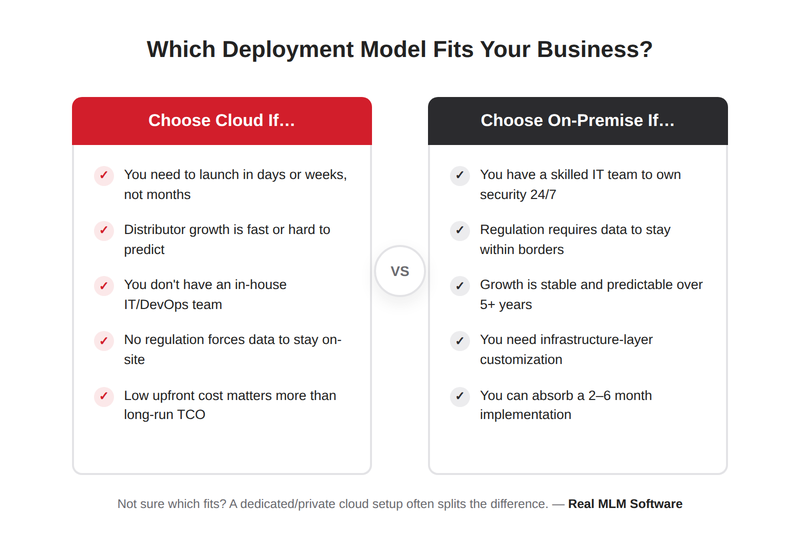
- Do you have an in-house IT/DevOps team that can own 24/7 infrastructure security, patching, and uptime today — not eventually? If no, lean cloud.
- Does a specific regulation in your operating market require distributor data to physically remain within national borders, with no exceptions? If yes, look at on-premise or a dedicated private-cloud option in that region.
- Is your distributor count stable and predictable, or are you expecting rapid, uneven growth in the next 12–24 months? Rapid/uneven growth favors cloud's elastic scaling.
- Do you need infrastructure-layer customization (legacy ERP integration, unusual network architecture), or does your customization need stop at compensation-plan logic and branding? Infrastructure-layer needs favor on-premise or dedicated hosting; plan-logic needs are well served by cloud.
- Can your business absorb a 2–6 month implementation timeline, or do you need to be live in weeks? A tight timeline all but decides this in favor of cloud.
If most of your answers point to limited in-house IT, unpredictable growth, and a need to launch fast — which describes the majority of new and scaling MLM companies — cloud-based MLM software is the lower-risk default. Reserve on-premise for the specific, provable cases above, not as a default "more serious" choice.
How we approach this, honestly
We build and host MLM software on cloud infrastructure by default because it's the lower-risk starting point for most of the businesses we work with, and we'll tell you plainly if your situation — a specific data-residency requirement, a deep legacy integration — genuinely calls for an on-premise or dedicated hosting approach instead. If you're weighing this decision for your own compensation plan and distributor footprint, get in touch and we'll walk through which model actually fits, including if that means a longer conversation about infrastructure rather than a quick yes.
Keep reading
- SaaS vs licensed MLM software — the next decision: how you pay for it and who owns the code.
- White-label vs custom — whether you share a platform with other companies.
- The buyer's checklist — the whole buying decision in one list.
Want to see a hosted platform in action? Try the live demo, or read how we build custom MLM software.
Frequently Asked Questions
Is cloud-based MLM software secure enough for financial/commission data?
Yes, when the vendor implements standard safeguards: encryption in transit and at rest, PCI DSS compliance for payment processing, role-based access control, and regular third-party security audits (look for a SOC 2 report). Security depends on how well a platform is built and maintained, not on whether it's cloud-hosted or on-premise.
Can I switch from cloud to on-premise MLM software later, or vice versa?
Migration is possible in both directions but is a genuine project, not a toggle — it typically involves data migration, compensation-plan re-validation, and a parallel-run period to confirm commission calculations match before cutting over. It's far easier to start cloud and migrate to a dedicated/private environment later than to build on-premise infrastructure first and try to "simplify" into cloud afterward.
Does on-premise MLM software guarantee better data privacy than cloud?
No — it guarantees more control over where data sits and who touches the infrastructure, which matters for specific data-residency regulations. It does not automatically mean better privacy outcomes; a poorly secured on-premise server is a more common breach vector than a well-managed cloud platform with proper certifications.
What does cloud MLM software hosting typically cost?
Pricing varies by distributor volume, transaction volume, and feature set, but managed cloud hosting for an active MLM platform commonly falls in the low thousands of dollars per month at meaningful scale, bundled into the vendor's subscription rather than billed separately. Get a quote based on your actual distributor count and transaction volume rather than relying on a generic published figure.
Is there a deployment option between cloud and on-premise?
Yes — dedicated or private cloud hosting, where your software vendor provisions infrastructure reserved exclusively for your company rather than a shared multi-tenant environment. It's worth asking about specifically if data control is your main concern but you don't want to run your own data center.