By now you may have worked through where your software should be hosted and how you want to pay for it and who should own the code. There's a third, separate question those two don't answer: is the platform itself something other companies are also running under their own logos, or something built uniquely around your business?
That's what white-label actually means. It's not about hosting, and it's not strictly about ownership — you can license a white-label platform's source code outright, or run a fully custom build as a SaaS subscription. White-label specifically means the underlying platform is a pre-built, shared product that gets rebranded — your logo, your colors, your domain — rather than designed from scratch around your compensation plan and workflows.
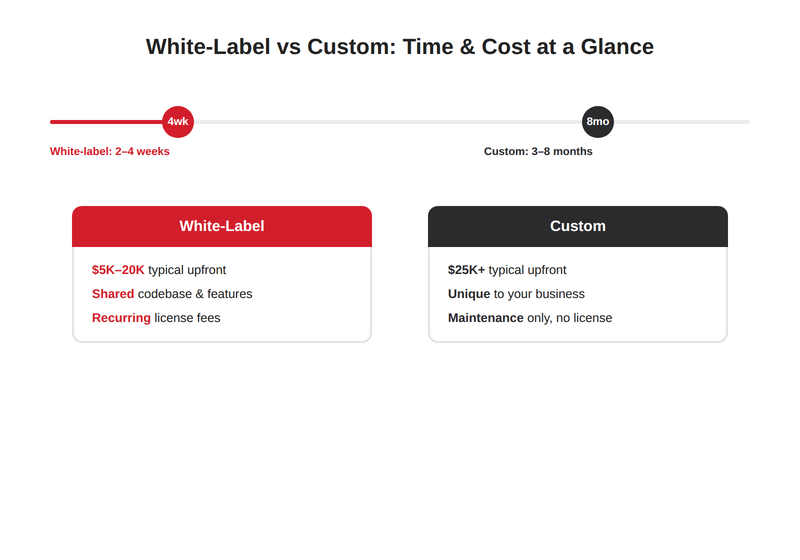
Quick answer: White-label MLM software gets you to market faster and cheaper — typically weeks instead of months, and a fraction of the upfront cost of a custom build — by rebranding a platform other MLM companies are also running. The trade-off isn't really the price over time (a 5-year cost comparison often lands closer than people expect); it's that your core platform capabilities are the same ones your competitors running the same white-label product also have. Custom development costs more and takes longer, but builds you something only your business has. Many companies deliberately start white-label and graduate to custom once the business has proven itself.
White-label vs custom MLM software: comparison table
| Criterion | White-Label MLM Software | Custom-Built MLM Software |
|---|---|---|
| Development time | Typically 2–4 weeks | Typically 3–8 months |
| Initial cost | Lower, commonly a few thousand to the low tens of thousands | Higher, commonly tens of thousands and up depending on scope |
| Customization level | Limited to the vendor's predefined options and add-ons | Effectively unlimited, built around your exact requirements |
| Scalability | Bound by the shared platform's architecture and limits | Designed around your specific growth trajectory |
| Ownership | Licensed use, typically with ongoing vendor dependency | Can include full ownership of the source code |
| Security control | Depends on the vendor's own protocols and practices | Fully within your control, built to your own standards |
| Ongoing costs | Recurring license or subscription fees for as long as you use it | Maintenance and support costs, generally more stable over time |
| Competitive differentiation | The same core features are available to any other company on the same platform | Proprietary features and workflows unique to your business |
What a white-label platform typically includes out of the box
A reputable white-label MLM platform usually ships with the functional core already built: support for standard compensation structures (binary, unilevel, matrix, generation, and similar), distributor and admin dashboards, automated commission processing, e-wallet and payment gateway integration, multi-currency and multi-language support, and reporting tools. Branding — your logo, color scheme, and domain — along with your specific compensation plan configuration and any third-party integrations (CRM, accounting, ERP) are the parts that get customized on top of that shared foundation.
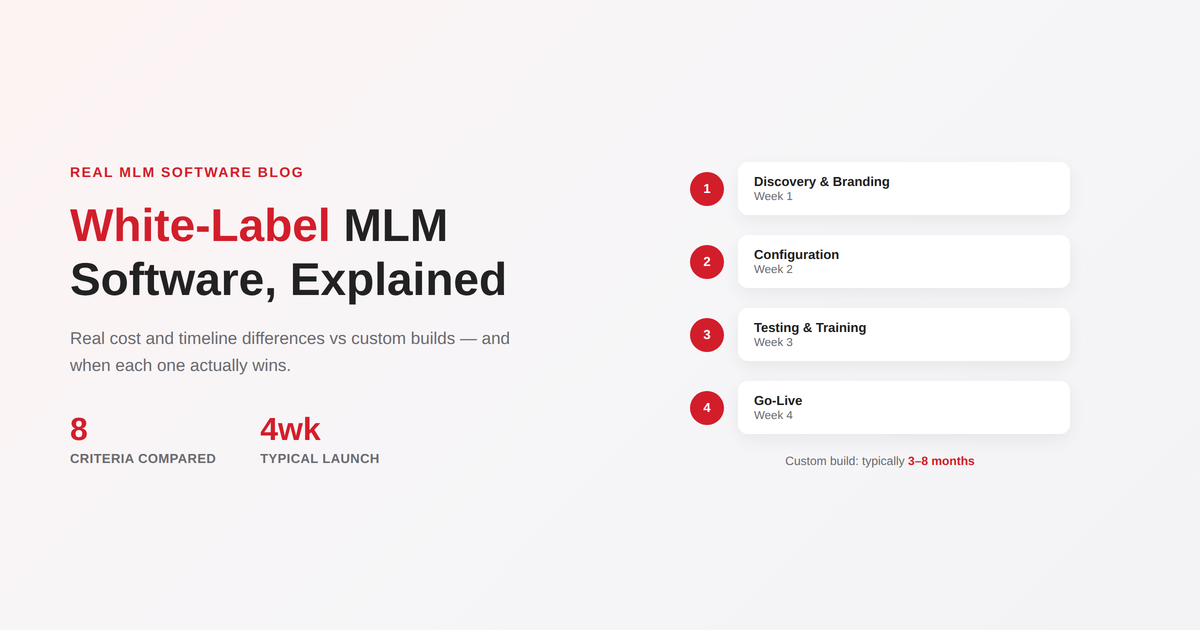
A typical rollout runs on roughly a 4-week rhythm: discovery and compensation plan review in week one, branding and configuration in week two, testing and admin training in week three, and go-live with initial monitoring in week four. Treat this as a general shape rather than a guarantee — a plan with unusual rules or extensive integration needs will push past a standard timeline even on a white-label platform.
The real cost comparison isn't as one-sided as it looks
The upfront gap between white-label and custom is real and significant — white-label commonly runs a fraction of custom development's initial cost. But upfront cost isn't total cost. Because white-label platforms typically carry ongoing license or subscription fees indefinitely, while a custom build's ongoing cost is mostly maintenance, the long-run numbers can converge more than the headline prices suggest. One industry cost model comparing the two over five years put them within roughly 5% of each other in total cost — worth treating as illustrative rather than a quote for your situation, but a useful reminder not to decide on the upfront number alone.
The risk that matters more than the price: you're running the same platform as your competitors
This is the part pure cost comparisons tend to underweight. A white-label platform is, by definition, available to other MLM companies too — including ones competing in your market. The compensation engine, the dashboards, the reporting tools: your distributors are seeing a UI another company's distributors are also seeing, just with a different logo. For a business where the software experience itself is a differentiator — a distinctive distributor app, a reporting feature competitors don't have, workflow automation built around how you specifically operate — that shared foundation is a real limitation, independent of what it costs.
This doesn't make white-label the wrong choice. It makes it the right question to ask honestly: does your business need to look and function differently from every other company on the same platform, or does a well-built, reputable white-label product do everything your distributors actually need?
When white-label is the right call
- You need to launch quickly and a slower, more expensive build would cost you market timing
- Your compensation plan is a standard structure the platform already supports well
- You're testing market viability before committing to a larger investment
- Your technical requirements are straightforward, without unusual integrations or workflow needs
When custom development is the right call
- Your compensation plan has genuine edge cases or rules a standard platform doesn't cleanly support
- You need specific integrations with existing CRM, accounting, or ERP systems
- You're operating under regulatory requirements that need direct control over compliance logic
- A differentiated software experience is part of how you compete, not just a back-office tool
The common middle path: start white-label, graduate to custom
As with the SaaS-to-licensed migration path we've covered separately, many MLM businesses deliberately start on a white-label platform to validate the business quickly and affordably, then move to a custom build once volume and differentiation needs justify the larger investment. This avoids overcommitting to custom development before you know the compensation plan and the market response actually hold up.
How we approach this, honestly
We build custom MLM software, so it would be easy to just tell you custom is always worth it — but that's not true for every business at every stage. If a standard compensation plan and a fast, affordable launch is what you actually need right now, we'll tell you that plainly, including if that means a white-label-style approach fits your current stage better than a full custom build. Get in touch and we'll give you an honest read on which approach fits where your business actually is.
Keep reading
- Open-source MLM software — the free alternative, and its risks.
- In-house vs outsourced development — if you plan to grow past white-label.
- How to hire an MLM software company — what to check in a vendor.
Read about our custom MLM software build.
Frequently Asked Questions
Is white-label MLM software the same as SaaS MLM software?
No — they answer different questions. SaaS is about how you pay (subscription vs one-time purchase) and whether you own the code. White-label is about whether the underlying platform is a shared product used by multiple companies or something built uniquely for you. You can combine these in different ways, including a white-label platform offered as a one-time licensed purchase.
Can I fully customize a white-label MLM platform's compensation plan?
Within the platform's supported plan types and configuration options, yes. If your plan needs genuinely custom logic outside what the platform's configuration allows, that typically requires either a higher-tier customization package from the vendor or a move to custom development.
Is white-label MLM software actually cheaper over time?
Not always by as much as the upfront price suggests. White-label's recurring license fees accumulate over years, while a custom build's ongoing cost is mainly maintenance, so the long-run totals can end up closer together than the initial quotes imply. Compare total cost over at least 3–5 years, not just the launch price.
What's the biggest risk of white-label MLM software?
Not cost or quality, in most cases — it's that other companies, potentially including direct competitors, can run the same underlying platform. If your software experience is meant to be a competitive differentiator rather than just operational infrastructure, that shared foundation is a real limitation to weigh.
Can I switch from white-label to custom MLM software later?
Yes, and it's a common and deliberate path — many businesses start white-label to validate their compensation plan and launch quickly, then migrate to custom development once the business has proven itself and the investment is justified.