Search "open-source MLM software" and you will find a long list of vendors calling their product open source. Here is the catch: most of them are not open source at all. A real open-source project is free, public, and anyone can read or change the code at their own. What most vendors actually sell is normal paid software. You just get the source code files after you pay a huge amount against the source. That is not the same thing. It's worth knowing the difference before you pick either path.
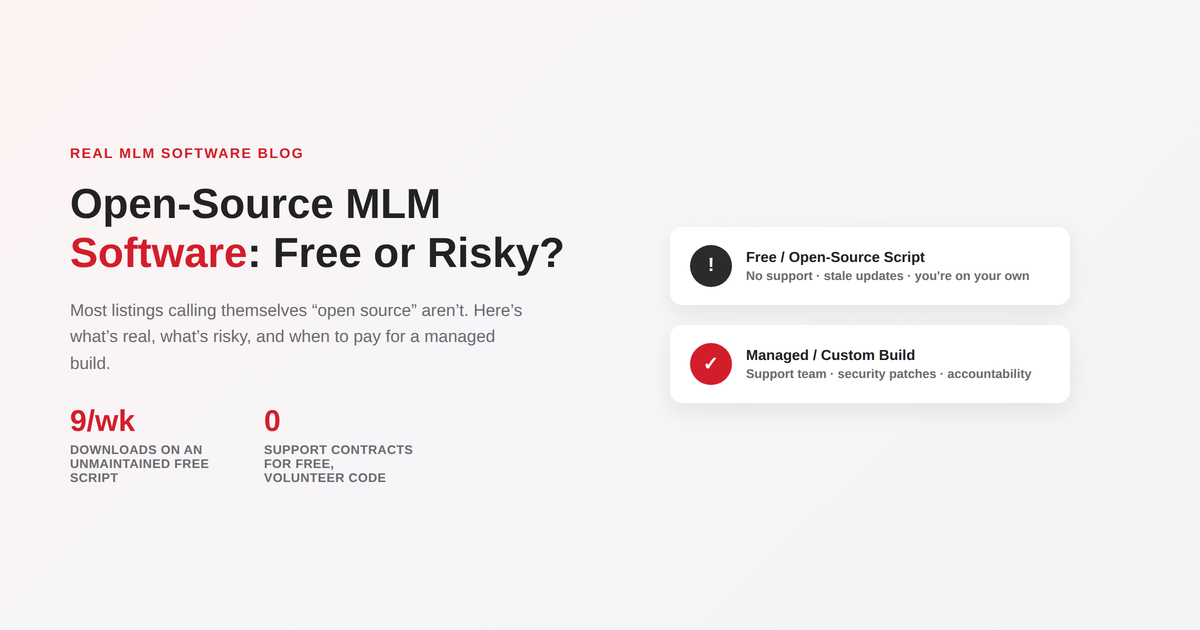
Short answer: True open-source MLM scripts do exist, and they are free. But most are old, unsupported, and risky to run a real business on. One script we checked hasn't been updated since early 2023 and gets about 9 downloads a week. If your commission engine breaks on a weekend, there is no one to call for support. A managed or custom build costs money and time, but someone is accountable when things need attention. For a business handling real payouts to real people, that accountability is usually worth paying for.
What "open source" actually means
Open source means the code is public. Anyone can look at it. Anyone can copy it, change it, or build on it, usually for free. No single company owns it or controls who uses it.
That is very different from a vendor who sells you a license and then also gives you the source code. That is still their product. You are still paying them for the software. You still depend on them for updates and fixes. Calling it "open source" is a marketing choice, not a technical one.
Real open-source MLM software does exist — here is what we found
We checked a few actual open-source MLM projects, the kind you'd find on SourceForge or GitHub. The results were mixed.
One WooCommerce-based MLM plugin on SourceForge supports binary, matrix, unilevel, and other plans. Sounds useful. But its last update was in February 2023. It gets roughly 9 downloads a week. It has zero user reviews. That is not a project you want running your commission payouts in 2026.
A different project on GitHub, written in Perl, looked healthier — 57 stars, 38 forks, and a maintained-looking codebase. But it is a small community project built by volunteers, not a business tool with support contracts or security audits. It can work for a hobby project. It is a harder sell for a company paying out real commissions every month.
The real risks of free MLM scripts
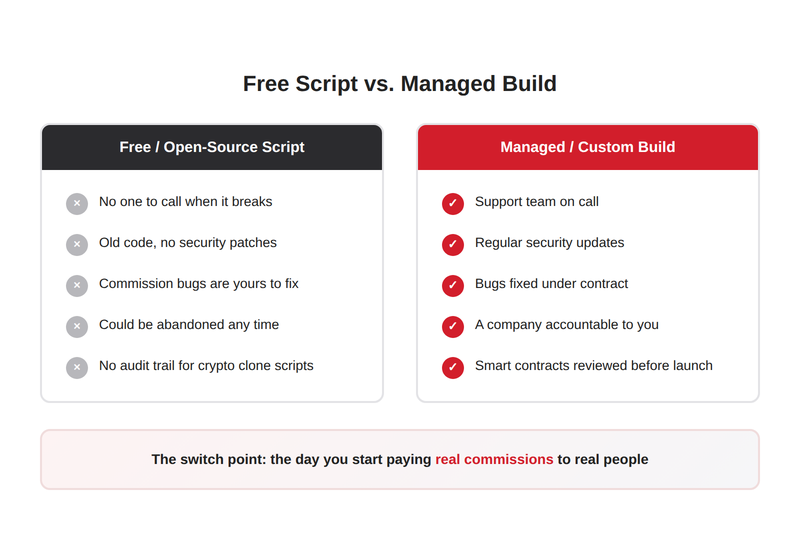
- No one to call when it breaks. Free, volunteer-run software has no support line. If your payout logic has a bug, you're on your own, or waiting on a forum post that may never get answered.
- Old code stops getting security fixes. A project with no updates since 2023 isn't getting patched against new security problems. That's a real risk for software that stores money, emails, and personal data.
- Commission bugs cost real money. A mistake in binary leg balancing or matrix spillover isn't a small glitch. It means distributors get paid the wrong amount. Fixing that after the fact is expensive and damages trust.
- "Free" crypto clone scripts carry extra risk. In the crypto MLM space, free or cheap smart contract clone scripts, often copied from infamous fraud-case platforms, are common. Many are copy-pasted from projects that were later hacked or abandoned. A security hole in a smart contract can't always be patched after it's live — by then, funds may already be gone.
- No accountability if something goes wrong. With paid, managed software, there's a company whose name is on the work. With a random free script, there usually isn't.
When a free script is actually fine
Not every use case needs a managed build. A free script can make sense if:
- You are testing an idea, not running a live business with real payouts yet.
- You have a developer on your own team who can read the code, fix bugs, and patch security issues as they come up.
- You are comfortable with the risk of the project being abandoned with no warning.
When you need a managed or custom build instead
- You are paying real commissions to real distributors every month.
- You need someone to fix bugs fast, not whenever a volunteer has time.
- Your compensation plan has rules that a generic free script doesn't support well.
- You are handling crypto payments or smart contracts, where a single bug can mean lost funds with no way to undo it.
If you're also weighing a pre-built, rebrandable option against a fully custom build, our post on white-label MLM software covers that related but different decision. And if cost is the main worry holding you back from a managed build, our guide on SaaS vs licensed pricing models breaks down what you'd actually pay.
How we think about this, honestly
We build paid, managed MLM software, so you might expect us to just say "never use free software." That's not quite right. If you are still testing an idea with no real money moving yet, a free script can be a fine place to start. But the moment real distributors are earning real commissions, the risks above stop being theoretical. Get in touch if you want an honest read on whether your current stage calls for a managed build yet, or not.
Keep reading
- White-label MLM software — a paid shortcut with its own trade-offs.
- SaaS vs licensed MLM software — paying for support and updates.
- The buyer's checklist — what to check before you commit.
Compare with our custom MLM software approach.
Frequently Asked Questions
Is open-source MLM software actually free?
Genuine open-source projects are free, yes. But most products labeled "open source" by vendors are actually paid software where you simply receive the source code after purchase. Always check whether you're paying a license fee before assuming it's free.
Can I trust a free MLM script I found on GitHub or SourceForge?
Check how recently it was updated and how many people are actually using it. A project with no updates in a year or more, and very few downloads, is a real risk for running a live business.
What happens if a free open-source MLM script has a bug in commission calculations?
You're responsible for fixing it yourself, or finding a developer who can. There's no support contract or guaranteed fix time, unlike with paid, managed software.
Are free crypto MLM clone scripts safe to use?
Generally, no. Many are copied from contracts that were later hacked or exploited. Smart contract bugs often can't be patched after launch, so a security flaw can mean permanently lost funds.
When does it make sense to move from a free script to a paid, managed build?
As soon as you're paying real commissions to real people. At that point, the cost of downtime, bugs, or a security breach is almost always higher than the cost of a managed build.