Search "smart contract MLM clone script" and you will find dozens of vendors selling one. They promise a ready-made platform, live in a few days, for a fixed price. What most of those pages do not mention: this exact style of platform has already produced one of the largest crypto fraud cases regulators have brought. Before you buy a copy of that design, it is worth knowing what actually happened, and why copying a broken design does not fix it.
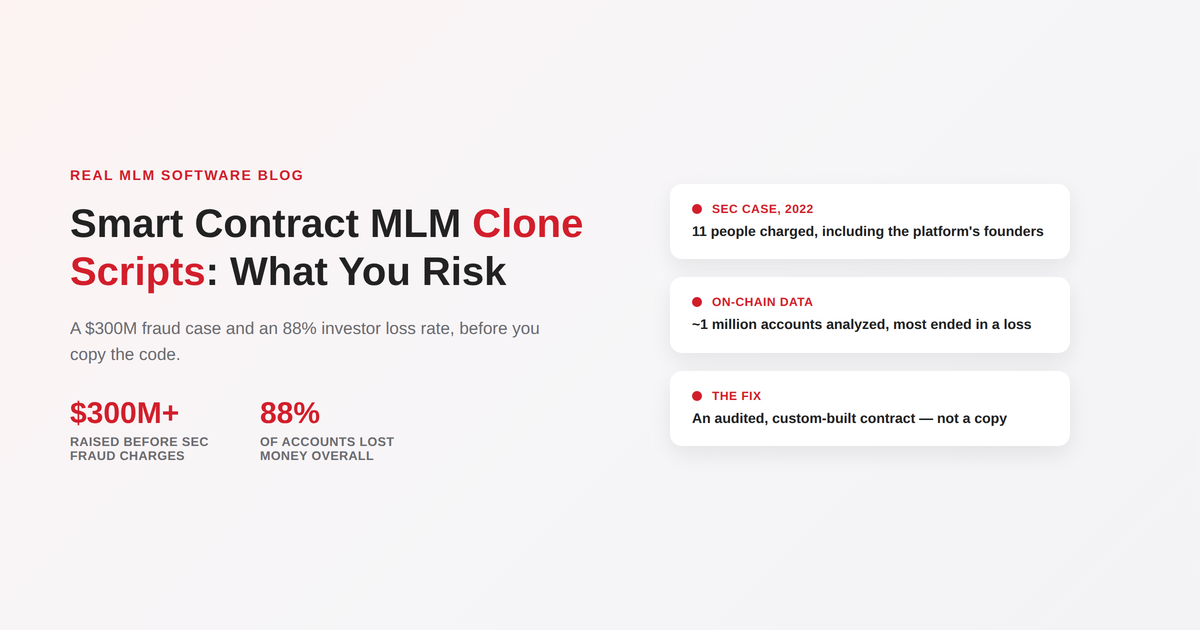
Short answer: One widely studied smart contract MLM platform raised over $300 million from investors worldwide before US regulators stepped in. Its founders and several promoters were charged with fraud. Researchers who studied its public blockchain records found that roughly 88% of the accounts that used it lost money overall. A clone script copies the same payout logic. It does not fix the part that caused people to lose money. If you want a crypto MLM platform, a custom, audited build gives you a say in how commissions actually work, and someone accountable if something breaks.
How these platforms actually work
The structure behind most smart contract MLM scripts is simple. You buy a "slot" through a smart contract. You earn money when people you recruit buy slots too, and from a share of recruits further down the chain, sometimes called spillover. There is no product. No service. The only money coming in is from new investors buying slots.
That is the classic structure of a pyramid scheme. Running it as code instead of a company does not change that. It just makes it automatic, and harder for regulators to shut down, since there is no single office or server to seize.
What regulators found in one major case
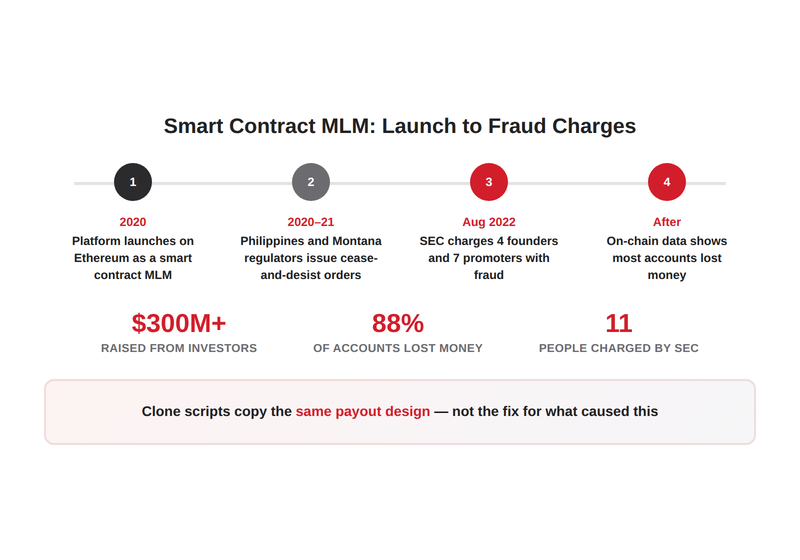
In one well-documented US case, regulators charged eleven people, including the platform's founders and several promoters, with securities fraud and selling unregistered securities. The filing described the platform as having "no apparent source of revenue other than funds received from investors" — in plain words, a Ponzi scheme running on a blockchain. Regulators in more than one country had already issued cease-and-desist orders before the federal fraud case was filed.
Academic researchers who studied that platform's own public blockchain records found the scale of the damage: out of roughly 1.15 million accounts that interacted with the contract, about 88% lost money overall. A small number of early participants made large gains. Everyone who joined later mostly did not.
What a "clone script" actually gives you
A clone script is prebuilt code that copies this slot-and-spillover structure. Vendors advertise it as ready to launch in days, often at a flat price. Several vendor pages we checked claim "100% security" for their contracts, but do not name a third-party audit firm or publish an audit report. That is a claim, not a guarantee.
Buying a clone does not inherit anyone else's legal case, since each deployment is its own entity and contract. But it does inherit the same payout design regulators have already called a pyramid scheme in writing. If you launch a near-identical structure, you are taking on a similar legal and reputational risk, whether or not you call it a clone.
Why smart contract bugs are a different kind of risk
- You usually cannot patch it after launch. Most smart contracts are immutable once deployed. A bug in your commission logic, once live, often cannot be fixed without migrating to a whole new contract and asking users to move their funds.
- "Self-executing" does not mean "correct." A smart contract runs exactly as written, bugs included. Code running automatically just means a mistake gets repeated automatically too, at full speed, for every transaction.
- Unaudited code is a common entry point for exploits. Clone scripts copied and resold many times, with little independent review, are a known target. If one copy has a flaw, every business running that same unaudited copy shares the same exposure.
- There is no customer support line for a smart contract. If funds get stuck or drained, there is usually no company to call, and no way to reverse the transaction.
What an audited custom build does differently
- The compensation logic is built for your actual plan, not copied from a design regulators have already flagged elsewhere.
- Independent security auditors review the contract code before it goes live, with a report you can show investors or regulators if asked.
- You get a real support relationship. Bugs get fixed under contract, not whenever a script's original author feels like it, if they are even still reachable.
- You can build in compliance features from day one — genuine product or service sales, income disclosures, and limits on recruitment-only earnings — rather than retrofitting them onto someone else's contract later.
If you are earlier in the decision — not sure whether you even need custom smart contract work yet — our post on open-source MLM software covers the free-script side of this same question. And if legal compliance is your main concern rather than the technical build, that deserves its own research pass before you launch anything.
How we think about this, honestly
We build custom smart contracts, so take this with that in mind. But the case above is public record, not our opinion. A $300 million case with federal fraud charges and an 88% investor loss rate is not a marketing angle, it is a documented outcome of this exact software pattern. If you are building a crypto MLM platform, the smart contract is the one part of your business you often cannot quietly fix later. Get in touch if you want to talk through what an audited build would look like for your specific compensation plan.
Keep reading
- A compliant crypto MLM pay plan — what a safer design looks like.
- Crypto MLM software cost — why quotes vary so widely.
- Open-source MLM software — the same question for free scripts.
Our smart contract development page explains how an audited, custom build works.
Frequently Asked Questions
Can a smart contract be fixed after it finds a bug?
Usually not directly. Most smart contracts are immutable once deployed. Fixing a serious bug typically means deploying a new contract and migrating users and funds, which is slow, costly, and not always fully possible.
Is it illegal to use a clone script?
Using the code itself is not automatically illegal. But if your business runs the same recruitment-only payout structure regulators have already called a pyramid scheme in other cases, you are taking on real legal risk, regardless of what the software is called.
Have regulators actually taken action against platforms like this?
Yes. In at least one well-documented case, regulators charged eleven people, including the platform's founders, with securities fraud after the platform raised over $300 million from investors.
How many people typically lose money in these schemes?
In the case researchers studied in depth, about 88% of the roughly 1.15 million accounts that used the contract lost money overall. A small number of early participants gained; most who joined later did not.
What should I check before buying a clone script from a vendor?
Ask for a named third-party audit firm and an actual audit report, not just a claim of "100% security." Ask who is responsible for fixing bugs after launch, and whether the compensation design has been reviewed for compliance, not just copied from an existing platform.