Ask five vendors what a crypto MLM platform costs and you will get five different answers. Some guides say $15,000. Others say $200,000. Both can be telling the truth. They are often pricing different things. This guide shows where the money actually goes, so you can compare quotes fairly.
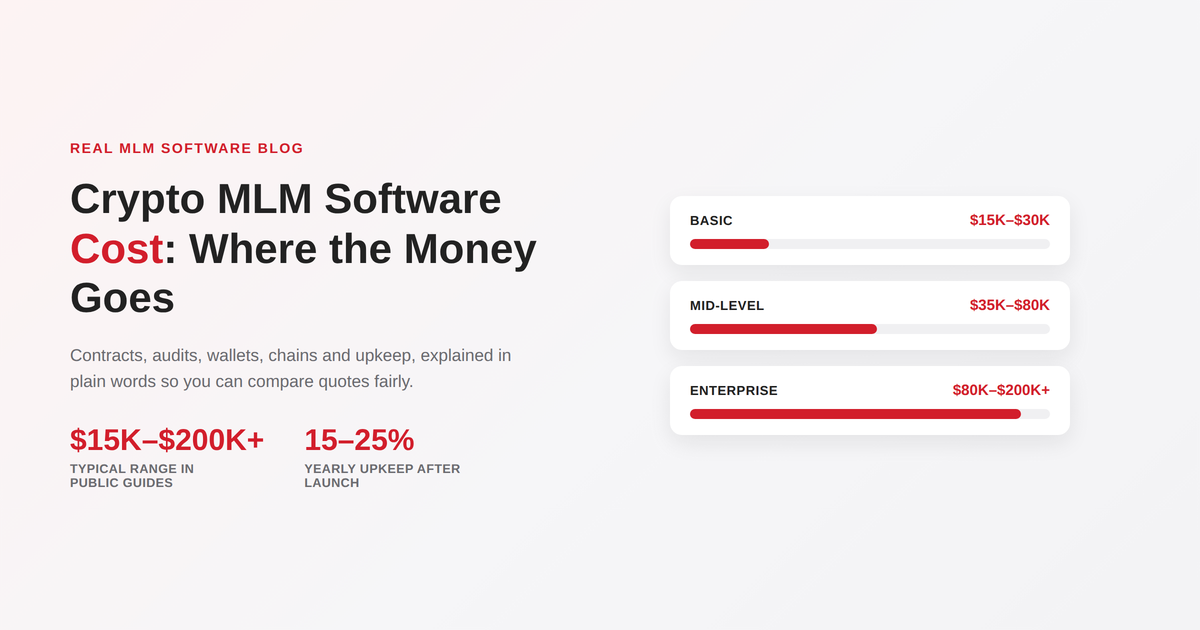
Short answer: Public vendor guides put a basic crypto MLM platform at about $15,000 to $30,000. A mid-level build runs about $35,000 to $80,000. An enterprise build can pass $200,000. One guide calls $45,000 to $90,000 a realistic budget for a serious business. These are industry estimates from other companies, not our price list. Your real cost depends on your compensation plan, your blockchain, and how much you want built.
Three common budget levels
Most guides sort projects into three levels. Here is the typical split.
| Level | Typical cost | Typical time | What you usually get |
|---|---|---|---|
| Basic | $15,000–$30,000 | 6–10 weeks | One compensation plan, one blockchain, a basic wallet, a standard dashboard |
| Mid-level | $35,000–$80,000 | 10–16 weeks | Several plans, two or three blockchains, stronger security, better reports, mobile-friendly screens |
| Enterprise | $80,000–$200,000+ | 16–28 weeks | Custom blockchain options, analytics, many languages, full identity checks, dedicated support |
Where the money goes
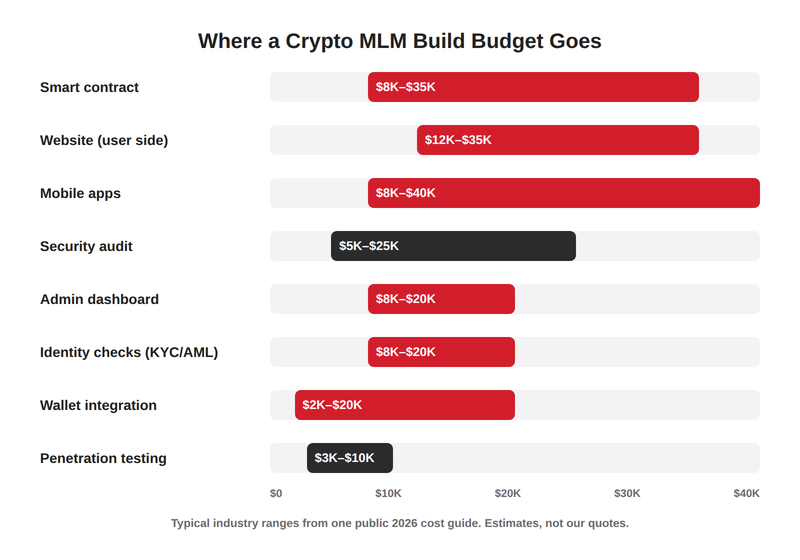
A platform is not one big item. It is a stack of smaller jobs. These ranges come from one public cost guide. Your quote may include some of them and skip others.
| Part of the build | Typical cost range |
|---|---|
| Smart contract (simple binary plan) | $8,000–$15,000 |
| Smart contract (complex hybrid plan) | $25,000–$35,000 |
| Security audit of the contract | $5,000–$25,000 |
| Wallet connection (MetaMask-style) | $2,000–$5,000 |
| Wallet built into your platform | $8,000–$20,000 |
| User-facing website | $12,000–$35,000 |
| Admin dashboard | $8,000–$20,000 |
| Identity checks (KYC/AML) | $8,000–$20,000 |
| Extra penetration testing | $3,000–$10,000 |
| Mobile apps | $8,000–$40,000 |
Why quotes are so different
- Vendors count different things. One quote may include the audit, wallet, and admin panel. Another may price only the contract. Always ask for a line-by-line list.
- Your plan is the biggest driver. A simple binary plan is cheap. A hybrid plan with ranks, bonuses, and pools is not. More rules mean more code and more testing.
- Guides disagree. One guide prices a full crypto ecosystem at $25,000 to $50,000 or more. Another prices enterprise builds at $80,000 to $200,000 or more. Neither is wrong. They define the work differently.
- Many guides are written by vendors. They want your business. Treat every range as a rough map, not a promise.
Your blockchain changes the bill
We build on Ethereum, Tron, and BSC. Building on Ethereum usually costs more than building on the other two. Running costs are less clear-cut. Network fees on all three chains changed a lot in 2025, and reports do not agree. Treat the fee column below as a rough guide.
| Blockchain | Typical build cost | Fee to send a token payment (2026 reports) |
|---|---|---|
| Ethereum | $30,000–$60,000 | Under $1 up to about $8, higher when busy |
| BSC | $18,000–$40,000 | About $0.01–$0.10 |
| Tron | $15,000–$35,000 | About $1–$4 for a USDT transfer |
Fees move every day, and they have dropped a lot on Ethereum and BSC. Check live numbers before you decide. Also think about your members. Even a small fee on every payout can hurt small earners.
Do not skip the audit
An audit is a careful review of your contract code by experts. They look for mistakes before real money flows through. It can feel like an optional extra. It is not. A bug in a live contract is often impossible to patch.
Audit prices depend on how complex your contract is. Mid-complexity contracts, such as staking or vesting, often land between $5,000 and $20,000. Rushing the job adds 20% to 50%. Clean code with good tests can cut the quote by 15% to 25%. Re-audits cost money too, so every time you change the contract, plan for another review.
Costs after launch
Launch day is not the end of the bill. Plan for these.
- Yearly upkeep. Guides put this at 15% to 25% of the build cost, every year.
- Servers and blockchain access. From a few hundred dollars a month for a small platform to several thousand as members grow.
- A fee reserve. You need some coins on hand to pay network fees. One guide suggests $2,000 to $5,000 to start.
- Legal and compliance checks. If you run in regulated markets, expect monthly costs here too.
White-label or custom?
White-label costs less up front. One guide shows about $5,000 to $25,000, plus $500 to $2,000 a month. A custom build can run $30,000 to $150,000 or more, with lower monthly fees. Neither is always better. Our posts on white-label MLM software and SaaS vs licensed pricing explain how to choose.
Five ways to spend less without cutting corners
- Launch with one compensation plan. Add more later.
- Start on one blockchain.
- Pay only for features your members will really use in year one.
- Give your developer clear documents. Clear plans mean fewer changes and a cheaper audit.
- Be wary of a very low quote. It often leaves out the audit or testing. Our post on open-source MLM software explains what cheap and free can really cost you later.
About our own pricing
We do not publish a fixed price list for crypto builds. The plan and the blockchain change the work too much. The numbers on this page come from public guides by other companies. They are a rough map only. If you want a real figure, tell us about your plan and we will send a line-by-line quote, so you can see exactly what each part costs.
Keep reading
- Ethereum vs Tron vs BSC — how your chain choice changes fees.
- Smart contract clone scripts — why a cheap copy can cost more.
- A compliant crypto MLM pay plan — seven steps to a safer plan.
Read about our smart contract development and crypto MLM software development work.
Frequently Asked Questions
How much does crypto MLM software cost?
Public guides range from about $15,000 for a basic platform to $200,000 or more for an enterprise build. Many serious businesses land between $45,000 and $90,000. Your compensation plan, blockchain, and features decide where you fall.
Which blockchain is cheapest?
Of the three we build on, Ethereum usually costs the most to build on. BSC usually has the lowest fees to run today. Tron sits in between. Fees change often, so check live numbers before you choose.
Is a smart contract audit worth the cost?
Yes. Most contracts cannot be easily changed after launch. An audit finds mistakes before real money is at risk. Audits for this type of contract often cost between $5,000 and $25,000.
What does crypto MLM software cost to run after launch?
Plan for yearly upkeep of 15% to 25% of the build cost, plus server and blockchain access costs, network fees, and any legal or compliance work your markets need.
Is white-label cheaper than custom?
Usually up front, yes. White-label can start around $5,000 to $25,000 but adds monthly fees. Custom builds cost more at the start and give you more control over how commissions work.