Most guides about the cheapest blockchain for an MLM platform were written when Ethereum was expensive and everything else was cheap. That is no longer a safe assumption. Fees on all three big chains changed a lot in 2025. So the better question is not "which chain is cheapest?" It is "which chain fits my members and my plan?"
Short answer: BSC usually has the lowest fees today. Tron has the largest base of people who already hold USDT, the stablecoin many members prefer. Ethereum has the biggest developer community and is the most widely trusted, but its fees swing the most. None of the three is best for everyone. We build on all of them, so this guide is meant to help you choose, not to sell you one.
First, why fees matter more for an MLM
On a normal crypto transfer, you pay one fee. An MLM platform is different. When one new member joins, the contract may pay commissions to several people above them. Each payment can carry its own network fee. Over thousands of members, small fees add up fast.
Also decide who pays. In some designs the member pays the fee. In others the platform does. This is a business choice, and it changes which chain feels cheap.
How each chain sets its fees
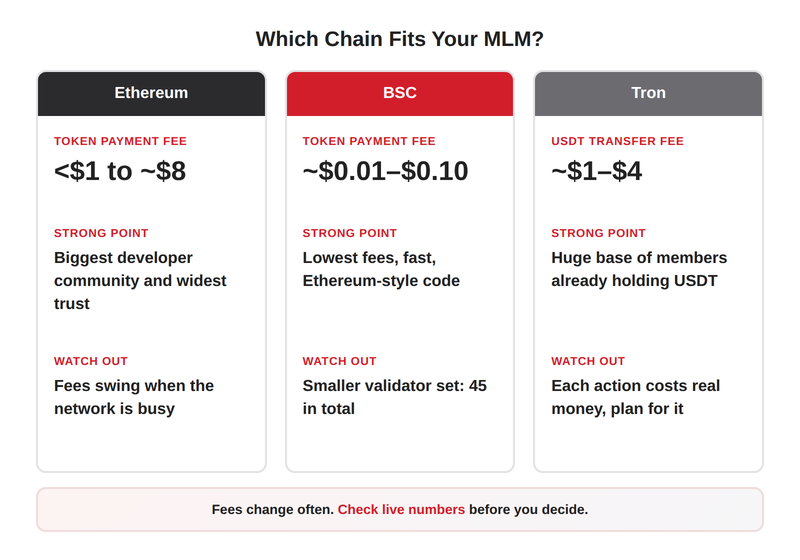
- Ethereum sets fees by demand. When the network is busy, fees rise. When it is quiet, they fall. Recent reports put a typical token payment anywhere from under $1 to about $8, so quotes differ by source and by day.
- BSC (BNB Smart Chain) uses a very low minimum price. Since October 2025 the minimum is 0.05 Gwei, which BNB Chain says works out to roughly half a cent for a basic transaction. Real costs for contract actions are higher, but still small.
- Tron uses a resource system called energy. The price of energy is set by a community vote, not by demand. In August 2025 it was cut from 210 to 100 sun per unit. One recent guide still puts a USDT transfer at about $2 to an existing wallet and about $4 to a brand-new wallet.
The takeaway: Tron is no longer the "nearly free" chain that older vendor pages describe. Always check live numbers before you decide.
The three chains side by side
| Ethereum | BSC | Tron | |
|---|---|---|---|
| Typical token payment fee | Under $1 to about $8 (varies a lot) | About $0.01–$0.10 | About $1–$4 for USDT |
| Who sets the fee | Network demand | A very low minimum price | A community vote |
| Block producers | Very large, spread-out network | 45 validators (21 main, 24 backup) | 27 elected representatives |
| Speed | Slower to fully confirm | Under 2 seconds to finalize | About 3 seconds per block |
| Contract language | Solidity | Solidity (Ethereum-compatible) | Close to Solidity, needs changes |
| Typical build cost* | $30,000–$60,000 | $18,000–$40,000 | $15,000–$35,000 |
*Build costs are rough industry estimates from one public vendor guide, not our quotes. Fees and speeds come from public network sources and recent guides, and they change often.
When Tron makes sense
Many people already hold USDT on Tron. One 2026 guide says Tron holds roughly half of all USDT in circulation, about $86 billion, and handled over 290 million USDT transfers in 2025. If your members are used to sending USDT from exchanges, they may already have what they need to join. That familiarity is Tron’s biggest strength for MLM.
Another plus: Tron fees do not jump when the network gets busy, because the price is set by vote. The trade-off is that each action costs real money, so you should plan for it.
When BSC makes sense
BSC is a strong pick when low fees matter most. It is also fully compatible with Ethereum tools, so the same style of contract code works. It confirms in under two seconds. The trade-off is a smaller group of validators, 45 in total, compared with Ethereum’s much larger network. Some buyers care about that more than others.
When Ethereum makes sense
Ethereum is the most established of the three. It has the largest developer community and the widest set of tools and reviewers. If trust and long-term reputation matter more than the lowest fee, this is a natural choice. The trade-off is that fees can rise when the network is busy, and they can differ a lot from one week to the next.
Can you switch chains later?
Partly. Ethereum and BSC both use Solidity, so moving between them is usually easier. Tron is close to Solidity but handles fees differently, so a move to or from Tron usually needs real changes and a fresh review. In any case, a new chain means a new contract, and your members would need to move too. It is much cheaper to choose well at the start.
How to choose in five minutes
- Do most of your members already hold USDT? Look at Tron first.
- Do you expect many small payments and want the lowest fees? Look at BSC first.
- Do trust and track record matter most to your buyers? Look at Ethereum first.
- Not sure? Ask your developer to estimate your fee per new member on each chain, using your real plan.
Our smart contract development and crypto MLM software pages explain what we build. Whichever chain you pick, the contract should be reviewed before real money flows through it.
A note on vendor comparisons
Many chain-comparison pages written by development companies give no sources. Some still quote fees and speeds from years ago. Before you trust any comparison, ask: where does this number come from, and how old is it? That includes this page. We link our facts to public sources where we can, and we tell you when they disagree. If you want a chain recommendation for your own plan, talk to us. We will give you an honest view, even if the answer is not the chain you expected.
Keep reading
- Custodial vs non-custodial wallets — who holds the keys once you pick a chain.
- Crypto MLM software cost — what a build costs on each chain.
- Is crypto MLM legal? — what regulators look at first.
The build side is covered on our blockchain development page.
Frequently Asked Questions
Which blockchain is best for an MLM platform?
There is no single best chain. BSC usually has the lowest fees. Tron has a very large base of USDT holders. Ethereum has the biggest developer community and the strongest reputation. Choose based on your members, your plan, and your budget.
Is BSC cheaper than Ethereum for MLM?
Usually yes. BSC has a very low minimum fee, and recent reports show payments costing cents. Ethereum fees fell a lot in 2025 but still swing with demand, and often cost more than BSC.
Why do many MLM platforms use Tron?
Because many people already hold USDT on Tron. Members who send USDT from exchanges can often join without extra steps. Tron fees are also set by vote, so they stay steady when the network is busy.
Can I move my MLM contract to another blockchain later?
Not easily. A new chain means a new contract, and your members must move too. Ethereum and BSC share the same language, which helps. Tron needs more changes. It is best to choose carefully at the start.
Who pays the network fee in a smart contract MLM?
That depends on how the platform is designed. Often the member pays when they join or upgrade. In other designs the platform covers some or all fees. Decide this early, because it changes your costs and your members' experience.