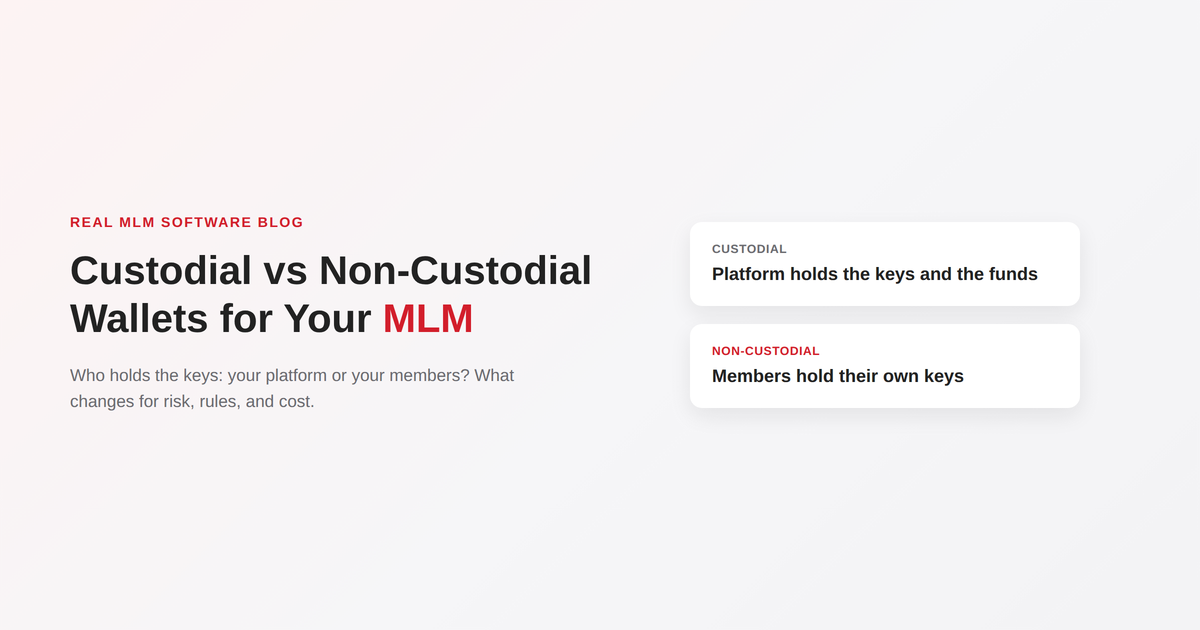
Every crypto MLM platform has to answer one quiet question: who holds the keys? The answer shapes your costs, your risks, and even which rules apply to you. Most buyers never ask it until something goes wrong. This guide explains it in plain words.
One thing first. This post is about crypto wallets, the place where coins actually live. It is not about the "e-wallet" inside MLM software that tracks commission balances. That is a different topic. We touch on how the two connect below.
Short answer: In a custodial setup, your platform holds the keys and the funds. In a non-custodial setup, each member holds their own keys, and your platform never touches their money. Custodial is easier for members. Non-custodial is lighter on you. Neither is free of risk, and the rules for each are very different.
What a "key" really is
Crypto does not sit in an account with a name on it. It sits at an address. A secret code, called a private key, controls that address. Whoever holds the key controls the money. That is the whole idea.
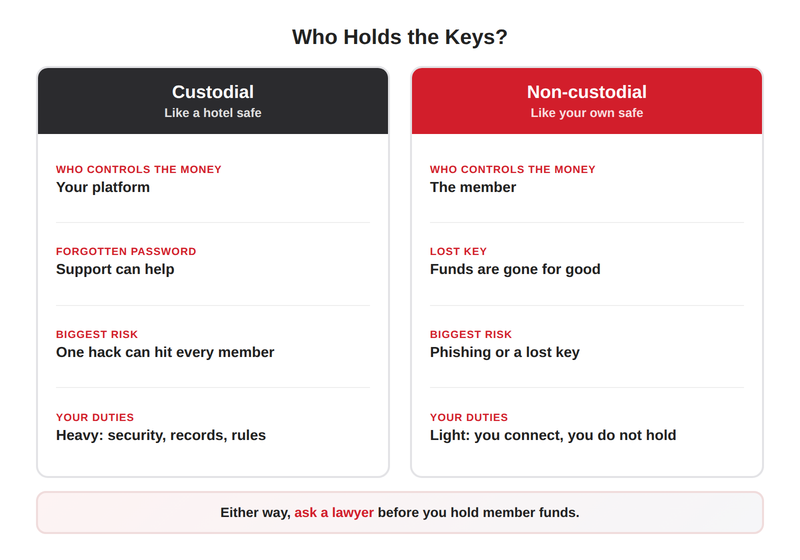
Think of a hotel safe versus your own safe at home. With a hotel safe, the hotel holds a master key. If you forget your code, the front desk can help. But the hotel also holds everyone's valuables, which makes it a target. With your own safe, nobody else can open it. But if you lose the key, nobody can help you.
The two types side by side
| Custodial (platform holds keys) | Non-custodial (member holds keys) | |
|---|---|---|
| Who controls the money | The platform | The member |
| Member forgets their password | Support can usually restore access | Funds are lost for good |
| Ease for new members | Very easy, like a normal app login | Harder, members must set up and protect a wallet |
| Biggest risk | One hack can hit every member at once | A member loses a key or gets phished |
| Your duties | Heavy: security, records, often licences | Light: you build the connection, you do not hold funds |
| Typical wallet example | Wallet built into your platform | MetaMask, TronLink and similar |
Where the risk sits
Blockchain research firms publish yearly reports on stolen crypto, and two patterns repeat. Attacks on individual wallets, mostly through phishing and stolen keys, happen all the time. But the biggest single losses tend to come from attacks on large services that hold funds for many people at once. We do not quote the latest totals here because they change every year, and you can read them in those reports.
The lesson is not that one design is safe. It is that the risk moves. With custody, the risk piles up in one place, with you. Without it, the risk is spread across your members.
How this plays out in an MLM
- Smart contract platforms often pay commissions straight to each member's own wallet. That is non-custodial by design. Members connect a wallet such as MetaMask on Ethereum-style chains like Ethereum and BSC, or TronLink on Tron. Our chain comparison explains how to choose a chain.
- Traditional web platforms often keep a balance for each member inside the system. Members cash out later. In plain terms, you are holding their money between payouts. That can look a lot like custody.
- Hybrid designs start members on a simple platform-held wallet and let them move to their own wallet later. This helps onboarding. But while you hold the funds, you carry the custody duties.
The rules, in plain words
Holding other people's crypto is treated more seriously than writing software. Here are two examples. They are general information only.
- European Union. Under MiCA, custody means keeping crypto-assets safe on behalf of clients, and it comes with duties such as keeping client assets separate from your own and having a written custody policy. Our post on whether crypto MLM is legal explains how to approach the question of authorisation.
- United States. FinCEN guidance has treated a hosted wallet provider, one that receives, stores, and sends crypto for its account holders, differently from a provider that only supplies software for wallets the owner fully controls. Shared-key setups are more complicated and depend on who has independent control of the funds. Guidance changes, so ask a lawyer how it applies to you.
Rules vary by country and change often. Ask a lawyer in each market you serve before you decide to hold member funds.
What each choice costs to build
In general, connecting to an outside wallet such as MetaMask is the lightest piece of work. A wallet built into your platform, whether custodial or non-custodial, takes more design, security and testing. Prices vary widely between vendors and change over time, so ask for a written quote for the exact design. Our cost guide shows what drives the budget. Custody also adds running costs that do not show up here, such as security work, records, and legal review.
How to choose
- Choose non-custodial if you want to stay out of holding funds, and your members are comfortable using a wallet app.
- Choose custodial only if easy onboarding matters more, and you are ready for the security, records, and legal duties that come with holding funds.
- Consider a hybrid carefully. Plan how long you will hold funds, and what you owe members during that time.
- Whatever you pick, teach members to protect their keys and to watch for phishing. Most losses start with a person, not code.
Where we stand
Wallet integration is part of what we build, and we can build either style. We do not claim any licence to hold customer funds, and we cannot tell you which rules apply to you. That is a lawyer's job. If you want to talk through what a wallet design could look like for your plan, get in touch.
Keep reading
- Is crypto MLM legal? — the rules that apply when you hold funds.
- Ethereum vs Tron vs BSC — which chain your members will pay on.
- Exchange referrals vs MLM — connecting an exchange without merging it into your plan.
Our blockchain development page explains how we handle chain and wallet work.
Frequently Asked Questions
What is the difference between a custodial and a non-custodial wallet?
In a custodial wallet, a company holds the private keys and your funds. In a non-custodial wallet, you hold your own keys, and no one else can move your money. Custodial is easier to use. Non-custodial gives you more control and more responsibility.
Which is better for an MLM platform?
It depends on your plan and your members. Non-custodial keeps you out of holding funds, which lowers your duties. Custodial is easier for new members but brings security and legal duties. Many smart contract MLM platforms pay members directly to their own wallets.
Does holding member funds make me a regulated business?
It can. In the EU, holding crypto for clients is a regulated custody service under MiCA. In the US, guidance has treated hosted wallet providers differently from software-only providers. Rules differ by country and change, so ask a local lawyer.
What happens if a member loses their private key in a non-custodial wallet?
The funds are lost. Nobody, including your platform, can recover them. That is why member education and clear warnings matter.
Is the e-wallet in MLM software the same as a crypto wallet?
No. An e-wallet in MLM software usually tracks a member's commission balance inside the platform. A crypto wallet holds coins on a blockchain. But if your platform keeps balances for members before paying them out, that can look like custody, so check the rules.