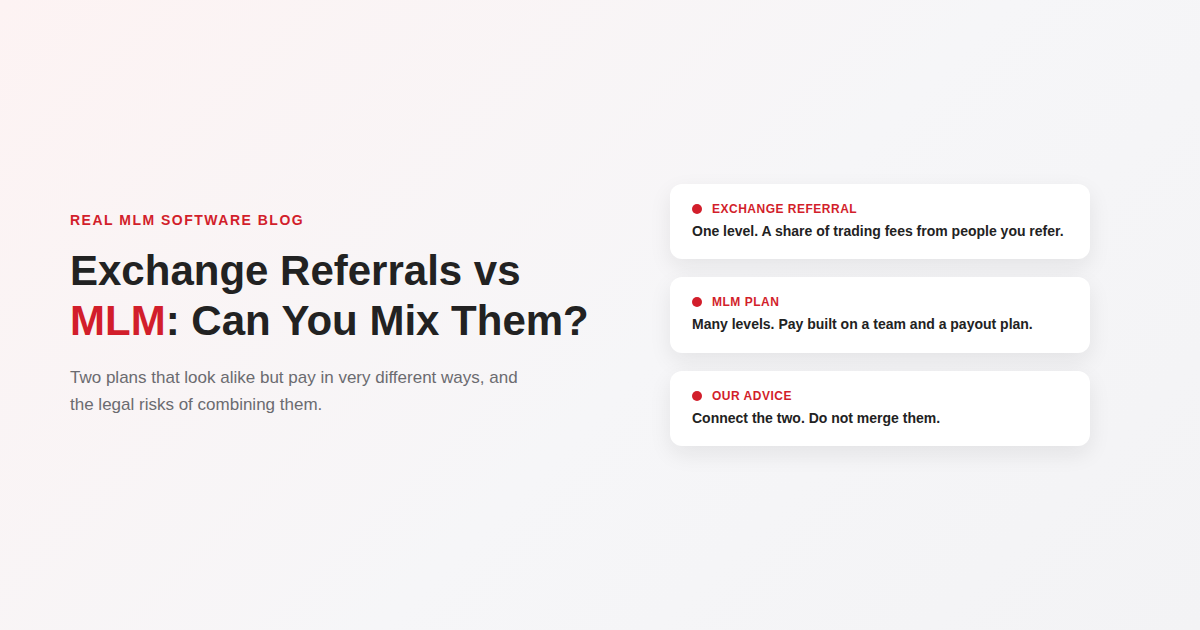
Crypto exchanges pay people to refer new traders. MLM plans pay people to bring in new members. Both reward you for spreading the word, so they look alike. They are not. The money comes from different places, and the rules are very different. This guide explains both in plain words, and what happens if you try to combine them.
Important: we are software builders, not lawyers. This is general information, not legal advice.
Short answer: An exchange referral program usually pays a share of the trading fees from people you refer. An MLM pays through a multi-level plan, ideally based on product sales. You can connect the two ideas, but mixing them raises the legal risk. An exchange is a regulated business, and multi-level payouts draw attention from regulators. If you try it, build in strong guardrails and get legal advice first.
How an exchange referral program works
Here is the usual pattern. You share a link. A new trader signs up and trades. The exchange earns a fee on every trade. You get a slice of that fee.
- The share is large. One industry guide reports that big exchanges often share about 20% to 50% of trading fees with the referrer. New exchanges often start at 30% to 40%.
- Some have more than one level. The same guide says a few exchanges let affiliates build sub-affiliate teams, with the top affiliate earning about 5% to 10% of what their sub-affiliates earn. Others stay single-level. One large exchange pays 50% of a referred user's net trading fees for 12 months, with one level only.
- ID checks are common. That exchange requires both the referrer and the new user to complete identity verification.
- Some regions are blocked. The same exchange turns its referral program off in the UK, Hong Kong, and the European Economic Area.
- Abuse is real. The guide estimates that without detection, 5% to 15% of payouts go to fraud such as fake accounts, self-referral, and wash trading. With active checks, it falls to about 1% to 3%.
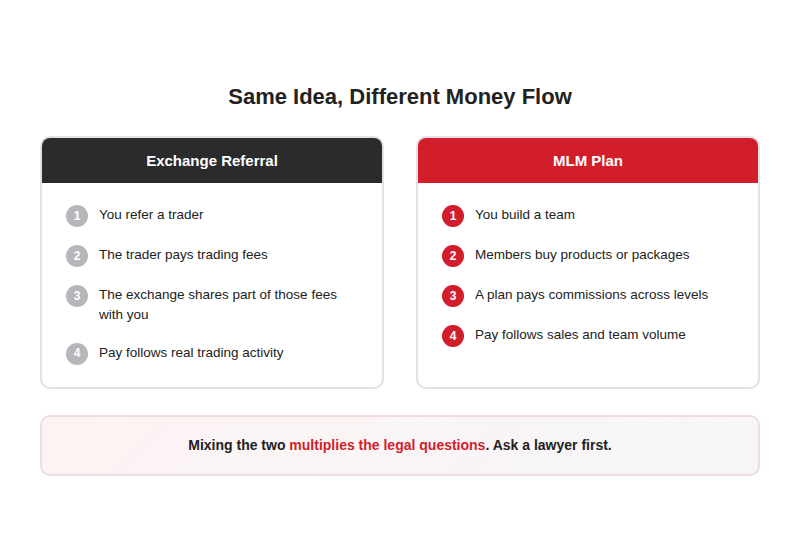
Exchange referral vs MLM plan
| Exchange referral | MLM plan | |
|---|---|---|
| Where the money comes from | Fees on real trades by referred users | Product or service sales, shared by a plan |
| How many levels | Often one, sometimes a few tiers | Often many levels |
| What a regulator looks at | Is the exchange licensed? Are users checked? | Do payouts depend on real sales or on recruiting? |
| Main abuse risk | Fake accounts, self-referral, wash trading | Pay for sign-ups, inventory loading |
| Typical payout | A share of trading fees | Percentages set by the plan |
What a white-label exchange is
A white-label exchange is a ready-made trading platform. A provider builds the core parts, such as the matching engine, wallets, and admin tools. You add your own name, logo, and domain. Many of these come with a referral feature built in.
Be careful with one idea. A ready-made platform does not remove the legal duties of running an exchange. Under global standards from the Financial Action Task Force, businesses that exchange, hold, or transfer crypto for others are treated as virtual asset service providers. They are expected to register or get a licence, check customers, keep records, and report suspicious activity. Which duties apply to you depends on your country and your exact service. Get advice before you launch.
Why mixing the two is risky
Combining a multi-level plan with an exchange puts two sets of rules on one product. You face exchange rules and MLM rules at the same time. Our guide on whether crypto MLM is legal explains the MLM side.
Regulators have acted against crypto "chain referral" schemes. In 2019 the FTC settled with four promoters of such schemes. It called them a type of pyramid scheme. They promised that a $100 investment could become $80,000 a month. Most participants failed to get their money back. The FTC banned all four from running or promoting multi-level marketing, pyramid schemes, or chain referral operations.
The lesson is simple. A referral reward is fine when it comes from real activity by real customers. It becomes a problem when people are paid mainly for bringing in more people.
If you still want to combine them, set guardrails
- Pay referral rewards only from real fees on real trades. Do not pay for sign-ups alone.
- Keep the number of levels low and easy to explain.
- Verify both the referrer and the new user.
- Build checks for self-referral, fake accounts, and wash trading.
- Show clear risk warnings. Do not promise income or returns.
- Get legal review in each country where you will operate. Our guide on building a compliant pay plan lists the design steps.
A simpler path: connect, do not merge
Many businesses do not need to own an exchange at all. They run an MLM platform and let members cash out through a wallet or an existing exchange. That keeps the two worlds separate. Our guide on custodial vs non-custodial wallets explains how the wallet side works.
Where we stand
We build MLM software, and we build wallet and exchange integrations. We do not claim to operate an exchange or to hold an exchange licence. If you are thinking about a full exchange platform, tell us your scope. We will give you an honest answer about what we can deliver and what needs other partners.
Keep reading
- Ethereum vs Tron vs BSC — which chain suits your members.
- Crypto MLM software cost — what a crypto platform costs.
- Smart contract clone scripts — the risk of copying a payout design.
For exchange work, see our cryptocurrency exchange development page.
Frequently Asked Questions
How does a crypto exchange referral program work?
You share a referral link. When someone signs up and trades, the exchange earns fees. You receive a share of those fees. Large exchanges often share roughly 20% to 50%, usually after the new user passes identity checks.
Is an exchange referral program the same as MLM?
No. An exchange referral pays from trading fees on real trades, usually over one level or a few tiers. An MLM pays through a multi-level plan from sales. They look alike but face different rules.
What is a white-label crypto exchange?
It is a ready-made exchange platform that you brand as your own. The provider builds the core trading system. You add your name, logo, and domain. It does not remove your legal duties as an operator.
Do I need a licence to run a white-label exchange?
Often, yes. Under global standards, businesses that exchange, hold, or move crypto for others are treated as virtual asset service providers and are expected to register or be licensed. The rules depend on your country, so ask a local lawyer.
Can an exchange have a multi-level referral program?
Some offer multi-tier affiliate programs. Others stay single-level, and some turn referrals off in certain regions. Rules differ by country, and multi-level payouts attract extra attention from regulators.