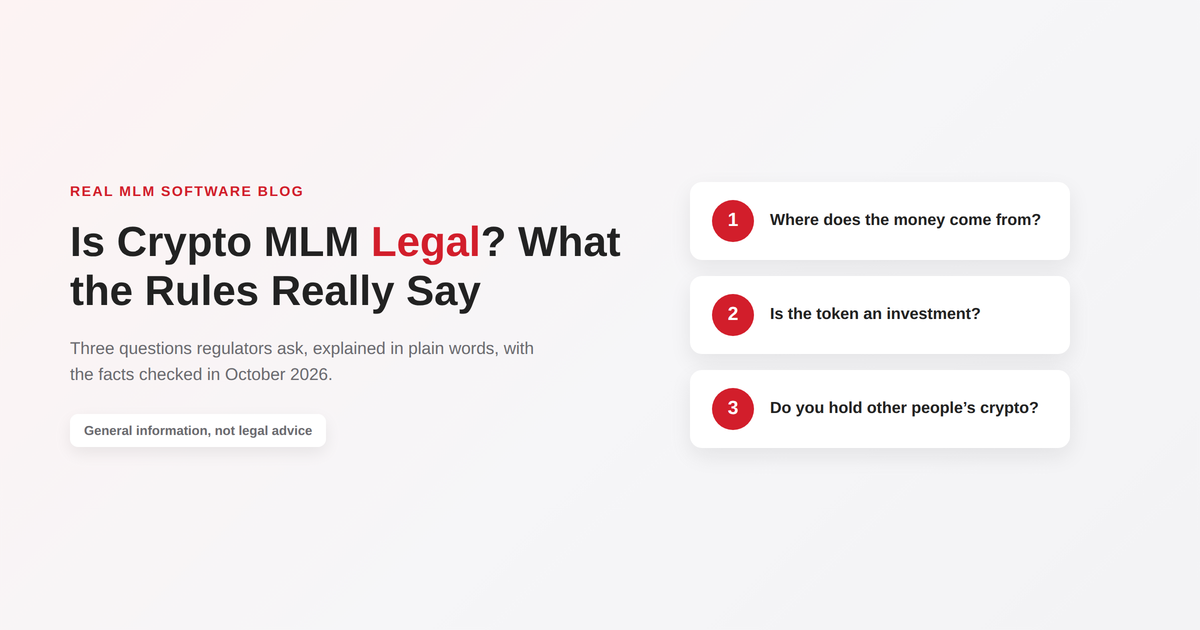
"Is crypto MLM legal?" sounds like a yes-or-no question. It is not. The honest answer is: it depends on how the business is built and run. And crypto adds a second layer of rules on top of the ones that already apply to ordinary MLM. This guide explains those rules in plain words.
Important: we build software. We are not lawyers. This page is general information, not legal advice. Laws differ by country and change often, so we do not quote figures or deadlines here. Check the current rules with a lawyer in each market.
Short answer: A crypto MLM is not automatically illegal. But it faces more risk than a normal MLM. Regulators ask three questions. Where does the money come from? Is the token being sold as an investment? Are you holding other people's crypto? If your answers are weak, no software can make the business legal.
Why crypto makes it harder
A normal MLM is judged on one thing: how its money flows. A crypto MLM is judged on that, and also on what the token is. So you get two sets of rules, not one. Many people only check the first set.
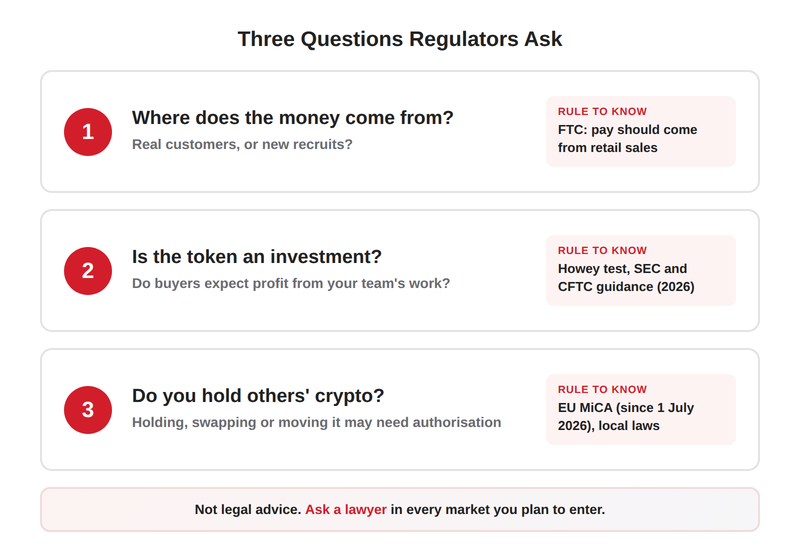
Question 1: Where does the money come from?
The US consumer regulator, the FTC, puts it simply. A legitimate MLM pays you based on sales to real retail customers. You should not need to recruit anyone to earn. A pyramid scheme pays mostly from what new recruits put in.
US regulators have used this idea for a long time. Older FTC guidance looked for signs of a lawful business: distributors who really sell what they buy, sponsors who make sales to real retail customers, and a company that buys back unsold stock. Which tests apply, and with what limits, changes over time and by country, so ask a lawyer for the current position.
Income honesty matters too. Regulators notice when top earners are shown and the typical result is hidden. Publish honest income information for all members, not only the best.
| Healthier sign | Red flag |
|---|---|
| Pay depends on sales to real customers | Pay depends on signing up new members |
| A real product or service people use | No clear product, or a product nobody outside the network wants |
| No forced buying to stay active | Pressure to buy bigger packages (inventory loading) |
| Clear refund or buy-back policy | No way to get money back |
| Honest income reports for all members | Only top earners shown |
| No promises of returns | Talk of "ROI", "passive income", or "double your money" |
Question 2: Is the token an investment?
In the US, a test called the Howey test asks whether people put money into a shared project and expect profit from other people's work. If yes, regulators may treat the token as a security. Securities have strict rules.
US regulators have also issued guidance on how different kinds of crypto assets are treated. Some kinds, such as tools or payment-type stablecoins, are generally treated differently from tokens sold as investments. That guidance changes, so ask a lawyer which category your token falls into today.
But there is a catch. Even a token that is not a security by itself can be sold as part of an investment deal. That happens when buyers reasonably expect profit from the team's future work. Regulators have said this expectation can come from marketing, roadmaps, and other messages. In plain words: how you talk about the token matters as much as the code.
Question 3: Do you hold other people's crypto?
Different countries regulate businesses that hold, swap, or move crypto for others. The European Union is one example. Its MiCA rules cover crypto service providers, and offering such services without authorisation can be prohibited. Whether a transition period or a pending application gives any protection depends on the country and the timing, so ask a lawyer to check the current position.
Whether your platform counts as a service provider depends on your design and your markets. A lawyer in that region can tell you. Do not guess.
What about India?
We are based in India, so this one matters to us. India has a law called the Prize Chits and Money Circulation Schemes (Banning) Act, 1978. It describes a money circulation scheme as a way of making quick or easy money, where payment depends on enrolling members into the scheme. It forbids promoting, conducting, enrolling in, or joining such schemes.
The Act carries criminal penalties, and state governments handle enforcement. Ask a local lawyer for the current position. So in India, a plan where pay comes mainly from enrolling people, not selling products, can fall into risky territory. Get local legal advice before you launch.
A warning from a lawyer
Some law firms that write about direct selling advise steering clear of mixing crypto and MLM unless clear laws arrive. Others say a careful design can lower risk. We share both views so you can decide with open eyes. Either way, it is a reason to speak to a lawyer first.
What software can and cannot do
- It can record real product sales separately from joining fees. It can keep a clear history of every payout. It can produce honest income reports. It can track refunds and buy-backs.
- It cannot make an illegal plan legal. It cannot replace a lawyer. It cannot control how you or your members describe the business.
- Code is not a shield. Regulators have charged people who ran pyramid schemes through smart contracts. Running on a blockchain did not protect them. Our post on smart contract MLM clone scripts explains why copying a risky design is a bad idea.
A checklist before you launch
- Do you have a real product or service that people buy because they want it?
- Do customers outside your network buy it?
- Can members earn without recruiting anyone?
- Are there no promises of returns or profit from the token?
- Do you have a clear refund or buy-back policy?
- Do you publish honest income numbers?
- Has a lawyer in each country you target reviewed the plan?
- Will the smart contract be reviewed before launch? Our cost guide shows what an audit and other checks can cost.
Where we stand
We build software to the plan you give us. We cannot judge whether a plan is lawful in your market. That is a lawyer's job. Our advice is simple: get legal review first, then build. When you are ready, tell us about your plan and we will talk through what a build could look like. You may also want to read how to choose a blockchain once the legal side is clear.
Keep reading
- A compliant crypto MLM pay plan — seven steps to a safer design.
- Exchange referrals vs MLM — what changes when an exchange is involved.
- Crypto MLM software cost — budget for checks as well as code.
See our crypto MLM software development page.
Frequently Asked Questions
Is crypto MLM legal?
It can be lawful in some places if it is built on real product sales and the token is not sold as an investment. But it carries more risk than a normal MLM. Laws differ by country, so get legal advice for each market.
Is a crypto token always a security?
No. US guidance treats different kinds of tokens differently, and many are not securities on their own. But a token can still be sold as part of an investment deal if buyers expect profit from the team's work. Ask a lawyer how your token is treated today.
What is the difference between MLM and a pyramid scheme?
A legitimate MLM pays based on sales to real retail customers. A pyramid scheme pays mainly from what new recruits put in. If members cannot earn without recruiting, that is a warning sign.
Does using a smart contract make a scheme legal?
No. Code does not change what a business is. Regulators have charged people who ran pyramid schemes through smart contracts.
Is MLM legal in India?
Direct selling is allowed, but India's Prize Chits and Money Circulation Schemes (Banning) Act, 1978 bans schemes where pay depends on enrolling members. Whether a plan falls under it depends on its design, so ask a local lawyer.