Once you've worked out where your MLM software should be hosted, a second, separate decision is waiting: how do you pay for it, and who actually owns it when the contract ends?
This is a different axis entirely from cloud vs on-premise. Hosting is about where the software runs. Licensing is about what you're actually buying — ongoing access to someone else's platform, or a copy of the software itself, source code included, that's yours to keep. You can combine these in more ways than most comparisons admit: a subscription platform hosted in the cloud is the most common pairing, but a one-time-licensed codebase can also be deployed on cloud infrastructure you control, not just in a private data center.
Quick answer: SaaS (subscription) MLM software is the lower-risk, faster starting point for most new and growing businesses — low upfront cost, vendor-managed updates, and an easy exit if the business doesn't work out. Licensed (one-time purchase, source-code-included) MLM software becomes the better economic and strategic choice once you're an established business with stable, high-volume operations, because you stop paying recurring fees for a platform you've already outgrown in capability, and you're not dependent on one vendor's pricing or survival. Neither is a trap by default — the trap is picking based on which number looks smaller today rather than where your business will be in two or three years.
SaaS vs licensed MLM software: comparison table
| Criterion | SaaS (Subscription) MLM Software | Licensed (One-Time Purchase) MLM Software |
|---|---|---|
| Upfront cost | Low — little to no setup fee, pay monthly/annually | High — one lump payment, often several thousand dollars or more |
| Ongoing cost | Recurring subscription for as long as you use it | None required beyond optional support/update contracts |
| Source code ownership | You never own the code — you're renting access to the vendor's platform | You own a copy of the actual source code and database schema |
| Vendor dependency | High — the vendor can change pricing, features, or shut down, and you lose access | Low — the vendor disappearing doesn't stop your software from running |
| Customization depth | Configuration-level; deep logic changes often need the vendor's own dev team | Full — your own developers (or any developer) can modify the code directly |
| Updates & maintenance | Handled by the vendor automatically | Your responsibility (or a paid support contract) once you own the code |
| Exit cost if you switch vendors | High — data export and a full re-platforming project | Low to moderate — you keep the code regardless of what happens next |
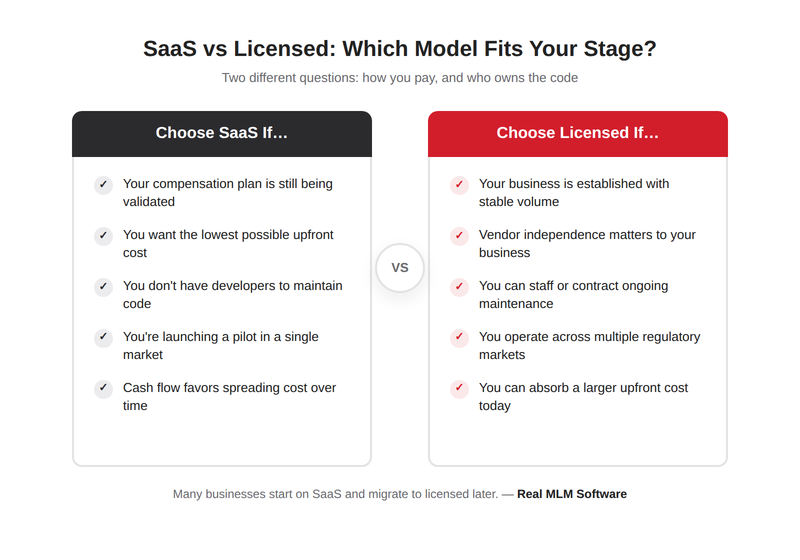
| Best fit | Startups, pilot launches, businesses still validating their compensation plan | Established, high-volume businesses with stable requirements and some technical capacity |
What "SaaS MLM software" actually means
SaaS (Software as a Service) MLM software means you never take possession of the underlying code. You get a login, your distributors get their panels, and the vendor runs the actual application on infrastructure you don't touch. You pay for continued access — usually monthly or annually, often scaled by distributor count or feature tier — and the moment you stop paying, you stop having a platform.
This isn't a downside by default. It means you're never responsible for patching, scaling, or maintaining anything at the code level, and a vendor with a large customer base can spread platform development costs across everyone using it, which is part of why the monthly price looks so reasonable at the entry tier.
What "licensed MLM software" actually means
Licensed (sometimes called "source code" or "white-label with ownership") MLM software means that after a one-time payment, you receive the actual application — the codebase and the database schema — with rights to self-host it, modify it, and run it indefinitely without further payment to the original vendor. One established MLM software vendor sells exactly this: full source code and database schema delivery, self-hosting rights, and modification rights, explicitly marketed on the basis that "your business does not depend on any single vendor for pricing, uptime, or continued operation" once you hold the code.
The trade-off is responsibility. Once you own the code, updates, security patches, and scaling work are either your job or something you pay a developer (your own, or the original vendor, or a third party) to handle. You've traded a predictable monthly bill for a one-time cost plus the ongoing cost of technical ownership.
What this actually costs: real tiers, not just "it depends"
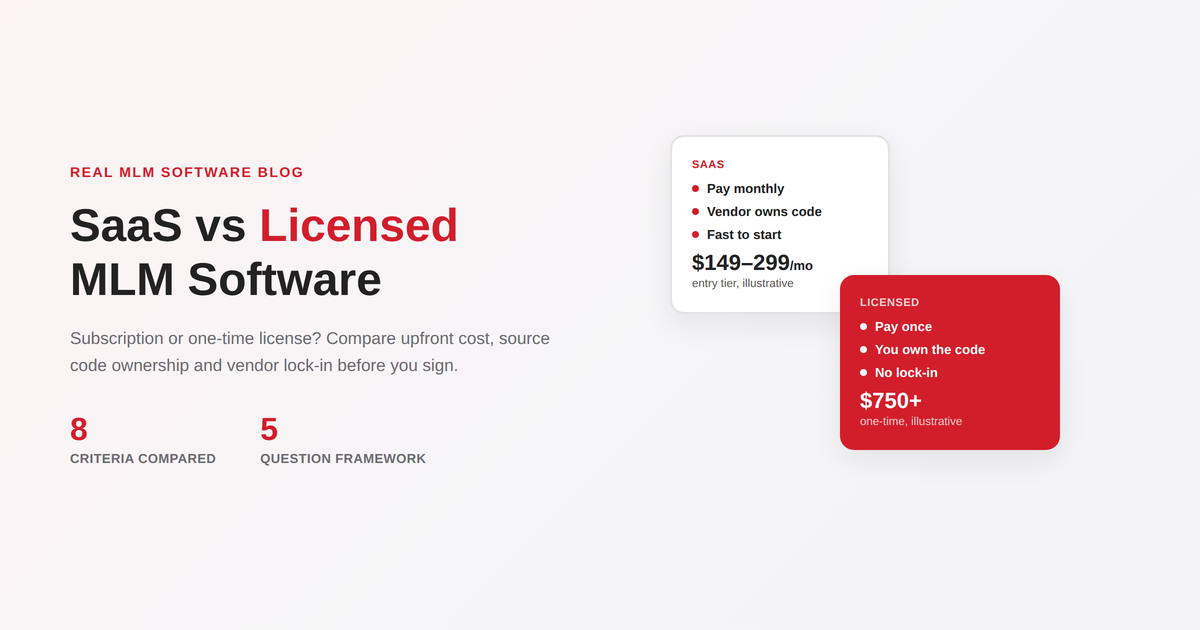
Pricing varies by vendor and feature set, but published vendor pricing gives a useful sense of scale. Entry-level MLM software commonly runs $650–$750 as a one-time licensed purchase, versus roughly $149–$299/month for a comparable subscription tier. At the enterprise end, one-time licensed packages run $20,000–$35,000 upfront, against $3,000–$4,000/month for an equivalent-tier subscription. These are illustrative, vendor-quoted figures — not a quote for your specific build — but they're useful for the one calculation that actually matters: break-even.
Run the math on those ranges and the one-time license pays for itself against the subscription in roughly 2.5 to 9 months, depending on tier. That sounds like an obvious win for licensing — until you account for what's missing from that comparison: a one-time license price typically does not include hosting, ongoing updates, or support, which are usually bundled into a SaaS subscription's monthly fee. Add those back in on the licensed side (your own hosting costs, plus whatever you pay a developer to maintain and update the code) and the real break-even point moves out considerably — often closer to the 2–3 year range general SaaS-vs-on-premise cost studies report for software generally. Get a quote for what's actually included before comparing a one-time number to a monthly number as if they were the same kind of cost.
Vendor lock-in: the risk that doesn't show up on a pricing page
The real argument for licensed software usually isn't the long-run cost math — it's independence. With SaaS MLM software, your entire business runs on infrastructure you don't own and can't move without a full re-platforming project: exporting distributor data, genealogy history, commission records, and e-wallet balances, then rebuilding on a new platform while trying not to disrupt live payouts. If your vendor raises prices sharply, changes terms, gets acquired, or shuts down, you're negotiating from a position of dependency.
Owning the source code doesn't eliminate every risk — you still need someone capable of maintaining it — but it removes the single point of failure where one company's business decisions can interrupt yours. This is the actual reason larger, established direct-selling companies more often run licensed or custom-built platforms: not because the sticker price is lower, but because the business is big enough that vendor dependency itself becomes the larger risk.
A common middle path: start on SaaS, migrate to licensed later
You don't have to pick once and commit forever. A pattern worth knowing about: many MLM companies deliberately start on a SaaS platform to validate their compensation plan and get to market fast, then migrate to a licensed or fully custom platform once the business has proven itself and the volume justifies the investment in independence. This sequencing avoids overpaying for infrastructure before you know the business works, while still giving you a clear path to ownership once it does.
If you're taking this route, ask any SaaS vendor upfront how straightforward data export actually is — distributor records, genealogy structure, and commission history should be exportable in a usable format, not held hostage in a proprietary export you'd have to reverse-engineer later.
Compliance and multi-country operations
If you're operating across multiple regulatory jurisdictions, licensed software has a practical edge: you (or your development team) can adjust compensation logic, disclosure language, and reporting formats directly to match a specific country's direct-selling regulations, rather than waiting on a SaaS vendor's product roadmap to support a market they may not prioritize. This matters more as you expand internationally than it does for a single-market launch.
A 5-question framework to decide
- Is your compensation plan already proven, or still being validated? Still validating favors SaaS — don't buy permanent infrastructure for a plan that might change in three months.
- Do you have (or can you contract) developers capable of maintaining a codebase long-term? If no, factor that ongoing cost into any licensed-software comparison, or lean SaaS.
- How much does vendor independence actually matter to your business? A high-volume, multi-year operation has more to lose from vendor dependency than an early-stage pilot does.
- Are you operating in, or expanding into, multiple regulatory jurisdictions? More jurisdictions favor the direct control licensed software gives you.
- Can your business absorb a larger upfront cost today, or does cash flow require spreading the cost over time? This is often the deciding factor in practice, independent of the long-run math.
How we approach this, honestly
We build both ways, and we'll tell you plainly which one fits what you've described — including when a SaaS-style phased approach makes more sense than committing to a licensed build on day one. If you're weighing this decision for your own compensation plan and growth stage, get in touch and we'll walk through the actual numbers for your situation rather than a generic comparison.
Keep reading
- White-label vs custom — the next question after hosting and payment.
- Open-source MLM software — the free option, and its risks.
- How to hire an MLM software company — if you decide to have it built.
See the live demo before you decide.
Frequently Asked Questions
Is licensed MLM software always cheaper in the long run than SaaS?
Not automatically. The headline numbers often favor licensing once you run the break-even math, but that comparison is only fair if you add back the hosting, maintenance, and update costs that a SaaS subscription usually bundles in and a one-time license does not.
Can I switch from SaaS to licensed MLM software later?
Yes, and it's a common path — many businesses start on SaaS to validate their compensation plan, then migrate to a licensed or custom-built platform once volume justifies it. Confirm upfront how easily your SaaS vendor lets you export distributor, genealogy, and commission data before you need to.
If I buy licensed MLM software, do I need my own development team?
Not necessarily on day one, but you need access to one — either in-house or a contracted developer or the original vendor under a support agreement — to handle updates, security patches, and any future feature work. Budget for this as an ongoing cost, not a one-time expense.
Does SaaS MLM software mean I don't own my distributor data?
You typically own your data but not the platform it lives in, which is a meaningful distinction. Reputable vendors will let you export your data on request; the risk isn't losing ownership of the data itself, but how difficult and disruptive it is to actually get it out and into a new system.
Is there a hybrid between SaaS and fully licensed software?
Some vendors offer a dedicated or white-label arrangement that sits between the two — you get more control and customization than standard SaaS without full source code ownership. Ask any vendor you're evaluating whether this tier exists before assuming it's purely SaaS or purely licensed.