Our guide to hiring an MLM software development company assumes you've already decided to bring in an outside team. This post is a step earlier: should you build an in-house development team at all, or hand the build to an external vendor in the first place? It's a broader staffing and strategy decision, not a vendor-evaluation checklist.
Generic "in-house vs outsourced software" guides exist everywhere, and most of the underlying trade-offs — cost, control, speed — apply to any software project. What those guides miss is what's specific to MLM: a compensation engine with binary legs, matrix spillover, and multi-level rollups is a narrow, unusual kind of complexity, and getting it wrong doesn't just mean a bug — it means distributors getting paid incorrectly. That changes the calculus in ways a generic comparison won't tell you.
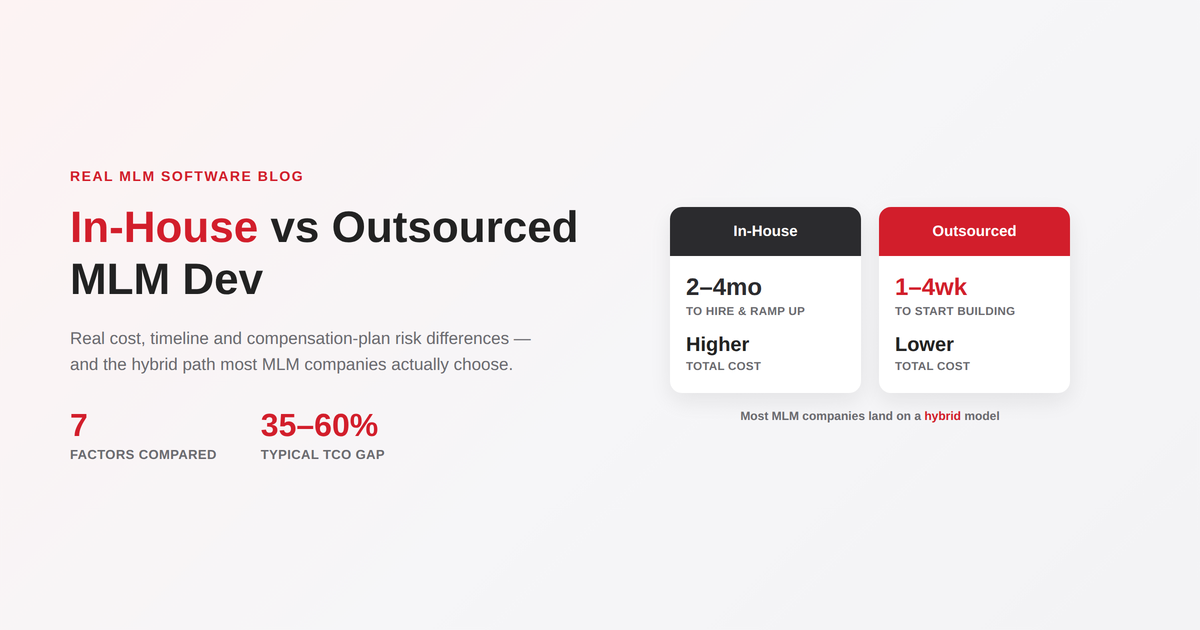
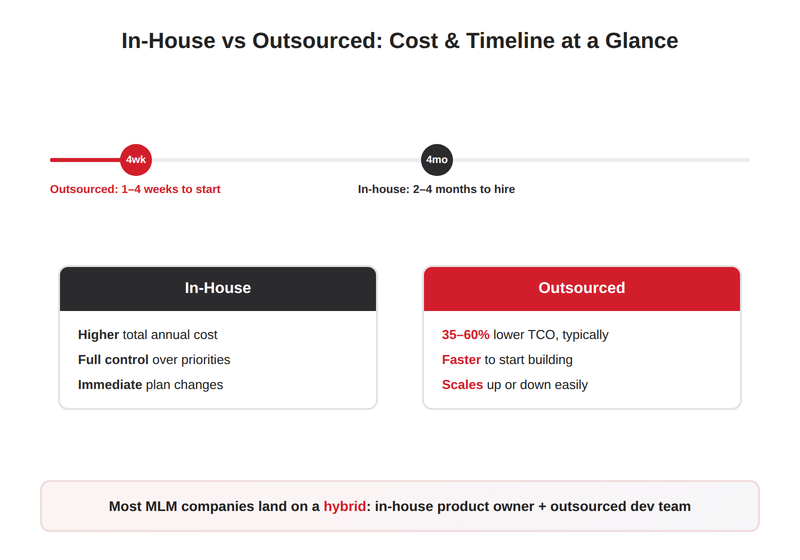
Quick answer: Outsourcing is usually the faster, cheaper path to a working MLM platform — industry cost guides put total in-house team costs 35–60% higher than an equivalent outsourced engagement once salaries, benefits, hiring time, and turnover are counted. In-house makes more sense once your compensation logic, integrations, or compliance needs are complex enough, or change often enough, that you need full-time, dedicated ownership. Many MLM companies land on a hybrid: a small in-house product owner plus an outsourced (or white-label-vendor) development team, which is often the practical middle path.
In-house vs outsourced MLM software development: comparison table
| Factor | In-House Team | Outsourced Team |
|---|---|---|
| Time to start building | Commonly 2–4 months to hire and ramp up a qualified team | Commonly 1–4 weeks to kick off with an existing team |
| Total annual cost | Higher once salary, benefits, hiring, tooling, and turnover are counted | Lower on a like-for-like basis, though scope and region vary the gap significantly |
| MLM compensation-plan expertise | Has to be built up from scratch unless you hire specifically for it | Often already exists if the vendor has built MLM platforms before |
| Ongoing plan changes | Immediate, no contract renegotiation needed | Depends on your support/retainer terms — check this before signing |
| Knowledge continuity | Stays in-house, but at risk if key developers leave | Depends on documentation and the vendor's own team stability |
| Security & compliance control | Fully within your direct oversight | Shared responsibility — needs to be defined explicitly in the contract |
| Scalability of the team | Slower to flex up or down — each change is a hiring or layoff decision | Generally easier to scale team size up or down as needs change |
Why the MLM compensation engine changes this decision
Most software outsourcing guides treat the decision as purely about cost and control. For MLM platforms, there's a third factor that matters just as much: how narrow and specialized compensation-plan logic actually is. Binary leg balancing, matrix spillover rules, PV/GV rollups across a multi-level genealogy tree, and rank-advancement calculations aren't general software engineering skills — they're a specific competency that either your in-house team has to build from direct experience, or an outsourced vendor needs to already have.
This cuts both ways. An in-house team with no prior MLM experience will spend real time — often months — learning these edge cases the hard way, frequently through bugs that affect real payouts. An outsourced vendor that has genuinely built MLM compensation engines before skips that learning curve entirely. The reverse is also true: an outsourced vendor without real MLM experience brings the same risk as an inexperienced in-house hire, just with less visibility into how the work is actually being done. This is why our vendor-hiring guide leads with verifying MLM-specific experience before anything else — it's the single biggest risk factor in either path.
The cost gap is real, but count the full picture
Industry cost-comparison guides for 2026 commonly put a fully-loaded in-house developer's annual cost well above their base salary once benefits (typically adding roughly 30%), recruiting costs, tooling, management overhead, and turnover risk are included — several put the realistic multiplier at 1.5–2x base salary. Outsourced engagements are quoted hourly, with rates varying significantly by region, and several industry guides put total-cost-of-ownership savings from outsourcing in the 35–60% range versus an equivalent in-house team over a year. Treat these as directional industry figures rather than a quote for your specific situation — actual numbers depend heavily on your location, the seniority you need, and local market conditions.
What often gets left out of these comparisons is outsourcing's own hidden costs: writing detailed requirements documentation, project management overhead on your side, the knowledge-transfer cost if you switch vendors later, and a documented higher defect rate when specifications are loose. None of this reverses the overall cost advantage outsourcing usually has — but it means the realistic gap is smaller than the headline hourly-rate comparison suggests, and it's a reason to invest in clear specifications however you staff the build.
When in-house development makes sense
- Your compensation plan is complex enough, or changes often enough, that you need developers who can modify it the same day, without a change-order cycle
- Your software experience is a genuine competitive differentiator, not just back-office infrastructure, and you want full control over every detail
- You're operating under regulatory requirements where you need direct, continuous oversight of compliance logic rather than a shared-responsibility arrangement
- You have the budget and the runway to absorb 2–4 months of hiring time before meaningful development even starts
When outsourcing makes sense
- You need to launch quickly and don't have months to spend recruiting and onboarding an internal team first
- Your budget favors a lower total cost of ownership over direct day-to-day control of the development process
- You can find a vendor with verifiable, genuine MLM compensation-engine experience — which removes most of the specialized-knowledge risk
- You want the flexibility to scale the team up during active development and down once the platform stabilizes
The hybrid model many MLM companies actually use
In practice, a clean either/or choice is less common than a hybrid: a small in-house team — often just a product owner or technical lead — who owns the compensation plan rules, compliance requirements, and day-to-day priorities, paired with an outsourced development team that does the actual build and ongoing engineering work. This keeps compensation-plan and compliance knowledge close to the business while avoiding the cost and time of staffing a full internal engineering team. It's conceptually similar to the start-white-label, graduate-to-custom path we've covered separately — both are ways to get real ownership over your platform without taking on the full cost of an internal team from day one.
How we approach this, honestly
We're an outsourced development option, so naturally we think outsourcing works well for most MLM businesses — but that's not a universal answer, and we'll say so plainly if your situation points the other way. If your compensation plan is simple and your budget favors speed, outsourcing to a team with genuine MLM experience is usually the faster, cheaper route. If you're operating at a scale or regulatory complexity where constant in-house ownership matters more than cost, we'll tell you that too. Get in touch and we'll give you an honest read on which path fits your stage.
Keep reading
- Cloud vs on-premise MLM software — where the software will live.
- SaaS vs licensed MLM software — a second big decision: payment and ownership.
- The buyer's checklist — what to look for in the platform.
Learn about our custom MLM software build.
Frequently Asked Questions
Is outsourced MLM software development actually cheaper than in-house?
On a total-cost basis, usually yes — industry guides commonly put outsourcing's total cost of ownership 35–60% lower than an equivalent in-house team once salary, benefits, hiring, and turnover are counted. The gap narrows somewhat once outsourcing's own overhead costs (documentation, project management, knowledge transfer) are included, but it rarely closes entirely.
How long does it take to hire an in-house MLM development team?
Industry hiring-timeline data commonly puts recruiting and ramping up a qualified in-house team at 2–4 months, versus 1–4 weeks to start with an existing outsourced team. That gap alone is often the deciding factor for businesses that need to launch quickly.
Does an outsourced vendor really understand MLM compensation plans?
Only if they've genuinely built MLM platforms before — this isn't guaranteed just because a vendor offers custom software development generally. Verify it directly by asking them to explain a compensation-plan edge case for your specific plan type from memory, without preparation time.
Can I switch from outsourced to in-house MLM development later?
Yes, and it's a reasonably common path once a business has validated its model and compensation plan and the volume justifies the cost of an internal team. Plan for a knowledge-transfer period when making this switch, since the outgoing vendor's undocumented decisions are a common source of friction.
What's the biggest risk of choosing in-house development for MLM software?
Underestimating how specialized compensation-plan logic actually is. Teams without prior MLM experience commonly learn binary leg balancing, matrix spillover, and multi-level rollup rules through real bugs that affect distributor payouts, rather than getting it right from the start.