Choosing an MLM compensation plan is usually framed as a structural question — how many legs, how many levels, how spillover works. That's part of it. But the more consequential question is often skipped entirely: does the plan you're building actually reward genuine product sales, or does it lean on recruitment to keep the numbers moving? Get the structure right and get that wrong, and you've built a business with a real legal exposure problem, regardless of which plan type sits on top of it.
This guide walks through the major MLM compensation plan types side by side, where each one genuinely fits, and — because it matters more than most comparisons let on — what actually determines whether a plan stays on the right side of FTC guidance. None of this is legal advice; it's a starting point for a conversation you should eventually have with a qualified attorney in your jurisdiction. But it's a starting point most comparison guides skip past.
The one distinction that matters more than plan type
Here's something worth clearing up before comparing structures at all: the FTC does not evaluate pyramid scheme risk based on which compensation plan type a company uses. Binary, Matrix, Unilevel, Board — none of these structures are inherently more or less compliant than another. What the FTC actually looks at is whether compensation is tied to genuine sales to real end customers, or whether it primarily flows from recruiting new participants and their required purchases.
A Binary plan built around real retail sales is no more legally exposed than a Unilevel plan built the same way. A Matrix plan that quietly depends on distributors buying inventory just to stay qualified carries the same risk regardless of the matrix width. The structure shapes how your team grows and how commissions get calculated — it doesn't, by itself, determine compliance. That's a decision you make in how the plan is built and operated, not which category it falls into.
Keep that in mind as you read the rest of this comparison — every plan type below can be built compliantly, and every one of them can be built in a way that isn't.
The major MLM compensation plan types
There isn't a single "best" plan — there's a best fit for your product, your target distributors, and how you want your network to grow. Here's an overview of the plan types we build software around most often:
- Binary Plan — each distributor has exactly two legs; commissions are typically calculated on the weaker leg, which naturally incentivizes balanced team-building rather than lopsided recruiting.
- Matrix Plan — a fixed-width, fixed-depth grid (like 3x5 or 5x7). Once it fills, new recruits spill over into available positions, creating a predictable, capped structure.
- Unilevel Plan — unlimited frontline width, with commissions paid across a defined number of depth levels. No spillover — every recruit lands directly under their sponsor.
- Board Plan — distributors join fixed-size boards that split into new boards once full, giving a clear, milestone-based path to a completion bonus.
- Crowdfunding Plan — gathers contributions from a wider public pool rather than relying purely on a distributor's direct network.
- Australian Binary Plan — a three-leg variation on the standard Binary structure that removes the matching requirement between legs.
- Stair-Step (Breakaway) Plan — distributors climb defined rank levels, and once they qualify at a high enough rank, their group "breaks away" into its own independent downline.
- Generation Plan — commissions paid in generational blocks based on qualified rank levels beneath a distributor, emphasizing product selling and rank achievement.
- Growth (ROI) Plan — returns based on company growth performance over a set period, rather than a traditional recruitment-driven downline.
- Donation Software — built around direct member-to-member contributions, structured around a "giving and getting" model as members move through the plan.
- Mobile Recharge Plan — distributors earn commission processing mobile, DTH, and data recharges for customers, with earnings tied to transaction volume rather than recruitment.
See our full range of MLM Compensation Plans for a closer look at each one.
Binary vs. Matrix vs. Unilevel: the three most commonly compared
These three come up most often when businesses are weighing their first compensation plan, so they're worth comparing directly.
Binary Plan
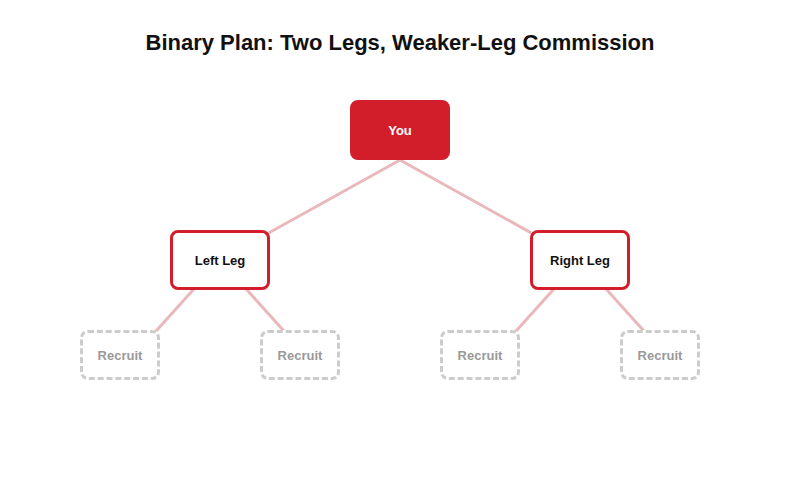
Structure: exactly two legs per distributor, commissions calculated on the weaker leg.
Strengths: simple to explain, encourages balanced team-building, supports strong spillover dynamics.
Trade-offs: requires ongoing balancing between legs, and commission logic needs to be modeled carefully to avoid runaway payouts as networks scale.
Tends to fit: businesses prioritizing fast, team-driven growth with a straightforward story to tell new recruits.
Matrix Plan
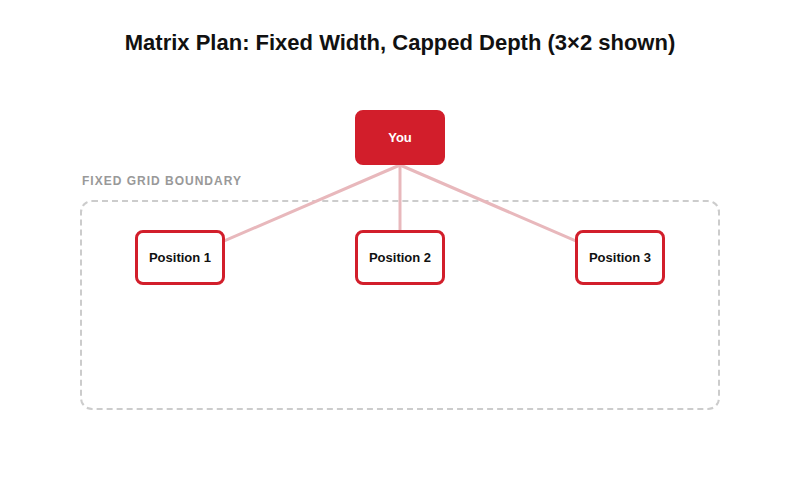
Structure: fixed width and depth (e.g. 3x5), with spillover once positions fill.
Strengths: predictable, capped structure that's easy for distributors to visualize and easy for a company to forecast payouts against.
Trade-offs: growth potential is inherently limited by the matrix size — once it's full, expansion depends on starting new cycles.
Tends to fit: businesses that want controlled, orderly growth rather than open-ended scaling.
Unilevel Plan
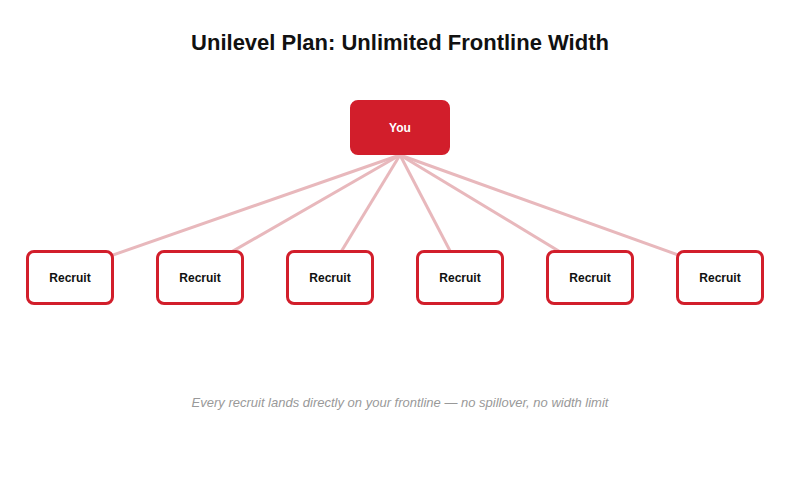
Structure: unlimited frontline width, commissions paid across a fixed number of depth levels.
Strengths: simple to understand, directly rewards personal recruiting and selling effort, no spillover complexity to manage.
Trade-offs: without width limits, tracking and reporting genuinely needs to scale with the network — this is where software quality starts to matter more than plan design.
Tends to fit: product-focused businesses where individual selling skill should be rewarded directly.
A practical framework for choosing
Rather than starting from "which plan sounds best," these four questions tend to produce a clearer answer:
- What does your product actually support? A plan built around frequent, repeat purchases (like the Mobile Recharge model) behaves very differently from one built around occasional, higher-value sales.
- What kind of distributor are you recruiting? Experienced network marketers who want to build teams gravitate toward Binary or Board structures. Individual sellers focused on their own customer base often do better under Unilevel.
- How much growth are you planning for, and how fast? Matrix and Board plans build in natural growth ceilings by design; Binary and Unilevel scale more openly.
- Can you actually report on it accurately? Whatever you choose, you need to be able to show — clearly, and on demand — what share of commissions is coming from real retail sales versus recruitment-linked activity. This is less about the plan itself and more about whether your software gives you that visibility at all.
Where software actually fits into this decision
The compensation plan is the rulebook; the software is what makes those rules hold up in practice. Whatever structure you choose, you need commission calculations that are accurate and auditable, genealogy tracking that shows exactly how earnings flow through the network, and reporting detailed enough to demonstrate — to your own team, and if it's ever asked for, to a regulator — where the money is actually coming from.
We build MLM software around the plan you've chosen rather than forcing your business into a fixed template, across all eleven plan types above. If you're still deciding, our team can walk through your specific product and growth goals and tell you honestly what's realistic to build. See our live software demo to see how commission tracking and reporting actually work before committing to anything.
Keep reading
- MLM genealogy trees explained — how the plan turns into a tree.
- The buyer's checklist — how to pick software that fits your plan.
- MLM vs affiliate software — when you do not need a plan at all.
Browse our MLM software plans or try the live demo.
Frequently Asked Questions
Is one MLM compensation plan type more legally risky than another?
No — the FTC's compliance test is based on whether compensation is tied to genuine retail sales rather than recruitment, not on which structural plan type a business uses. Any plan type can be built compliantly, and any plan type can be built in a way that isn't.
Can I combine more than one compensation plan type?
Yes — hybrid plans that combine elements of two structures (like Binary for team-building alongside Unilevel-style leadership bonuses) are common, though they add complexity to both plan design and the software needed to track them accurately.
How do I know if my compensation plan needs legal review?
If a meaningful share of your projected commission payouts would come from recruitment or required purchases rather than sales to real end customers, that's worth a conversation with a qualified attorney before launch, regardless of which plan structure you're using.
Can I switch compensation plans after launching?
It's possible, but it's a significant undertaking — existing distributor earnings, rank structures, and expectations all need to be handled carefully during a transition. It's much easier to get the initial choice right than to migrate later.