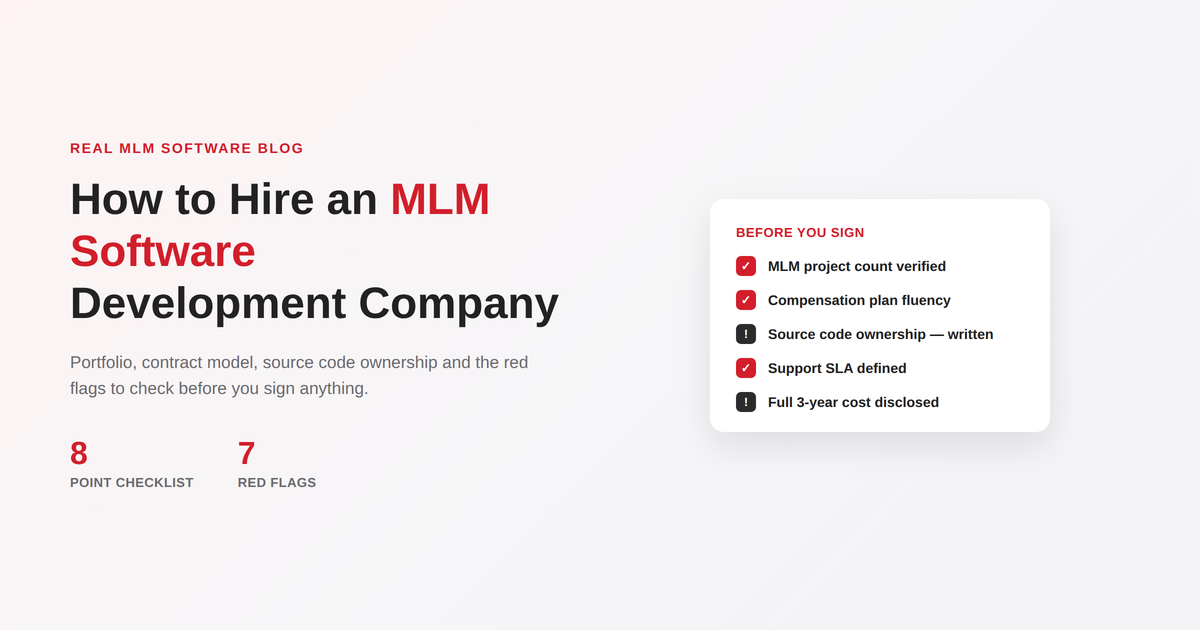
Our buyer's checklist for choosing MLM software covers how to evaluate the platform — does it handle your compensation plan, is there a real demo, what's actually included. This is a different question: once you've decided to have something built, how do you evaluate the company you're about to hand your business logic, your distributor data, and a meaningful budget to?
The two overlap, but they're not the same filter. A company can demo a polished product convincingly and still be the wrong team to build or maintain yours — understaffed, unfamiliar with MLM-specific edge cases, or structured in a way that leaves you stuck if the relationship goes wrong. This is what to actually check before you sign anything.
Quick answer: Verify MLM-specific experience first (not general software experience — ask them to explain a compensation plan edge case from memory, unprepared), get source code ownership and support SLAs in writing before paying anything, and match the contract model to how settled your requirements actually are: fixed-price only for a tightly scoped, unlikely-to-change build, time-and-materials or a milestone-based hybrid for anything with real compensation-plan complexity or open questions. Everything below expands on why each of these matters and what a wrong answer looks like.
The one question most buyers skip: do they actually know MLM, or just software?
A generic software development shop can build you something that looks like MLM software. Whether it correctly handles binary leg balancing, matrix spillover, PV/GV rollups across a 10-level genealogy tree, or the specific compliance distinction between commissionable retail sales and recruitment-based volume is a different, much narrower kind of expertise — and it's the single most common place generalist vendors get MLM builds wrong.
The test that actually works: ask them to explain how your specific compensation plan type handles a real edge case — what happens to volume when a binary leg is unbalanced, how a matrix plan handles spillover when a level is full, how generation plans skip inactive distributors — without letting them prepare an answer first. A team that's actually built MLM compensation engines before will explain this fluently. A team that hasn't will reach for generic answers or need to "check with the dev team and get back to you." That gap is the clearest signal you'll get before signing anything.
Checklist: what to verify before you hire
| What to check | What a good answer looks like | Red flag |
|---|---|---|
| MLM project count | A specific number of completed MLM builds, with at least a few live client references you can actually contact | Vague answers, or only marketing testimonials with no way to verify them |
| Compensation plan fluency | Can explain your plan's edge cases from memory, unprepared | Needs to "check and get back to you" on basic plan mechanics |
| Source code ownership | Written confirmation of what you own at project completion, and under what conditions | Vague or verbal-only promises about ownership |
| Commission engine testing | A real answer about how commission calculations are tested before launch, with some sense of post-launch bug rates | No testing process they can describe, or no data on how issues after launch get handled |
| Plan configurability | Routine changes (a new rank, an adjusted percentage) happen through an admin panel | Every small change requires a paid developer ticket |
| Post-launch support SLA | Written response and resolution time commitments, especially for critical issues like broken payouts | No SLA at all, or no defined response time for critical issues |
| Scalability evidence | Can describe the largest distributor network they've actually deployed and how it performed | No answer, or evasiveness about real-world scale |
| Full cost over time | A complete breakdown: build cost, hosting, support, maintenance, and the cost of future plan changes | Only a build quote, with hosting/support/change costs disclosed later |
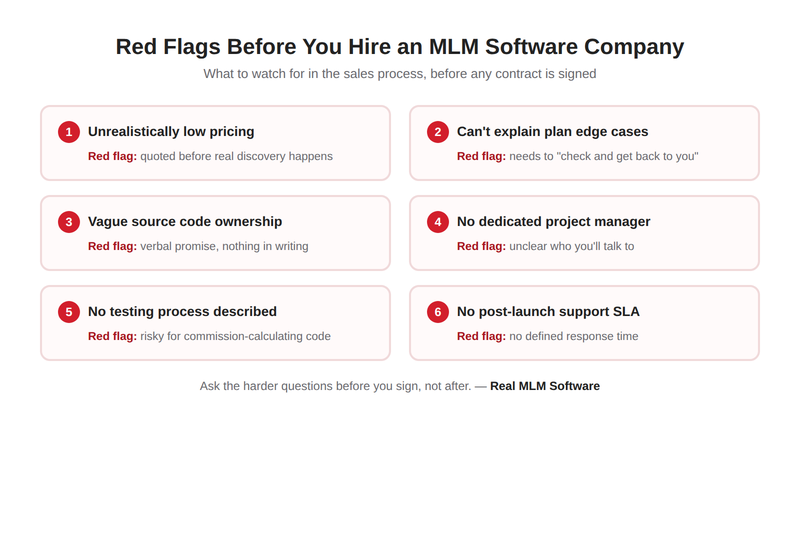
Red flags that apply to any software vendor, MLM or not
Beyond the MLM-specific checks above, a handful of broader warning signs are worth watching for in any custom software hiring process:
- Unrealistically low pricing quoted before they understand your actual requirements — often a sign of inexperience or corners that will get cut later
- Vague, pre-discovery estimates given without asking real questions about your compensation plan, scale, or integrations first
- No clear development process they can walk you through, or jumping straight to "when do we start" without any discovery or planning phase
- No dedicated project manager, or an unclear answer about who you'll actually be communicating with day to day
- Heavy reliance on freelancers rather than a stable core team, which raises continuity risk mid-project
- No automated testing practices they can describe, particularly concerning for software that calculates real money owed to real people
- Unclear IP and source code terms buried in or absent from the contract, rather than stated plainly upfront
Fixed-price or time-and-materials? Match the contract to your actual certainty
This decision matters more than most buyers realize, and it's worth understanding before you negotiate anything.
Fixed-price means you agree on a scope and a price upfront, and the vendor absorbs the risk of going over. In exchange, expect the quote to include a real risk premium — commonly cited in the 15–30%+ range — built in to cover the vendor's uncertainty, and expect any requested change after signing to come with its own separate, often expensive change order. This model works when requirements are genuinely settled and unlikely to move: a well-defined, narrow feature addition to an existing platform, for instance.
Time-and-materials (T&M) means you pay for actual work done, and priorities can shift as you learn more during the build. Independent research on project outcomes has found fixed-price contracts associated with a higher rate of project failure specifically because requirements are rarely as settled as they seem upfront — and a full MLM platform build, with its genealogy logic, commission edge cases, and compliance considerations, is exactly the kind of project where early assumptions often need revisiting. If you go this route, protect your budget with a not-to-exceed cap, per-sprint budgeting, and a real-time view into hours burned, rather than an open-ended commitment.
A middle path many MLM builds actually use: a milestone-based hybrid, where major phases (core compensation engine, genealogy and reporting, e-wallet and payouts, mobile apps) are each scoped and priced as their own fixed-price phase, giving you cost predictability per milestone without locking the entire build into a single estimate made before any real discovery happened.
Source code ownership: get it in writing, not in a sales call
Whatever a sales conversation implies about ownership, what matters is what the contract actually says. If you're expecting to own the code outright — relevant if you're going the licensed, one-time-purchase route rather than an ongoing SaaS subscription — get explicit written confirmation of what you receive at project completion, under what conditions, and whether that includes the database schema as well as the application code. "Full ownership" verbally promised and never written down is not full ownership.
Where to actually find vendors worth evaluating
Beyond a general web search, third-party review and directory platforms — Clutch, GoodFirms, G2, and similar — let you filter by MLM/direct-selling software experience specifically and read reviews from companies who've actually gone through the process. Cross-reference anyone you're seriously considering there, and ask for client references you can contact directly rather than relying on case studies alone — a vendor confident in their work won't hesitate to connect you with a current client.
How we approach this, honestly
We'd rather you ask us the harder version of these questions than the easy ones. Ask us how many MLM builds we've completed, ask us to walk through how a specific plan type handles an edge case without prep time, and ask what you'll actually own when the project is done. If the honest answer to any of that doesn't fit what you need, we'll tell you — including if that means we're not the right fit for this particular build. Get in touch and put these questions to us directly.
Keep reading
- In-house vs outsourced development — should you build a team at all?
- The buyer's checklist — how to judge the platform itself.
- White-label vs custom — a cheaper start, with trade-offs.
See what we build on our custom MLM software page, or try the live demo.
Frequently Asked Questions
How do I verify a software company's MLM experience is real, not just claimed?
Ask for client references you can contact directly, not just case studies, and ask the team to explain a compensation plan edge case for your specific plan type without preparation. Genuine experience shows up as fluency; claimed experience tends to produce vague or deflected answers.
Should I choose fixed-price or time-and-materials for an MLM software build?
Fixed-price fits a narrow, well-defined, unlikely-to-change scope. Time-and-materials, or a milestone-based hybrid, better fits a full platform build, since MLM compensation logic commonly surfaces edge cases and open questions during development that a fixed-price contract makes expensive to address.
What should be in writing before I pay anything?
At minimum: what you own at project completion (code, database schema, or both), the post-launch support SLA with specific response times, and a complete cost breakdown that includes hosting, maintenance, and the cost of future plan changes — not just the initial build quote.
Is a lower quote ever a red flag rather than a good deal?
Yes, specifically when it's quoted before the vendor has asked real questions about your compensation plan, scale, and integrations. A quote given without that discovery is a guess, and an unrealistically low one often means corners get cut on testing, support, or the complexity of your actual plan.
Do I need to ask about automated testing for MLM software specifically?
Yes — more than for most software categories, because commission calculations directly determine real money owed to real distributors. A vendor who can't describe how they test the commission engine before launch is a meaningful risk, not a minor gap.