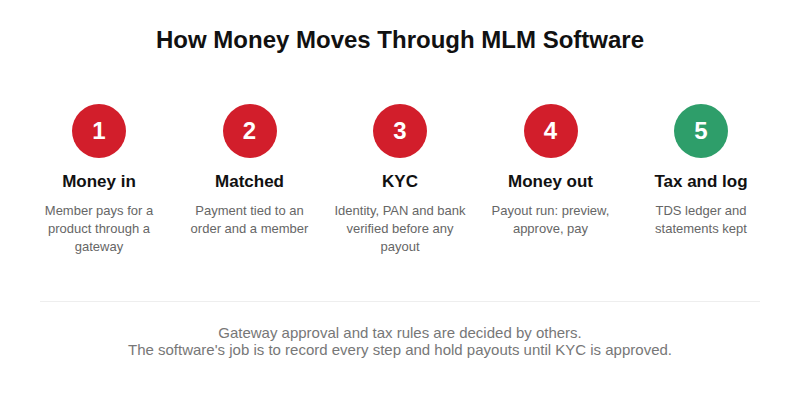
Money moves through an MLM platform in three directions. It comes in when members buy products. It has to be tied to a real person, which is where KYC comes in. And it goes out again as commissions, with tax records alongside. Most buyers focus on the first one, the payment gateway, and discover the other two late. This guide covers all three for businesses operating in India, and says plainly where the answer depends on someone other than the software vendor.
Important: we build software. We are not lawyers or tax advisers. Payment gateway policies, tax rules and direct selling regulations differ and change over time, so this guide does not quote their figures. Confirm the current position with the gateway, your accountant and your lawyer before you rely on it.
Quick answer: Connecting a payment gateway is a technical job. Being approved by one is a business decision the gateway makes, and gateways differ in how they treat MLM-style businesses. KYC should be a status that controls payouts, not a form that sits in a folder. Payouts need a statement for every member, a hold for unverified members, and a tax ledger that tracks each member's commission across the financial year. Ask the gateway about your business before you build, and ask your accountant which tax rules apply.
Money in: a gateway you can connect is not the same as a gateway that approves you
A software vendor can connect almost any gateway that publishes an API. Whether that gateway lets you accept payments is a different question, and for MLM businesses it is the one that most often surprises people. Every gateway sets its own merchant policy and keeps the right to approve or refuse a business. Those policies cover things like multi-level plans, fees charged to people for joining, and crypto, and they can change, so check the current terms of each gateway you are considering.
That does not mean an MLM business cannot use a gateway. It means the gateway will look at how your plan earns money. A business whose members pay for real products, with no pay for recruiting alone, is in a different position from one that collects “registration” or “package” fees. The wording on your website, the products on your invoices and the structure of your plan all matter.
| Question for the gateway | Why it matters |
|---|---|
| Do you accept direct selling or network marketing businesses, and under what conditions? | Approval is at the gateway's discretion, and answers differ between gateways |
| Which documents do you need for a company in our category? | Business proof, bank details and owner identity are normal; a plan description may be asked for too |
| Can we collect fees other than for products or services? | Fees charged only for joining draw close attention from gateways and regulators |
| How are refunds and chargebacks handled? | Your commission reversal logic has to follow the refund |
| Do you allow crypto-related activity? | Many card and bank gateways do not, so a crypto plan may need a separate payment route |
Ask your lawyer whether joining or subscription fees are allowed under the rules that apply to your model. Our guide to MLM software for health and wellness brands looks at record-keeping duties in India's direct selling rules in more detail.
What the software must do with a payment
- Tie every payment to an order. The payment ID from the gateway, the order, the member and the amount should all be linked, so any commission can be traced back to the sale that created it.
- Handle every state, not only success. Pending, failed, cancelled and refunded payments each need a defined result. A failed payment must not credit volume. A refund must reverse the commission.
- Confirm payments server to server. The platform should verify the gateway's confirmation message rather than trusting the page the customer returns to, because that page can be faked or never loaded.
- Show payment information to buyers. Payment methods, applicable fees, the cancellation and refund process and the payment provider's contact details should be easy to find on the website.
- Reconcile daily. A report comparing gateway settlements to platform orders catches missing or duplicate payments early.
KYC: a status that controls payouts
Direct selling regulations in India generally expect a company to keep a record of its sellers, including identity proof, address proof and contact details, and to have a written agreement with each seller. You will also need a PAN for tax purposes and a verified bank account to pay commissions. Your lawyer can confirm the current requirements. In software terms, all of this becomes a workflow, not a file upload box.
| Item | Purpose | What the software should do |
|---|---|---|
| Identity and address proof | The seller record that regulations generally ask for | Collect on joining, store with restricted access, keep status as pending, approved or rejected |
| PAN | Tax deduction and returns | Store the number, validate its format, and flag members without one |
| Bank account | Where commission is paid | Verify the account holder name matches; delay the first payout after any change |
| Seller agreement | A written agreement with each seller | Record acceptance of the terms with date and version |
| Review queue | Someone has to look at exceptions | Show rejected, mismatched and expiring documents to a named reviewer |
The single most useful rule is this: no payout to a member whose KYC is not approved. The commission is still calculated and held, so nothing is lost, but money only leaves once the record is complete. That one rule prevents most payout errors and most disputes.
Identity documents are among the most sensitive files you hold. Make sure they are stored with restricted access, and ask your adviser which rules apply to the specific identity numbers you collect.
Money out: payouts, wallets and tax records
Commission is usually calculated in cycles, shown in the member's wallet, and paid to the bank account on request or on a schedule. Each step needs rules.
| Step | What the software should do |
|---|---|
| Commission statement | Give each member a statement for each cycle showing the sales and rules behind the number |
| Wallet and minimum payout | Keep balances as ledger entries, with a minimum payout amount you set |
| Payout run | Preview the run, approve it, then pay, and guard against the same run being paid twice |
| Payment file or payout service | Produce a bank upload file, or send instructions through a payout service, and mark each payment paid or failed |
| Failed payouts | Return the amount to the wallet with a reason, and tell the member |
| Tax deduction records | Apply the tax rules your accountant gives you and keep a ledger of the tax withheld per member |
| Reconciliation | Show that total paid plus tax withheld equals total approved |
Tax. Whether tax has to be deducted from commission payouts, and at what rate, depends on your business and changes over time, so it is a question for a chartered accountant. What the software needs to do is simple to say: keep each member's total commission for the financial year, apply the rates and thresholds your accountant gives you, handle members without a PAN the way your accountant advises, and keep a ledger you can export for returns and certificates.
Do not hard-code tax rates into the software. They should be settings your finance team can update, with the date of each change recorded.
Complaints and records
Payments generate complaints: a payout that did not arrive, a refund that is late. Regulations for direct selling generally expect a complaint process with timely responses, and a ticket number for each complaint helps you show that you followed it. A support system tied to the member's payout history makes this much easier to manage.
A word on crypto
If your plan uses crypto, do not assume your card and bank gateway will handle that part. Many gateways restrict crypto-related activity, so crypto payments usually need a separate route and a separate legal check. Our guide on whether crypto MLM is legal explains what regulators look at.
Questions to put to a vendor
- Which gateways do you integrate today?
- Who talks to the gateway during approval, and do you help prepare the application?
- How does a refund reverse commissions and volume?
- Can payouts be blocked until KYC is approved?
- How are tax rates and thresholds set, and can my team change them?
- What reports can I export for my accountant?
- Can you show a failed payout and how it is handled?
How we approach this
We integrate Razorpay, CCAvenue and PayPal, and other gateways can be connected from their published documentation. We cannot promise that any gateway will approve your business, because that decision is theirs. Our advice is to ask the gateway about your model before the build, and we are happy to help you prepare the questions. If you want to see the KYC status, payout run and wallet screens, open the live demo, or tell us about your plan. You can also read about our MLM software for India work.
Keep reading
- MLM software for health and wellness brands — record-keeping in India's direct selling rules.
- Is crypto MLM legal? — what changes when crypto is involved.
- The buyer's checklist — including payment gateway coverage.
See what we build on our custom MLM software page, or compare the software features.
Frequently Asked Questions
Which payment gateway should an MLM business in India use?
It depends on your plan and products, because each gateway decides for itself which businesses it approves. Ask each gateway about your model and read its current terms before you build. We integrate Razorpay, CCAvenue and PayPal, and others can be connected from their documentation.
Will a payment gateway approve my MLM business?
We cannot say, because approval is the gateway's decision. Gateways look at how your plan earns money, the products you sell and the fees you charge. Ask them directly and keep their answer in writing.
What KYC should MLM software collect?
Identity proof, address proof and contact details for each seller, a PAN, and a verified bank account, along with an accepted seller agreement. The software should hold payouts until the record is approved. Your lawyer can confirm the current requirements.
Does MLM software calculate tax on commissions?
It can track each member's commission across the financial year, apply the rates and thresholds you set, and keep a ledger. Your chartered accountant decides which rules apply, because they change.
Can MLM software pay commissions through a bank upload file or an API?
Yes, either way is possible. The software can produce a payment file for your bank, or send instructions to a payout service, and then record each payout as paid or failed. Check the terms of any payout provider before you rely on it.