Vitamins, supplements, herbal products, and wellness drinks are among the most common things sold through direct selling. They are also among the most closely watched. Regulators care about what you say a product does. They care about what your sellers say too. So software for this industry needs more than a commission engine. This guide lists what a health and wellness brand should look for.
Important: we are software builders, not lawyers or food-safety experts. This is general information, not legal advice.
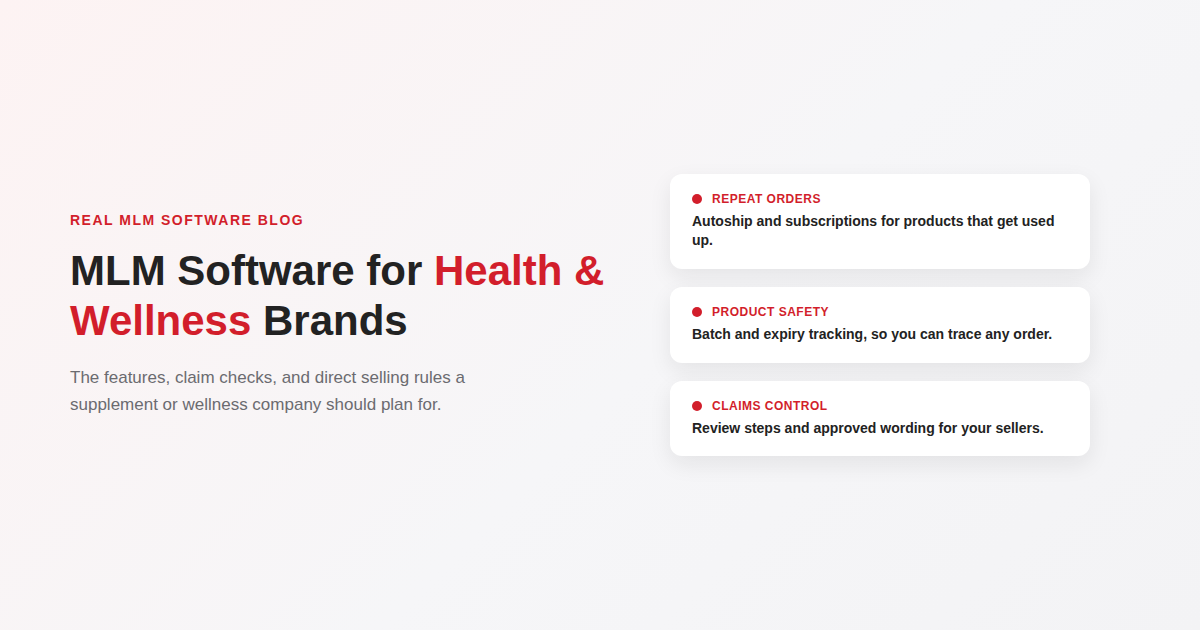
Short answer: A wellness MLM needs standard MLM software plus a few extras. These are autoship and subscriptions, batch and expiry tracking, a product information record, a review step for claims, and tools to keep your sellers' messaging compliant. Many general MLM platforms can be set up for this. Ask any vendor to show each feature working, not just to list it.
Why wellness is different from other MLM products
- Products are used up. Customers reorder every month. That makes repeat orders the heart of the business.
- Products are regulated. Food, supplement, and health regulators set rules on labels, ingredients, and claims. In India that includes FSSAI. In the US it includes the FDA. Rules differ in every country.
- Claims carry legal risk. What you say about health benefits must be backed by evidence. That applies to the company and to the people selling for it.
- Safety matters. If a batch has a problem, you need to find who received it, fast.
Features a wellness MLM should have
| Feature | What it does | Why wellness needs it |
|---|---|---|
| Autoship and subscriptions | Orders a customer's products on a set schedule and takes payment | Repeat orders are the core of the business |
| Batch and expiry tracking | Records which batch went to which order and when it expires | Lets you act quickly on a quality problem or recall |
| Product information record | Stores ingredients, pack size, and certificate details for each product | Keeps labels, pages, and invoices consistent |
| Claims review step | Holds new product text and marketing material for approval before it goes live | Reduces the chance of unapproved health claims |
| Seller training and messaging tools | Shares approved wording and rules with your sellers | Sellers are often the source of risky claims |
| Country-wise tax and shipping | Applies the right tax, price, and shipping rules by country | Product rules and prices differ across borders |
| Order and refund rules | Supports return windows and refunds as your local law requires | Direct selling laws often include refund rights |
Claims: what regulators expect
Regulators in many countries publish guidance on health product claims. In the US, the Federal Trade Commission (FTC) is one example. Three ideas matter for MLM brands. Check the current guidance of the regulator in each country you sell in.
- You need evidence. Health benefit claims generally need to be backed by good scientific evidence, and for many claims regulators expect more than a testimonial or a lab result.
- Testimonials do not remove the duty. The advertiser can be responsible for claims made through testimonials. A vague disclaimer does not fix a misleading ad.
- Many people can be liable. Regulators have said that anyone taking part in deceptive marketing can be held responsible. That can include marketers, distributors, and influencers.
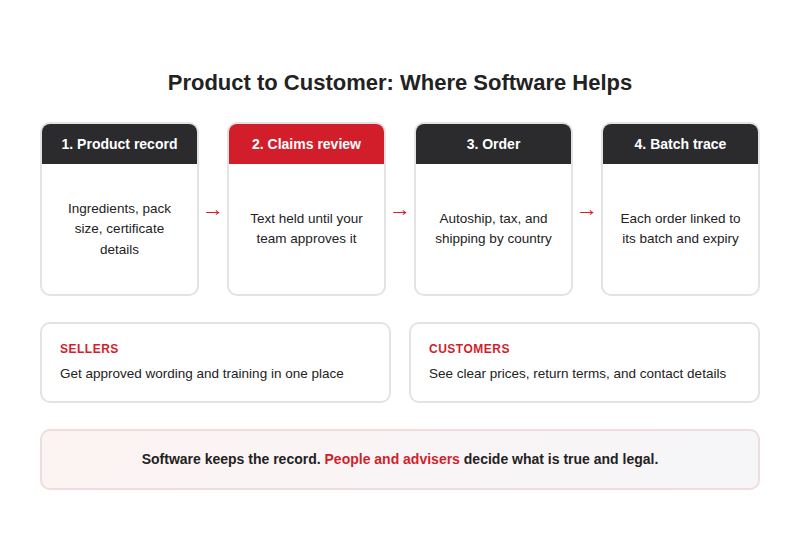
Software cannot decide what is true. It can help your team follow a process. For example, it can hold new product text for review, keep the approved wording in one place, and keep a record of who approved what.
Income claims matter too
Health claims are only half the issue. Income claims are the other half. Showing sellers' earnings without context can mislead new recruits. Our guide on legal risks in MLM explains why regulators look hard at pay that depends on recruiting. A good platform lets you publish clear, honest earnings information in a standard format.
India: what the Direct Selling Rules ask for
If you sell in India, the Consumer Protection (Direct Selling) Rules, 2021 apply. They cover areas such as the ones below. We list them to show what your software should help you record, not to restate the rules, because rules change.
- Keep records of every direct seller, including identity and address proof.
- Sign a written contract with each seller.
- Show your company name, address, and contact details on your website.
- Show the total price of goods clearly, with a breakdown.
- Have a complaints system with set response times.
- Follow the limits on entry and subscription fees, and do not run pyramid or money circulation schemes.
Check the current rules, including time limits and fee limits, with a lawyer before you launch. State governments may add their own requirements.
Questions to ask a vendor
- Can you show autoship working end to end, including failed payments?
- Can I trace a batch to the orders that received it?
- Is there an approval step before new product text goes live?
- How do you handle different tax rules in different countries?
- Who owns the data, and can I export it?
For a wider checklist, read our buyer's checklist. If you are weighing hosting and licence models, see SaaS vs licensed MLM software.
Where we stand
We build custom MLM software, so autoship, batch tracking, and approval steps can be built around your products. We do not hold food or health certifications, and we do not decide your product claims. Your regulatory and legal advisers do that. If you sell wellness products and want to see what a build would involve, tell us about your products and countries.
Keep reading
- A compliant crypto MLM pay plan — income honesty and refunds, in seven steps.
- The buyer's checklist — questions to ask any vendor.
- MLM compensation plans compared — how the plan affects your team.
See how we build custom MLM software and e-commerce MLM software.
Frequently Asked Questions
What features does MLM software for health and wellness need?
Beyond standard commissions, it should support autoship and subscriptions, batch and expiry tracking, a product information record, a review step for product claims, seller training tools, and country-wise tax and shipping.
Why is batch tracking important for supplements?
If a batch has a quality problem, you need to know which orders received it. Batch tracking links each batch to its orders so you can reach those customers quickly.
Can MLM software stop my sellers from making false health claims?
Not by itself. Software can share approved wording, hold material for review, and keep records. Your policies, training, and enforcement still do the main work.
Who is responsible for health claims in direct selling?
Regulators in many countries say anyone taking part in deceptive marketing can be liable. That can include the company, marketers, distributors, and influencers. Ask a lawyer how this applies in your country.
Do direct selling rules in India affect my software?
Yes. The 2021 rules cover seller records, written contracts, clear price display, and a complaints process. Your software should help you keep those records. Confirm the current rules with a lawyer.