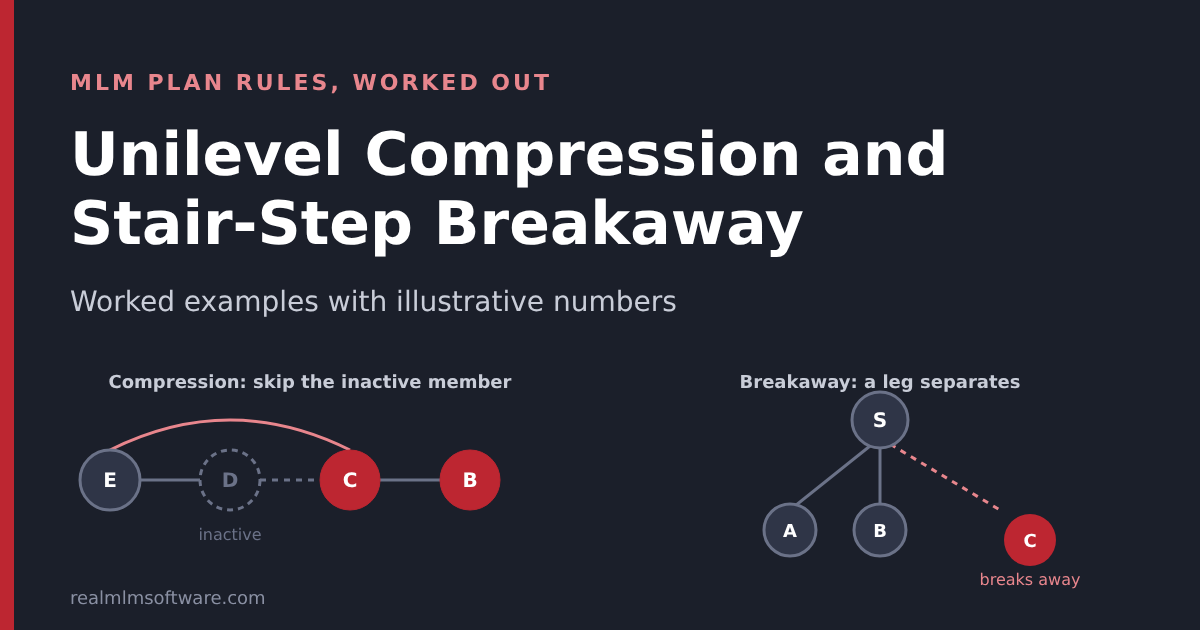
The binary carry-forward post showed one plan rule worked out line by line. Two rules in other plans raise the same “why did the payout come out like that?” question once a network is live: compression in unilevel plans and breakaway in stair-step plans. Both get a sentence in the overview of compensation plan types, but an overview doesn’t show the calculation. This post does.
Every number below is made up to show the method. They are not recommended rates, and they are not what any member should expect to receive. Real rates, qualifying rules and how the plan is funded from product sales are yours to decide, with legal advice for each country where you operate.
Quick answer: Compression closes the gap in a unilevel upline when a member in the chain is inactive, so the next eligible member is treated as one level closer to the buyer and the sale pays the full set of level rates. Breakaway, in a stair-step plan, separates a leg from its sponsor’s group volume once the leg head reaches a set rank, and replaces the sponsor’s rank-based pay on that leg with a smaller override. Both change who is paid and how much the company pays out, so both need to be written down as exact rules before the software is built.
What unilevel compression means
A unilevel plan pays commission on a sale to the members above the buyer, level by level, down to a fixed number of paid levels. That works neatly until someone in the chain isn’t eligible for the period: they missed a minimum purchase, their account is suspended, or their KYC is still pending. The plan then needs an answer to a simple question: what happens to their level?
- No compression: the level stays where it is and simply isn’t paid. Every member above keeps their original level number.
- Compression: the ineligible member is skipped and the chain closes up. The next eligible member above is treated as one level closer to the buyer and is paid at that level’s rate.
Some plans call this “dynamic compression”. The name varies. What matters is that the plan document says which of the two applies, and that the software follows the same rule on every sale.
Worked example: one sale, five members above the buyer
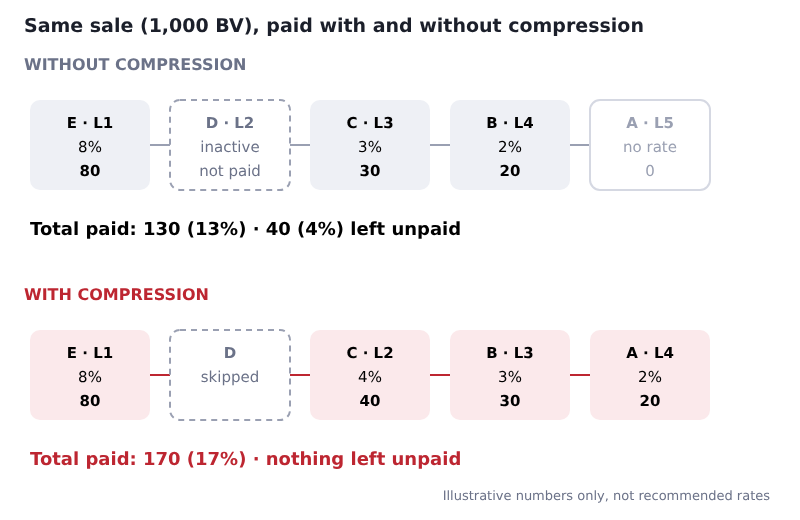
Member F buys products worth 1,000 BV (business volume). The plan pays four levels above the buyer at 8%, 4%, 3% and 2%, so the full set of rates adds up to 17% of the sale. Member D, at level 2, is inactive this period. Commission is shown in plain currency units.
| Position above buyer F | Member | Eligible this period? |
|---|---|---|
| Level 1 (rate 8%) | E | Yes |
| Level 2 (rate 4%) | D | No — missed the minimum personal purchase |
| Level 3 (rate 3%) | C | Yes |
| Level 4 (rate 2%) | B | Yes |
| Level 5 (no rate, beyond the paid levels) | A | Yes |
Now the same 1,000 BV sale paid both ways:
| Member | Without compression (level 2 stays empty) | With compression (D skipped, levels close up) |
|---|---|---|
| E | Level 1, 8% = 80 | Level 1, 8% = 80 |
| D | Level 2, 4% = 40 — not paid, member inactive | Skipped |
| C | Level 3, 3% = 30 | Now level 2, 4% = 40 |
| B | Level 4, 2% = 20 | Now level 3, 3% = 30 |
| A | Level 5 — no rate, nothing paid | Now level 4, 2% = 20 |
| Total paid | 130 (13% of the sale) | 170 (17% of the sale) |
| Rate share left unpaid | 40 (4%) | 0 |
What the example shows from the company’s side
- Payout cost moves with the rule. The same sale cost 130 without compression and 170 with it, because with compression the inactive member’s share is paid to someone else instead of staying unpaid.
- Fund the plan at the full rate. With compression, a sale pays the whole set of rates whenever enough eligible members sit above the buyer. The plan has to be affordable at 17%, not at the 13% one particular sale happened to cost.
- Position in the chain matters. Member A at level 5 is paid only when compression pulls A into level 4. A small-looking sentence in the plan document decides who is paid in practice.
- What happens to unpaid shares is a plan decision, not a software default. Without compression, the plan must say whether the unpaid 40 stays with the company, goes to a pool, or passes to someone else.
Compression rules to settle before the build
Compression looks like one switch, but the software needs answers to each of these. Leaving any of them open means the developers will guess.
| Decision | Options | Why it matters |
|---|---|---|
| What makes a member “eligible” | Minimum personal volume, an order within a set number of days, completed KYC, a minimum rank | Decides how often levels are skipped. Use one clear rule that members can see |
| When eligibility is checked | At the moment of each order, or once at period close | The two can pay different people for the same sale. Pick one and use it everywhere |
| Do skipped levels close up? | Compression (levels close up) or no compression (level stays empty) | Sets the payout cost: the full rate on every sale, or a lower and variable total |
| Level unlocks by rank | Pay by the compressed level number, or only where the member’s rank unlocks that level | Decides whether a lower-ranked member can be paid at a deeper compressed level |
| Unpaid shares | Kept by the company, moved to a pool, or passed to the next eligible member | Changes the real payout percentage, so it must be in the plan document |
| Statements | Show the original level and the compressed level on each payout line | Lets a member see why a payout was or wasn’t made, which cuts down support queries |
What stair-step breakaway means
A stair-step plan starts like unilevel, with no limit on the frontline. Members then climb ranks by meeting group-volume targets, and each rank has its own rate. Breakaway is the rule for what happens when a member in your group climbs high enough: their leg “breaks away” from you. Its volume stops counting toward your group volume, and you are usually paid a smaller override on that leg instead. Your own volume is then free to build the next rank.
The plan below is made up. It uses a differential, which means a sponsor is paid the difference between their own rate and the rate of the member in the leg. Some stair-step plans work differently, and the software has to follow whichever rule your plan uses.
| Rank | Qualifying group volume (GV) per period | Rate |
|---|---|---|
| Starter | 0 | 4% |
| Builder | 5,000 | 8% |
| Leader | 12,000 | 12% |
- Qualifying GV is the member’s own volume plus the volume of every leg that has not broken away.
- Differential: on each leg, the sponsor is paid (sponsor’s rate − leg head’s rate) × the leg’s volume. On the sponsor’s own volume, the sponsor’s full rate applies.
- Breakaway: a leg whose head reaches Leader stops counting toward the sponsor’s GV. The differential on that leg is replaced by a flat 2% override on the leg’s volume.
Worked example: one sponsor, one breakaway
Sponsor S has 500 BV of personal volume this period and three legs. Each leg’s volume includes the leg head’s own purchases. Leg A is 3,000 BV and its head ranks Starter. Leg B is 5,500 BV and its head ranks Builder. Leg C is 12,500 BV and its head has just reached Leader. Here is S’s calculation without a breakaway rule, and then with one:
| Line | Without a breakaway rule | With the breakaway rule |
|---|---|---|
| S’s qualifying GV | 21,500 (500 + 3,000 + 5,500 + 12,500) | 9,000 (500 + 3,000 + 5,500) |
| S’s rank and rate | Leader, 12% | Builder, 8% |
| Own volume 500 | 12% = 60 | 8% = 40 |
| Leg A, 3,000 | (12 − 4)% = 8% = 240 | (8 − 4)% = 4% = 120 |
| Leg B, 5,500 | (12 − 8)% = 4% = 220 | (8 − 8)% = 0% = 0 |
| Leg C, 12,500 | (12 − 12)% = 0% = 0 | Flat 2% override = 250 |
| Total paid to S | 520 | 410 |
Reading the result
- Without a breakaway rule, Leg C’s 12,500 BV keeps S at Leader, yet S is paid nothing on that leg because the two rates are equal. The sponsor line is propped up by a leg that pays it nothing.
- With the rule, S’s qualifying GV falls to 9,000, below the 12,000 Leader target, so S drops to Builder. S loses 360 of rank-based pay (520 on the other lines before, 160 after) and gains a 250 override, so S’s total is 410, which is 110 less than before.
- Leg C’s head is now paid as a Leader on their own group, separately from S.
What this means for plan design
- Rank cliffs. S fell below a threshold because one leg left. Plans soften this with a rank-maintenance rule, a grace period, or rank based on rolling volume. Each choice changes the payout cost, so model it before you fix it.
- The override rate. A low override makes breakaway costly for the sponsor. A high one raises the plan’s cost. Run it against sample trees at both ends.
- The breakaway rank. The lower the rank at which legs separate, the more legs break away and the earlier it happens.
- Funding. However the rates are set, they should be paid out of real product sales. That is a design and legal question, not something the software settles for you.
What the software has to record
Both rules are easy to dispute later unless the software keeps its working. At a minimum, record:
- Each member’s eligibility status for every period, with the date it was checked
- For compression: the original level and the compressed level on every payout line
- Rank history with effective dates, and each leg’s breakaway flag and start date
- The volume counted in every leg and in each member’s qualifying GV
- The version of the plan rules used, so any past period can be recalculated and match
How we approach this
Both rules look like one line in a plan document, and both change payouts for many members at once. We suggest writing each rule as a worked example like the ones above, with your own rates, before any code is written, so you, your accountant and the developers all check the same numbers. If you’d like to go through your plan with us, get in touch.
Keep reading
- Binary carry-forward and flush-out — another plan rule worked out with numbers.
- MLM compensation plans compared — how the main plan types differ.
- Genealogy trees explained — sponsor vs placement, and how volume rolls up.
See our unilevel plan and stair-step plan software pages, or read about our custom MLM software build.
Frequently Asked Questions
What is compression in a unilevel MLM plan?
Compression is a rule for what happens when someone in a sale’s upline chain is not eligible for the period. Instead of leaving their level empty, the plan skips them and treats the next eligible member as one level closer to the buyer, so the full set of level rates is paid to eligible members.
Is compression the same as spillover?
No. Spillover places a new member in an open position in the tree, so the tree itself changes. Compression leaves the tree as it is and only changes who is paid on a sale when a member in the chain is ineligible.
Does compression make an MLM plan more expensive to run?
It can. Without compression an ineligible member’s share goes unpaid, and with compression it is paid to someone else, so the payout on a sale can be higher. Fund the plan at the full set of rates, and state in the plan document what happens to any share that is not paid.
What is breakaway in a stair-step plan?
Breakaway is the rule that separates a leg from its sponsor’s group volume once the leg head reaches a set rank. The sponsor usually stops being paid the rank-based differential on that leg and is paid a smaller override instead, and the sponsor’s own volume is free to build the next rank.
Can one plan use both compression and breakaway?
Yes. Hybrid plans combine rules like these, for example unilevel-style level pay with ranks and a breakaway. Each added rule makes the calculation harder to check, so test the plan on sample trees and keep the rule version recorded with every payout run.