Earlier posts covered which blockchain to build on and the cost of moving USDT on Tron. This one asks a different question: once you have picked a chain, which stablecoin should your platform pay out in, and what can go wrong with it? Most teams reduce this to “USDT or USDC”. In practice the choice matters less than the controls you put around whichever one you use.
A note on scope. “Payouts” here means a company paying commissions and settlements that were earned from product sales. We don’t build schemes that pay returns on members’ deposits, and nothing below is investment advice or legal advice. Rules on crypto and stablecoins differ by country, so check yours with a local adviser.
Quick answer: Neither stablecoin is safer in every situation. Both have traded away from their $1 target at times, and in both cases the issuer can freeze an address, so the real risks are the same: a broken peg, a frozen address, and a payout sent on the wrong chain. Choose the token your members already hold, read the issuer’s current terms yourself, write down a rule for what happens if the peg breaks, screen addresses before every payout, and build the token as a setting so you can support both or switch later.
USDT and USDC compared for payout operations
This table avoids market figures on purpose, because they change quickly. It compares what matters when you are the one sending the payments.
| Operational question | USDT | USDC | What to do |
|---|---|---|---|
| Who issues it? | Tether, a private company | Circle, a private company | Read each issuer’s current terms and reserve reporting yourself |
| Can the issuer freeze an address? | Yes | Yes | Assume any wallet you use, including yours, could be frozen |
| What does a freeze do? | Transfers to or from the address stop | Transfers to or from the address stop | Plan a failed-payout path (see below) |
| What happens to frozen balances afterwards? | The issuer’s decision; the contract design differs from USDC | The issuer’s decision; the contract design differs from USDT | Don’t keep large balances in one hot wallet |
| Has it traded away from $1? | Yes, at times | Yes, at times, including briefly in March 2023 | Write a peg-break rule before launch |
| Which chains? | Issued on several chains | Issued on several chains | Each chain has its own contract. Confirm the exact contract address |
| Where do your members hold it? | Varies by country and chain | Varies by country and chain | Ask your members. Don’t assume |
| Transfer fees | Set by the chain, not the token | Set by the chain, not the token | See the TRC20 fee post for the Tron case |
Risk 1: the peg breaks
A stablecoin aims to stay at $1, but it is only as steady as its reserves and its ability to redeem. In March 2023 USDC briefly traded below $1 after its issuer disclosed that part of its reserves sat at a bank that had just failed, and it later returned to $1. USDT has also traded away from $1 at times. Nobody can promise it won’t happen again.
For a platform, the question is not whether it will happen. It is who bears the difference when a payout goes out during a break. Settle that in your terms now. Here is the same commission statement of 200 units, with a token trading at an illustrative 0.97, handled three ways:
| Rule | What is sent | Value the member receives | Who bears the gap |
|---|---|---|---|
| Pay the token count on the statement | 200 tokens | 194.00 | The member |
| Adjust the count to a price feed | 206.19 tokens | 200.00 | The company |
| Pause token payouts when the price moves past a set limit | Nothing until the limit clears | Held, or offered another payout method | Neither, but payouts are delayed |
There is no single right rule. The first is simple and shifts risk to members, the second needs a reliable price source, and the third needs a limit and a fallback. What matters is that the rule is written in the terms, built into the software and the same for everyone.
Risk 2: an address is frozen
Because the token is a contract run by the issuer, a freeze is enforced on-chain. A frozen address can’t send or receive the token, so the failure shows up in your payout run, not in a report. Each chain has its own contract, so screening and monitoring has to be done per chain.
Your own wallets are exposed too. If a company hot wallet is frozen, payouts stop until it is resolved. Here is what can fail and the control that limits the damage:
| What fails | What happens | Control |
|---|---|---|
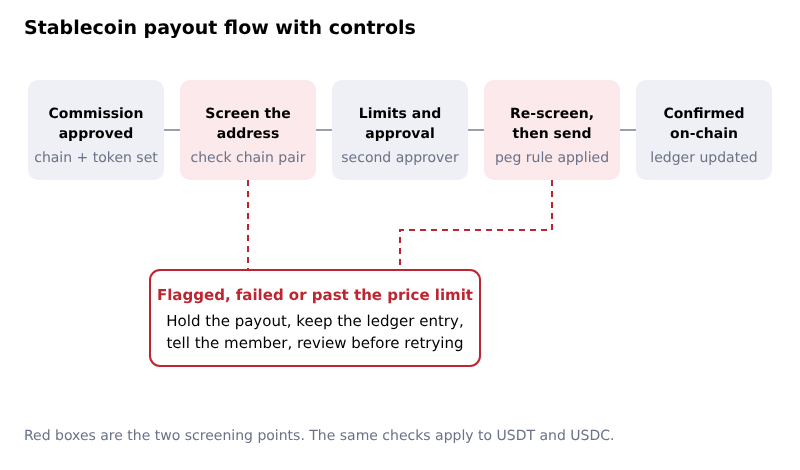
| Payout to a frozen member address | The transfer is rejected or reverts | Screen the address before approving and again before broadcasting. If it fails, keep the ledger entry as “failed, funds retained”, tell the member and ask for a new address after verification |
| Deposit from a flagged source | You may credit funds you later can’t use | Hold deposits as pending until screening returns, then credit |
| Company hot wallet frozen | All payouts from that wallet stop | Keep the hot-wallet balance small, split across wallets, and refill from cold storage by approval |
| Wrong chain or token for the address | Funds sent where the member can’t reach them | Store chain and token with every payout address, and block mismatches |
| Peg breaks during a payout run | Members receive less value than stated | Apply the written peg-break rule and pause above the limit |
Risk 3: the right token on the wrong chain
The same token name can exist on several chains, and each is a separate contract with its own address format. A member who pastes an address from a different network, or a platform that stores only a wallet address and not the chain it belongs to, can send a payout somewhere the member can’t reach. This is the most common operational mistake and the easiest to prevent: store the chain and the token with every payout address, show them to the member when they save it, validate the address format for that chain, and reject any payout where the pair doesn’t match the allowed list.
For a first payout to a new address, many platforms send a small test amount or require the member to confirm the address by a second step. Whether you do that is a design choice, but the point stands: a mistake here is permanent, and no support team can reverse an on-chain transfer.
What members should see on their statements
Most payout disputes are really information problems. A statement that shows only a total leaves the member guessing when a payout is late or smaller than expected. Show, for every payout:
- The amount on the commission statement and the unit it is stated in
- The token, the chain and the destination address, with the status (pending, sent, confirmed, held or failed)
- If a rate was applied, the rate, its source and the time it was taken
- For a held or failed payout, a plain reason and what the member can do next
- The transaction reference once it is sent, so the member can check it on a block explorer
The same record helps you. When a member says a payout never arrived, the answer is in your ledger and on the chain, not in anyone’s memory.
A payout checklist for either token
- Choose the unit of account. Do statements show a fiat amount or a token amount? Convert at one defined moment, from one defined source.
- List the allowed token and chain pairs. A payout can only go to a pair on the list.
- Write the peg-break rule and set the price-move limit that pauses payouts.
- Screen addresses before approval and again before broadcast, using a screening provider you have vetted. Treat deposits as pending until screening returns.
- Set limits and approvals. Per-payout and daily caps, and a second approver above a set amount. Our post on Custodial vs non-custodial wallets covers who holds the keys.
- Keep the hot wallet small and refill it by approval.
- Reconcile every day. Ledger entries against on-chain transfers, with failed and held payouts listed separately.
- Make the token a setting, not code. Adding or switching a token should not need a rebuild.
Which one should you start with?
| Your situation | A practical starting point |
|---|---|
| Most of your members already hold one of the two | Start with that token. Add the other once the controls above are working |
| You want a fallback if one issuer freezes your wallet or the peg breaks | Build the token as a setting and support both from the start |
| You pay members in several countries | Check each country’s rules on crypto and stablecoins with local advisers before choosing |
The honest summary is that the two tokens fail in similar ways. A platform that supports both, with screening, limits and a written peg-break rule, is better protected than one that picked the “safer” token and built nothing around it.
How we approach this
We build the payout token as a configuration, route payouts through an approval queue with limits, and keep a ledger that records the chain, token, address and status of every transfer, so a held or failed payout is visible and explainable. Which token you support, which screening provider you use and what your peg-break rule says are your decisions, ideally made with your lawyer. If you’d like to go through your payout design with us, get in touch.
Keep reading
- TRC20 USDT payout fees — the cost side of Tron payouts.
- Crypto deposits and withdrawals in MLM software — address generation, confirmations and reconciliation.
- Custodial vs non-custodial wallets — who holds the keys and the funds.
See our crypto MLM software development and blockchain development pages, or read about our smart contract development.
Frequently Asked Questions
Is USDC safer than USDT for MLM payouts?
Neither is safe in every situation. Both can lose their peg and both issuers can freeze an address. Read each issuer’s current terms and reserve reporting, check which one your members already hold, and put controls around whichever you use instead of relying on the choice alone.
Can the issuer freeze my company’s payout wallet?
Yes, in principle. Issuers can freeze addresses, including a platform’s own wallets. Keep the hot-wallet balance small, split it across wallets and refill from cold storage by approval, so a freeze can’t stop every payout at once.
What should happen if the peg breaks during a payout run?
Whatever your written rule says. Common choices are paying the token count on the statement, adjusting the count to a price feed, or pausing payouts above a price-move limit. Decide before launch, put it in your terms and build it into the software.
Can one platform support both USDT and USDC?
Yes. If the token is a setting rather than hard-coded, you can add a second token without a rebuild. Remember that each chain has its own contract for each token, so confirm the exact contract address and screen per chain.
Do I need to screen member addresses before paying out?
It is a sensible control. Screen before approval and again before broadcast, and hold deposits as pending until screening returns. Whether it is required where you operate is a question for your lawyer.