When a member pays into a crypto MLM platform, the screen says “deposit received” within a minute or two. Behind that message, the software has done several separate jobs: it gave the member a place to send money, watched the network for the payment, decided when the payment was safe to count, moved the funds somewhere secure and updated the member's balance. Withdrawals reverse the trip, with more checks. If any one of these jobs is weak, the platform either loses money or loses member trust.
This guide walks through those jobs in plain language, so you know what to ask a vendor to show you. It is about the deposit and withdrawal flow itself. For the cost of network fees on payouts, see our guide to TRC20 USDT payout fees, and for who holds the keys, see custodial vs non-custodial wallets. This is general information, not legal or security advice, and details differ by network and by design.
Quick answer: A safe deposit flow gives each payment a traceable address, waits for enough network confirmations before crediting, moves funds out of the deposit addresses into a protected wallet, and records every step. A safe withdrawal flow checks the member, the limits and the destination, asks for approval when the amount is large, sends once only, and confirms the result. A daily reconciliation compares three records, the blockchain, the wallet ledger and member balances, and flags any difference before it grows.
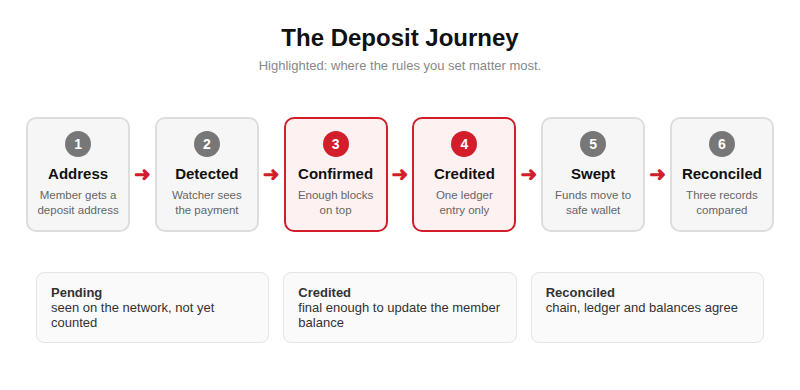
The deposit journey, step by step
- Address issued. The member is shown an address (and sometimes a tag or amount) to send to.
- Payment broadcast. The member sends from their own wallet or an exchange. The platform has no control over this step.
- Detected. A watcher service sees a transaction to one of your addresses. At this point it is only pending.
- Confirmed. The network has built enough blocks on top of the transaction for you to treat it as final.
- Credited. The ledger adds the amount to the member's balance, and the plan logic can react, for example to a package purchase.
- Swept. Funds are moved from the deposit address into a collection wallet that the platform controls.
- Reconciled. A scheduled check confirms the chain, the wallet and the ledger agree.
| Stage | What the software does | What can go wrong |
|---|---|---|
| Address issued | Creates or looks up a deposit address for the member | Two members given the same address, or an address reused after it was retired |
| Detected | Watches the network through a node or provider | Provider outage means missed deposits; the watcher must be able to catch up from a past block |
| Confirmed | Counts blocks on top of the transaction | Crediting too early risks a reversed transaction; waiting too long annoys members |
| Credited | Writes one ledger entry for the deposit | The same deposit credited twice if the job runs twice |
| Swept | Moves funds to the collection wallet | Not enough network fee balance on the deposit address to move the funds |
| Reconciled | Compares the three records | Differences found late, when the cause is hard to trace |
Address generation: how members get an address
There are three common designs. Each one changes how easy it is to match a payment to a member, and how much work the sweeping step needs.
| Design | How it works | Strength | Weakness |
|---|---|---|---|
| One shared address with a tag or memo | All members pay the same address and add a reference | Simple and cheap to run | Members forget or mistype the tag; support has to match payments by hand; not every network supports a tag |
| One address per member | Each member gets their own address, derived from a master key set | Easy to match a payment to a member; address stays the same | Many addresses to watch and sweep; a member can send an unexpected token or amount to it |
| One address per deposit request | A fresh address (and often a fixed amount and time window) for each deposit | Clear audit trail per deposit; late or wrong payments are easy to spot | Most addresses to manage; members must start a new request each time |
A common technical pattern is to derive all these addresses from a master public key, so the web server can create addresses without ever holding the keys that can spend from them. Ask your vendor where the spending keys live, who can use them and how they are backed up. Our admin keys handover checklist covers key custody in more detail.
Confirmations: when does a deposit count?
A transaction that is visible on the network is not yet final. On most networks there is a small chance that recent blocks are replaced, which can undo a transaction that looked complete. A confirmation is another block built after the one holding the transaction. More confirmations make a reversal less likely, and they also take longer.
The number of confirmations to wait for is a setting, not a law. It should be chosen per network, and many teams use a higher threshold for larger amounts. Agree the rule with your technical reviewer, write it down and make sure members are told what “pending” means on their screen.
Real payments rarely arrive in the clean way the table above suggests. Good software has a defined answer for each of these cases:
| Case | What the system should do |
|---|---|
| Payment arrives but has not reached the confirmation threshold | Show it as pending; do not credit yet; do not let the plan act on it |
| Member sends less than the expected amount | Credit what arrived, or hold it, according to a rule you set, and tell the member |
| Member sends more than the expected amount | Credit the full amount received, or flag it for review if the deposit was for a fixed package |
| Payment arrives after the request window closed | Do not drop it silently; route it to a manual review queue |
| Member sends the wrong token or uses the wrong network | Detect it, hold it out of balances and record it; recovery may be possible but is never automatic |
| The same transaction is seen twice by the watcher | Credit once only, using the transaction identifier as a unique key |
| A transaction disappears after being seen | Reverse or flag the pending entry; this is why you wait before crediting |
Hot, cold and collection wallets
Not every wallet should be treated the same. A practical set-up uses several wallets with different jobs and different protections.
| Wallet | Job | Who or what can move funds | Typical controls |
|---|---|---|---|
| Deposit addresses | Receive member payments | Only the sweeping service, to the collection wallet | Never used for payouts; kept nearly empty |
| Collection wallet | Holds swept deposits for a short time | The platform, under rules | Moves funds on to hot or cold storage on a schedule |
| Hot wallet | Pays out member withdrawals | An automated service, within limits | Small balance, daily and per-payout limits, alerts |
| Cold storage | Holds the larger reserve | Several named approvers together | Offline or hardware-backed keys, multi-person approval, written runbook |
The idea is simple: keep only what you need for the next payout cycle where the software can reach it, and keep the rest somewhere that needs several people to move it. A hot wallet that is allowed to hold everything is a single point of failure.
A made-up example for illustration: Example Co keeps in the hot wallet roughly enough to cover one normal payout day. When the balance falls under a set line, the system raises a top-up request. Moving funds from cold storage needs two of three named approvers. If the hot wallet is ever drained faster than expected, an alert goes to the operations team and withdrawals pause until someone reviews them. These numbers and roles are invented, and yours should reflect your own volumes and team.
The withdrawal journey
Withdrawals carry more risk than deposits, because the platform is the one sending money. A sensible flow is:
- Request. The member asks to withdraw an amount to an address.
- Checks. The system checks the balance, the minimum and maximum, any hold period, the member's verification status and whether the address is valid for the network.
- Address rules. New or changed destination addresses can be held for a cooling-off period, or confirmed by email or app code, before the first payout.
- Approval. Small amounts may go automatically. Larger amounts wait for one or two people on your team.
- Send once. The payment is created with a unique reference, so a retry never produces a second payment.
- Confirm. The software watches the network until the payout is confirmed, then marks it complete.
- Failure handling. If the payout fails, the funds return to the member's balance, or to a review queue, and the reason is recorded.
Our posts on MLM software security and admin keys explain why approvals, logs and separate roles matter on the admin side too.
Reconciliation: the daily check that saves you
Reconciliation means comparing records that should agree. A crypto MLM platform has three sources of truth, and they can drift apart because of a missed deposit, a failed payout or a bug.
| Record | Where it lives | What it tells you |
|---|---|---|
| Blockchain | The network and your node or provider | What was really received and sent |
| Wallet ledger | The platform's wallet database | What the software believes it holds in each wallet |
| Member balances | The MLM database | What members have been told they are owed |
A daily job should check that member balances match the ledger and that the ledger matches the on-chain balances, allowing for transactions still waiting for confirmation. Any difference goes to a named person with a clear owner, a date and a reason, not into a spreadsheet nobody opens. Keep every adjustment as a separate, dated entry instead of editing old rows, so the history stays honest.
- Alert when a difference appears, not once a month.
- Keep a log of who approved every manual correction.
- Test the process by deliberately creating a mismatch in a test environment and checking that it is caught.
- Keep exports that your accountant or auditor can read without help from the developers.
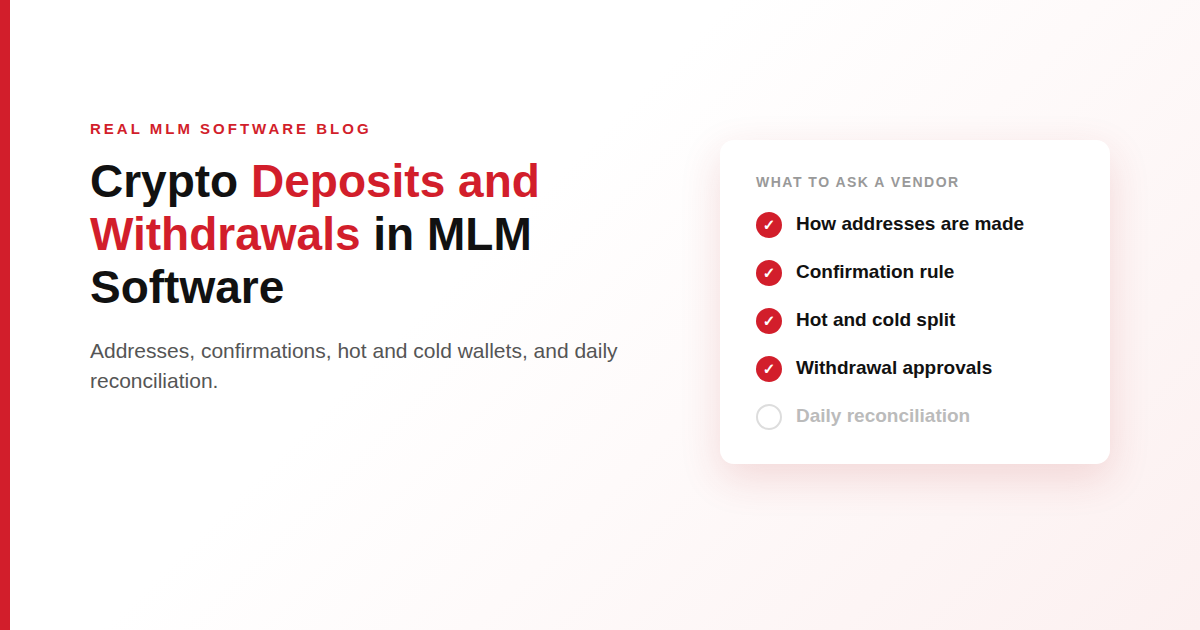
What to ask a vendor to show you
- How addresses are created, and where the spending keys are held.
- How many confirmations are required on each network, and whether that can change by amount.
- What happens in each edge case from the table above, shown live on a test network.
- How the hot, collection and cold wallets are separated and who can move funds between them.
- Which withdrawal limits, cooling-off periods and approvals can be configured.
- How a duplicate payout is prevented if a job is retried.
- What the daily reconciliation report looks like, and what happens when it finds a gap.
- What happens during a provider or node outage, and how the watcher catches up afterwards.
Compliance: holding member funds has consequences
If your platform receives members' crypto and credits it to balances, a lawyer or regulator may treat that as holding funds for others, which can bring licensing, reporting and customer-protection duties in some countries. Whether it applies to you depends on where you operate, the design and the plan. Please get advice for each market before launch, and read our guides on whether crypto MLM is legal and custodial and non-custodial wallets. Software can keep a clean record, but it cannot make an unlawful model lawful.
How we approach this
We build the deposit, withdrawal and reconciliation layers around your plan and your chosen network, and we agree the confirmation rule, wallet split and approval limits with you before we write code. Before launch we run the edge cases above on a test network with you, and we hand over the wallet and key documentation so that your team knows what exists and who can act. If you would like to walk through your own flow, contact us and we will go through it with you.
Keep reading
- TRC20 USDT payouts — who pays the network fee and how to avoid duplicate payouts.
- Ethereum vs Tron vs BSC — choosing a network for your platform.
- Custodial vs non-custodial wallets — who holds the keys to members' funds.
See our crypto MLM software development and blockchain development services, and our wallet and exchange integration page.
Frequently Asked Questions
How long does a crypto deposit take to show in a member's balance?
It depends on the network and on the confirmation rule you set. The deposit appears as pending first, then is credited once enough confirmations are in. Waiting for more confirmations is safer but slower, so the rule should be a deliberate choice.
Should every member get their own deposit address?
It is a common design because it makes matching payments to members easy. The trade-offs are more addresses to watch and sweep, and members sometimes sending the wrong token to their address. A fresh address for each deposit request gives an even clearer trail but needs more work from the member.
What is a hot wallet and why not keep all funds in it?
A hot wallet is connected to the software so it can pay withdrawals automatically. Because it is reachable by software, it should hold only what you need for the next payout cycle. The larger reserve belongs in cold storage that needs several people to move it.
What is reconciliation in a crypto platform?
It is a regular check that the blockchain, the wallet ledger and member balances all agree. When they do not, a named person investigates the difference before it grows. Doing it daily keeps problems small and traceable.
Can a deposit sent on the wrong network or token be recovered?
Sometimes, but never automatically, and not in every case. The platform should detect the payment, keep it out of balances and record it. Recovery depends on the network, the token and the keys involved, so it needs a manual process and a technical review.