Many crypto MLM businesses pay members in USDT on the Tron network, usually called TRC20 USDT, because it is widely used for stablecoin transfers. Choosing the network is only the first decision. The second, which gets far less attention, is how the payout will actually work day to day: who pays the network fee, how small a withdrawal can be, how often members are paid, and what happens when a transfer fails. If you are still deciding on a chain, start with our comparison of Tron, Ethereum and BSC.
This guide is about payout operations. It does not quote any current network fee, because those change with network conditions and you should always check them on the day you build or change your rules. Instead it shows how to plan for a fee you do not control. All amounts in the examples are made up for illustration. This is general information, not legal, tax or financial advice.
Quick answer: A blockchain transfer costs a fee per transfer, not per dollar sent, so small and frequent payouts lose the biggest share of the amount to fees. You can handle it by deciding who pays the fee (company, member, or a mix), setting a minimum withdrawal, paying on a fixed schedule instead of on demand, and keeping a funded fee reserve in the payout wallet. Then you need controls so a failed or repeated request never pays a member twice.
Why the fee shapes the payout design
A bank transfer is usually invisible to the person receiving it. A blockchain transfer is not. Every payout is a transaction, every transaction has a network cost, and that cost does not shrink when the payout is small. The result is that a member who earns a little each week can lose a noticeable share of every payout to fees if you send each one separately.
There is a second, less obvious point. On some networks the fee is paid in the network's own coin or in network resources, not in USDT. That means a wallet holding only USDT may not be able to send anything until it also holds enough of what pays the fee. Check how your chosen network charges this at the time you build, because the rules and the amounts can change.
Who pays the fee? Three common models
| Model | How it works | Good for | Watch out for |
|---|---|---|---|
| Company pays | The member receives the full amount and the company absorbs the fee. | Simple member experience; larger payouts | Cost grows with the number of members and payouts, and can be hit by many small withdrawals |
| Member pays | The fee is deducted from the withdrawal, and the member sees the net amount before confirming. | Keeping company costs predictable | Members must see the fee clearly before they confirm; a changing fee must be shown at request time |
| Minimum plus mixed | A minimum withdrawal applies. Above it the company pays, or a flat fee is deducted. | Balanced cost and fairness | The rule has to be written in plain words in the terms and shown on the withdrawal screen |
None of these is correct for every business. What matters is that the rule is decided in advance, written in your member terms, and shown on the withdrawal screen. A fee that appears for the first time after a member confirms is the quickest route to disputes.
A worked example (assumed numbers)
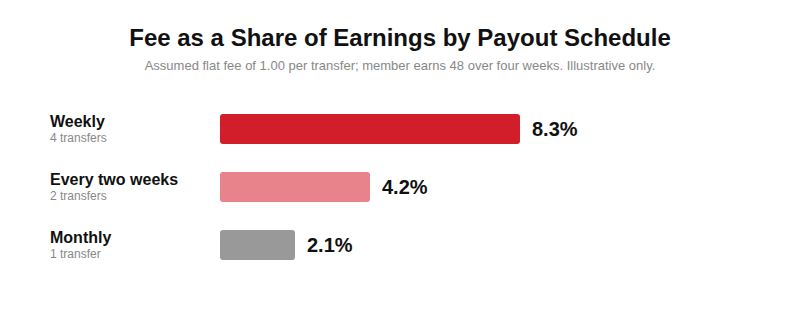
Suppose a flat fee of 1.00 per transfer. This is an assumed number to show the effect, not a real network fee. A member earns 12 per week, which is 48 over four weeks. Here is what the fee share looks like under three payout schedules:
| Schedule | Transfers in four weeks | Fees paid | Fee as share of 48 earned |
|---|---|---|---|
| Weekly | 4 | 4.00 | 8.3% |
| Every two weeks | 2 | 2.00 | 4.2% |
| Monthly | 1 | 1.00 | 2.1% |
The member earned the same amount in all three rows, yet the cost of getting it out is four times higher under the weekly schedule. Multiply that by hundreds of members and the same fee that looked trivial for one transfer becomes a real line in your operating costs, or a real deduction from members.
Design levers you can set
- Minimum withdrawal. Set it high enough that a typical fee is a small share of the minimum. Review it when network conditions change.
- Fixed payout days. Paying on set days lets you group requests, check them and fund the wallet once, instead of reacting to each request.
- Batching. Some designs send many payouts through a payout contract so several members share one transaction. This can lower the cost per member, but the contract needs a proper audit. Our post on smart contract MLM clone scripts explains the risks of using unaudited code.
- Fee estimate at request time. Show the member the estimated fee and the net amount before they confirm, and tell them it can differ slightly if the network changes before the transfer.
- A funded fee reserve. Keep enough of the network's fee asset in the payout wallet and raise an alert in the admin panel when the balance drops below a level you choose.
- An approval step. For large payouts, add a manual or two-person approval before the transfer is signed.
What can go wrong, and the control for each
| Problem | What happens | Control to look for |
|---|---|---|
| Wrong network | A member pastes an address for another network, or sends from an exchange on the wrong chain, and the funds are lost or stuck | Show the network name on the withdrawal screen; validate the address format; warn on first-time addresses |
| Typo in the address | Funds go to an address nobody controls | Address confirmation step; optional email or code confirmation when the address changes; withdrawal address cooling-off period |
| Payout wallet out of fee asset | Transfers fail until the wallet is topped up | Reserve balance alert; a queue that holds requests instead of dropping them |
| Failed transfer | The fee may still be spent and the member is not paid | Clear transaction states (queued, sent, confirmed, failed) and a retry that checks the status first |
| Duplicate payout | A retry or double click pays the same request twice | One transaction per request ID; the second attempt is refused if the first exists |
| Mismatch with the ledger | The wallet and the member balance disagree | Store the transaction hash against each request and reconcile wallet against ledger every day |
The duplicate and mismatch rows are the ones that cost real money. Each payout request needs a unique ID, a status that only moves forward, and a saved transaction hash, so that someone in your team can answer “was this member paid, how much, and when?” in seconds.
What your software should handle
- Configurable minimum withdrawal, payout days and fee mode (company, member or mixed).
- A fee estimate and net amount shown before the member confirms.
- Address validation, a displayed network name and a cooling-off option for new addresses.
- A payout queue with statuses and an admin screen for approving, holding or retrying.
- The transaction hash stored with every payout and a link to the block explorer.
- A fee reserve alert and a daily reconciliation report.
- A log of who approved or changed payout settings.
Wallet design also affects the fee and security picture. Whether the platform holds the keys or members do is covered in our guide to custodial vs non-custodial wallets, and the effort involved is part of what shapes the budget in the crypto MLM software cost guide.
Test it in a demo before you sign
Ask the vendor to run these on a test network or with test balances, not with real funds:
- Set a minimum withdrawal and try a request below it. It should be refused with a clear message.
- Request a withdrawal and check that the fee and net amount are shown before confirming.
- Double-click the confirm button, or refresh and repeat. Only one payout should be created.
- Empty the fee reserve and request a payout. It should wait in the queue, not vanish.
- Open the payout record and find the transaction hash and status history.
- Change the withdrawal address and see whether a confirmation or cooling-off step applies.
If any of these cannot be shown, you have found a gap in the payout design. Our MLM software demo shows the admin and member panels, and we can walk through your own payout rules on a call.
Compliance and tax: check before you set the rules
How a payout is treated by tax authorities, payment rules and financial regulators depends on the country, your business model and the asset used. We do not quote rates or rules here because they change. Before you launch, check the current rules with your accountant and lawyer, and read our guides on whether crypto MLM is legal and on building a compliant crypto compensation plan. We build commission plans based on product sales and do not build deposit-return or investment-return schemes.
How we approach this, honestly
We design the payout flow with you: who pays the fee, the minimum, the schedule, the approval steps and the records you want to keep. We then build it around the network you choose. We cannot control network fees, and we will not promise a particular cost. We will help you plan for it. If you would like to talk it through, get in touch or look at our crypto MLM software development service.
Keep reading
- Ethereum vs Tron vs BSC — how to choose the network before you plan payouts.
- Custodial vs non-custodial wallets — who holds the keys and what it means for payouts.
- Crypto MLM software cost — what drives the budget.
See our smart contract development and token development services.
Frequently Asked Questions
Who should pay the fee on TRC20 USDT payouts?
There is no single right answer. The company can absorb it, the member can pay it as a deduction, or a minimum withdrawal can be combined with one of those. Whichever you choose, write it into the member terms and show the fee and the net amount before the member confirms.
What is a good minimum withdrawal for crypto payouts?
It depends on the network fee on the day and on how much your members typically earn. Set the minimum so the fee is a small share of it, review it when the network fee changes, and check the current fee at the time rather than relying on an old figure.
Why do small payouts cost more in proportion?
A transfer fee is charged per transaction, not as a percentage of the amount. The same fee takes a larger share of a small payout, which is why fixed payout days and minimums are common.
How do I stop a member from being paid twice?
Give every payout request a unique ID and allow only one transaction per ID. A retry should check the status of the first attempt before it does anything, and the transaction hash should be saved for every payout.
Can MLM software batch crypto payouts?
Some designs do, using a payout contract or grouped transfers, which can lower the cost per member. A payout contract handles real funds, so it should be audited, and you should ask the vendor how batches are approved and how a failed item inside a batch is handled.