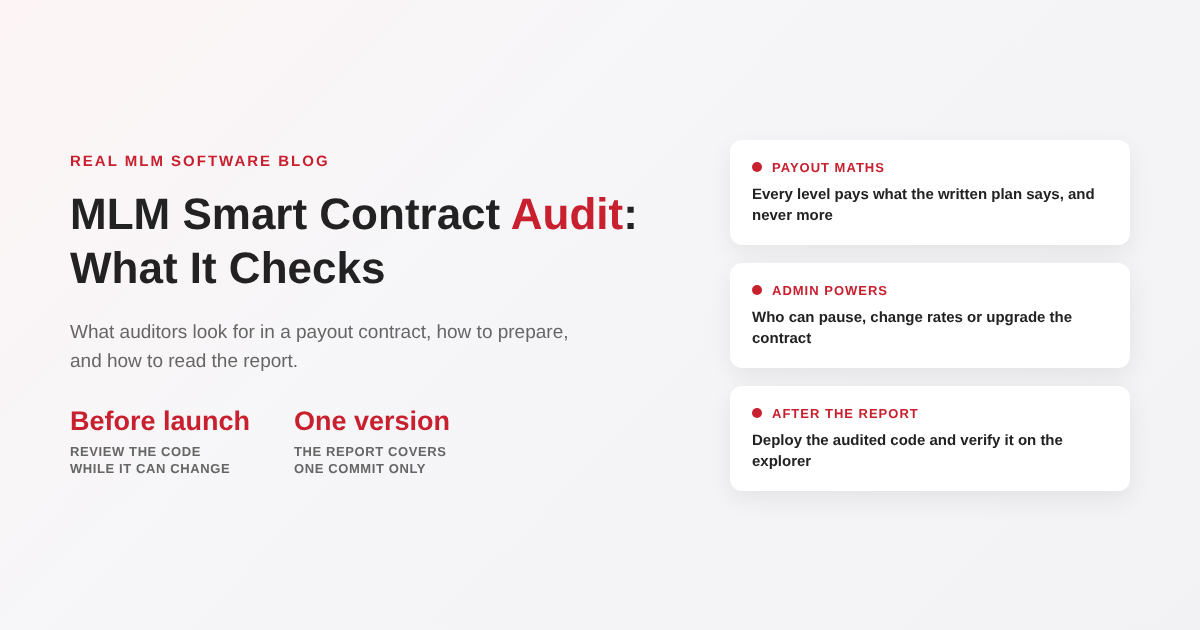
Once a smart contract is live, it cannot simply be patched like a website. If the payout logic has a mistake, the mistake runs with real money until someone notices. That is why a crypto MLM platform that holds or moves member funds should have its contract reviewed by independent security experts before launch. This guide explains what a smart contract audit checks in an MLM contract, how to prepare for one, and how to read the report you get at the end.
This is general information, not legal or security advice. Every contract is different, and only a review of your real code can tell you whether it is safe.
Short answer: A smart contract audit is a line-by-line review of your contract code by independent specialists, using automated tools and manual checks, before the contract goes live. For an MLM contract they look hardest at the payout maths, loops that walk up the team tree, withdrawals, admin powers and upgrades. You get a report listing each problem by severity and whether it was fixed. To get value from it, freeze your plan before the audit, deploy exactly the code that was audited, and verify that code on the block explorer.
What an audit is, and what it is not
An audit is a focused security review of a fixed version of your code. The auditors try to find ways the contract could lose funds, pay the wrong amount, get stuck, or be taken over. They report what they find, your developers fix it, and the auditors check the fixes.
An audit is not a guarantee. It reviews the code it was given at one point in time. It does not approve your business model, it is not legal clearance, and it does not cover your website, admin panel or servers. Our guide on whether crypto MLM is legal covers the legal side, which an audit never answers.
What auditors check in an MLM contract
General contract audits look for common bugs. An MLM contract adds risks of its own, because it pays many people across many levels from the same pool of funds.
| Area | What can go wrong | What the auditor looks for |
|---|---|---|
| Payout maths | Level percentages add up to more than was paid in, or rounding leaves small amounts stuck in the contract | Every payout path matches the written plan; totals never exceed the amount received; rounding is handled on purpose |
| Loops up the team tree | A payout that walks through many upline levels runs out of gas once the tree grows deep, so purchases start failing | A fixed maximum depth, or a design that does not loop through the whole tree in one transaction |
| Withdrawals | A member withdraws more than once before the balance updates (re-entrancy), or one failed transfer blocks everyone | Balances updated before funds move; members pull their own funds; one failure cannot freeze the rest |
| Admin powers | One key can change rates, move funds or pause the contract with no limits | Which functions are restricted, who holds each role, and whether a multisig or a delay protects them |
| Upgrades | Whoever controls the upgrade can replace the rules after launch | Whether the contract is upgradeable, who can upgrade it, and how that power is limited |
| Token handling | The same token has different decimals on different chains, so amounts come out wrong | Correct decimals for each network and token; safe handling of tokens that do not behave like the standard |
| Placement and spillover | Two purchases in the same block place people in the wrong position, or a position is filled twice | Placement rules that give the same result whatever order the transactions arrive in |
| Records | Payouts happen with no clear trail, so disputes cannot be settled | An event logged for every purchase, commission and withdrawal |
Token decimals are a common surprise. USDT, for example, uses 6 decimal places on Ethereum and Tron but 18 on BNB Smart Chain. A contract copied from one network to another without checking this can pay amounts that are wrong by a huge factor. Our comparison of Ethereum, Tron and BSC covers the other differences between the networks.
How to prepare before the audit starts
Auditors work to a fixed scope and a fixed timeline. The better you prepare, the more of that time goes into finding real problems instead of working out what the contract is meant to do.
- Freeze the plan. Decide the compensation plan before the audit, not during it. Every change after the audit starts means more review.
- Write the plan down. Give the auditors a written description of every commission, with two or three worked examples in real numbers. This is how they check that the code does what you intended.
- Send the tests. Automated tests that cover each payout path, including edge cases such as an empty upline or the maximum depth, show the auditors what has already been checked.
- List every admin role. Write down each restricted function, which role can call it, and which wallet will hold that role after launch. Our admin keys handover checklist shows what that map should contain.
- Run it on a test network. A working deployment on a test network lets the auditors try real transactions and catches setup mistakes early.
- Name the exact version. The audit should cover one specific commit of your code, identified by its commit hash, so everyone knows exactly what was reviewed.
The audit process, step by step
Firms differ in the details, but most audits follow the same order.
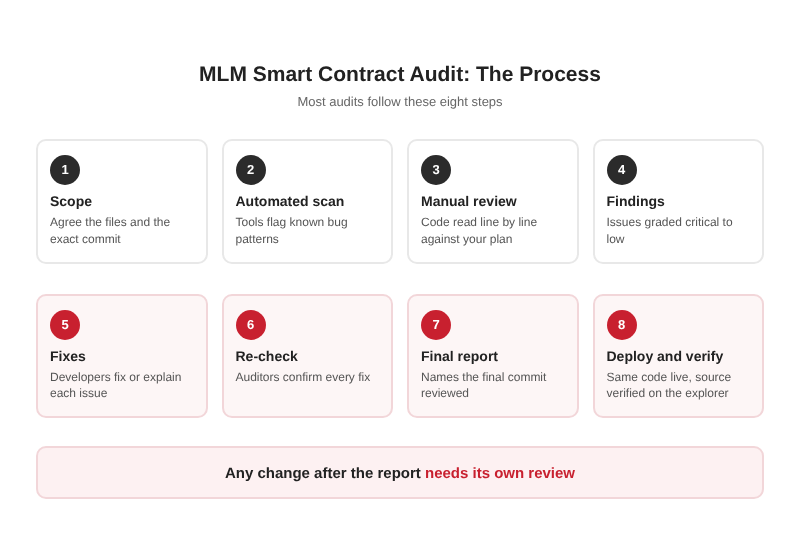
- Scope. You agree which files and which commit are covered, and what is out of scope.
- Automated scan. Analysis tools flag known bug patterns across the code.
- Manual review. Specialists read the code line by line and compare it with your written plan. This is where most serious problems are found.
- Findings. You receive a draft list of issues, each with a severity level.
- Fixes. Your developers fix the issues, or explain why an issue is accepted as it is.
- Re-check. The auditors review the fixes and mark each finding as fixed, partly fixed or acknowledged.
- Final report. The report names the final commit that was reviewed.
- Deploy and verify. You deploy that exact code and publish the source on the block explorer, so anyone can match it to the report.
How to read the audit report
Many people only read the summary page. These are the parts that actually tell you whether the audit covers what you are running.
- Scope and commit. Check that the report names the files and the commit hash, and that the contract you deploy is built from that commit.
- Severity. Findings are usually graded critical, high, medium, low and informational. Critical and high findings should all be fixed before launch.
- Status of each finding. "Fixed" means the auditors checked the change. "Acknowledged" means the team chose not to change it. Read every acknowledged item and the reason given.
- Out of scope. Anything listed here was not reviewed. If your payout contract calls another contract that is out of scope, that part is unchecked.
- Date. A report covers the code on that date. Any change after it is not covered.
Treat these as warning signs: a report with no commit hash, a contract whose source is not verified on the explorer, a report for a different contract name or network, or a vendor who claims "100% secure" but will not show the report at all. We described this last pattern in our post on smart contract MLM clone scripts.
After the audit
- Deploy exactly the audited code. Do not add "small" changes between the final report and launch.
- Verify the source on the explorer. Etherscan, Tronscan and BscScan all let you publish the source so anyone can compare it with the report.
- Review every change. A new commission, a changed rate or an upgrade needs its own review, even if the original audit was clean.
- Move the admin roles. Hand the admin roles to the wallets you agreed, ideally a multisig, and keep the proof.
- Watch the contract. Set up alerts for large withdrawals, admin actions and failed transactions, so you notice problems in hours, not weeks.
What an audit does not cover
Most crypto MLM platforms are only partly on-chain. The member panel, the admin panel, the payout scheduler, KYC and the servers all sit outside the contract, and a contract audit does not look at them. Those need their own checks; our MLM software security checklist lists twelve you can run in a demo. An audit also says nothing about whether your plan is fair or legal. A contract can be technically safe and still pay out in a way regulators object to, which is why the plan design itself matters. Our guide to a compliant crypto MLM pay plan covers that part.
Choosing an auditor
Ask any audit firm these questions before you sign:
- Can we see published reports for contracts similar to ours, ideally payout or reward contracts?
- Who will review the code, and how many reviewers are on it?
- Is the re-check of fixes included, and how many rounds?
- Will the final report name the commit hash, and can we publish it?
- Which networks do you cover, if we deploy on more than one?
Audit cost depends mainly on the size and complexity of the contract, the number of networks, and how many rounds of fixes are needed. A clear written plan and good tests usually make an audit faster. Our guide to crypto MLM software cost shows where the audit fits in the overall budget.
How we approach this
We build custom smart contracts for MLM plans on Ethereum, Tron and BNB Smart Chain. For any contract that holds or moves member funds, we recommend an independent audit before launch. We prepare for it the way this guide describes: a written plan with worked examples, automated tests for every payout path, a role map and a test-network deployment. We then fix the findings and deploy the audited version. We do not call our own review an independent audit. If you are planning a crypto MLM platform, see our smart contract development service or tell us about your plan.
Keep reading
- Smart contract admin keys — what you should hold on handover day.
- Smart contract MLM clone scripts — the risk of copying a payout design.
- Ethereum vs Tron vs BSC — which network suits your members.
See our crypto MLM software development and blockchain development services.
Frequently Asked Questions
What is a smart contract audit?
It is an independent review of a smart contract's code before launch. Specialists use automated tools and read the code line by line to find bugs, unsafe admin powers and logic errors, then check your fixes and write a report.
Does every crypto MLM smart contract need an audit?
Any contract that holds or moves member funds should have one. Once it is live it is hard or impossible to change, so a mistake can keep costing money until it is noticed.
What do auditors check in an MLM contract?
The payout maths at every level, loops that walk up the team tree, withdrawals, admin and upgrade powers, token decimals on each network, placement rules, and whether every payout leaves a record on-chain.
Does an audit mean the contract is 100% safe?
No. It reviews one version of the code at one point in time. It lowers the risk but cannot remove it, and it does not cover your admin panel, servers or the legality of your plan.
Do I need a new audit if I change the contract?
Yes. Any change after the final report is not covered by it. A small change usually needs a smaller review of the changed parts, but it still needs one before it goes live.
How do I check that the deployed contract is the audited one?
Find the commit hash in the report, make sure the contract source is verified on the block explorer, and compare it with the code at that commit. Your developer can show you this on a call.