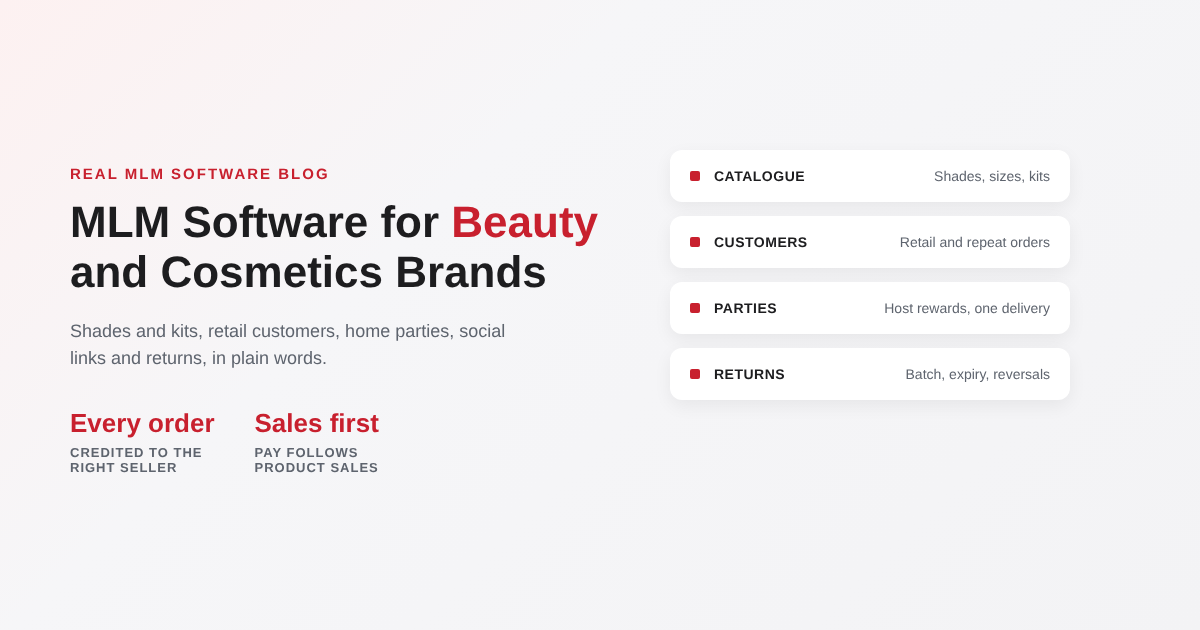
Beauty and cosmetics is one of the oldest categories in direct selling, and one of the hardest for software. A single lipstick can come in many shades, a skincare routine is sold as a kit, customers reorder every few weeks, and much of the selling still happens at home parties and on social media rather than in a shop. Generic MLM software built around one product and one price struggles with all of that. This guide covers what MLM software for a beauty or cosmetics brand needs to handle, from product variants and kits to party orders, retail customers and returns.
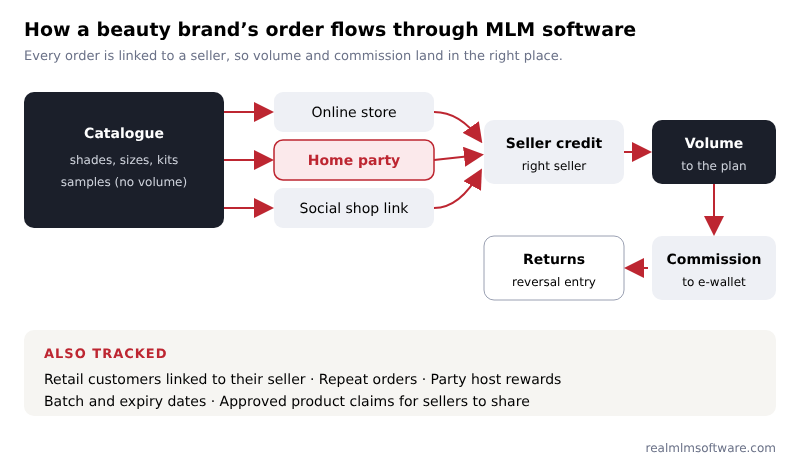
Quick answer: MLM software for beauty and cosmetics brands needs a product catalogue that handles shades, sizes and kits; separate accounts for retail customers and sellers; repeat orders and subscriptions; a home-party or event sales module; personal shop links for social selling; and batch, expiry and returns tracking. The compensation plan should pay on these sales, including retail and repeat orders, so the software must connect every order to the right seller and the right volume.
If you sell supplements or wellness products, many of the same points apply, plus a few of their own, as our guide to MLM software for health and wellness brands explains.
Why beauty brands need more than standard MLM software
| Beauty business need | What the software has to do |
|---|---|
| Many shades, sizes and finishes of one product | Product variants with their own stock code, price, volume and stock level |
| Kits, routines and starter sets | Bundles built from individual products, with stock taken from each item |
| Customers who reorder every few weeks | Repeat orders, reminders and optional subscriptions (autoship) |
| Selling at home parties and events | Party orders grouped under a host, with host rewards and one delivery |
| Selling on Instagram, WhatsApp and Facebook | Personal shop links so orders are credited to the right seller |
| Retail customers who never become sellers | Customer accounts that can order without joining the business |
| Products with a shelf life | Batch and expiry dates on stock, and first-expiry-first-out dispatch |
| Opened or damaged products returned | Returns with reasons, refunds or replacements, and commission reversed where your policy says |
Product catalogue: variants, kits and samples
The catalogue is where most beauty projects either work or fail. Each shade or size needs its own stock code (SKU), stock level and, if your plan uses it, business volume (BV). Kits should be built from the individual products, so selling a kit reduces the stock of each item inside it. Samples and testers can be set up as zero-volume items, so they leave stock without counting towards commission.
- Variants: shade, size, finish or fragrance, each with its own image, price and stock.
- Kits and bundles: fixed kits, or “build your own routine” from a set list.
- Samples and testers: tracked in stock, excluded from volume.
- Seasonal and limited editions: start and end dates, so they disappear from the store when the season ends.
- Languages and currencies: product names and descriptions in each market’s language.
Our guide to e-commerce with MLM software explains how store orders turn into volume and commission.
Retail customers and repeat orders
In beauty, the people who buy most often are frequently customers, not sellers. The software should let a seller invite customers to order through the seller’s link, keep those customers linked to that seller, and credit each order to them. Regulators in many countries also look at how much of a business’s sales go to real customers outside the seller network, so being able to report that split is useful. This is general information, not legal advice.
- Customer accounts with order history, saved addresses and favourite shades.
- Reorder in one tap, and optional subscriptions for consumables like cleansers and moisturisers.
- Reminders when a product is likely to run out, based on the last order date.
- Reports that separate customer sales from sellers’ own purchases.
Home parties and events
Party selling is still common in beauty. A seller runs a party, a host invites guests, guests order, and the host earns a reward. The software needs to group those orders under the party, apply the host reward and credit the seller’s volume, ideally with one delivery to the host.
Here is how the software might handle one party. These are made-up test rules, not earnings figures: the host reward is 10% of party sales as product credit, and the seller’s volume is half of the sales value.
| Orders | Number of orders | Sales value |
|---|---|---|
| Guest orders at the party | 8 | 18,000 |
| Host’s own order | 1 | 2,000 |
| Party total | 9 | 20,000 |
- Host reward: 10% of 20,000 = 2,000 as product credit, which the host can spend in the store.
- Seller’s volume from the party: 10,000 BV, which then counts in the seller’s plan in the normal way.
- Guests who order again later stay linked to the seller as customers.
Social selling links
Much beauty selling now starts on Instagram, WhatsApp or Facebook. Each seller should have a personal shop link and product share links, so a customer who taps a link from a story lands in the store with the seller already attached. Without this, orders from social media get credited to the wrong person or to no one, which causes disputes. A member mobile app makes sharing those links easier.
Batch, expiry and returns
- Batch and expiry dates recorded on stock, with dispatch of the earliest expiry first.
- Alerts before stock reaches its expiry date, so it can be sold, sampled or written off.
- Returns with a reason code, such as damaged, wrong shade or reaction, and a refund, replacement or store credit.
- Commission reversal on refunded orders, recorded as its own line in the seller’s wallet. Our post on how e-wallets work shows how that should look.
Product claims and compliance
Beauty products come with rules about what you can claim and how products must be labelled, and these rules differ by country. Software cannot decide what is allowed, but it can help you control what sellers say: approved product descriptions and images that sellers share instead of writing their own, a library of approved social posts, and a record of which content each seller used. Check the current rules in each market with your regulatory adviser before launch.
Which compensation plans suit beauty brands
Beauty brands often use unilevel or stair-step plans, because they reward steady repeat sales and team building around product use. Many add a retail profit margin for sellers and rewards for party hosts. Whatever you choose, pay should follow sales of products to real customers, not sign-ups. Our post on compensation plans compared helps you pick, and our compression and breakaway examples show how ranks and level pay work in practice.
A checklist for your software vendor
- Can one product have many shades or sizes, each with its own stock and volume?
- Can kits take stock from each item inside them?
- Can retail customers order without joining, and stay linked to their seller?
- Is there a party module with host rewards and grouped delivery?
- Do personal shop links credit social media orders to the right seller?
- Are batch, expiry and returns tracked, with commission reversed on refunds?
- Which payment gateways are integrated for your markets (see payments, KYC and payouts in India)?
- Can you see all of this running in a live demo before you sign?
How we build MLM software for beauty brands
We build custom MLM software around your product range and your plan, with the catalogue, customer, party and returns features your business needs, linked to the commission engine, e-wallet and payouts. Each of these modules affects the scope, as our post on MLM software cost explains. To check how your range and plan would work, send us your product range and plan.
Frequently Asked Questions
What should MLM software for a cosmetics brand include?
A catalogue that handles shades, sizes and kits; retail customer accounts linked to sellers; repeat orders and subscriptions; a party sales module; personal shop links for social selling; batch, expiry and returns tracking; and a commission engine that pays on all of these sales.
Can customers buy without becoming sellers?
Yes. Retail customers can have their own accounts and order through a seller’s link. Their orders are credited to that seller, and the business can report customer sales separately from sellers’ own purchases.
How does MLM software handle home parties?
Orders from a party are grouped under a host. The software applies the host reward your plan sets, credits the seller’s volume and can send one combined delivery to the host.
How are returns handled for cosmetics?
Each return gets a reason, such as damaged or wrong shade, and a refund, replacement or store credit. If commission was already paid on the order, a reversal entry is recorded in the seller’s wallet, following your returns policy.
Which MLM plan is common for beauty brands?
Unilevel and stair-step plans are common because they reward repeat product sales, often with a retail margin for sellers and rewards for party hosts. The right choice depends on your products, margins and markets.