Many MLM companies start with one plan and later add a second way to pay: a binary team bonus with unilevel commissions on top, or a unilevel plan with rank bonuses. That combination is called a hybrid plan. It can reward different kinds of work, but it also makes the software harder to get right, because one sale now feeds more than one calculation. This guide explains how a hybrid MLM plan works, how good software runs it without paying twice, and what to test before you launch one.
Short answer: A hybrid MLM plan combines two or more compensation structures, most often binary and unilevel, in one plan. Each product sale creates one volume record, and each part of the plan reads that same record by its own rules. Good hybrid software keeps one source of volume, calculates each bonus separately, applies one shared payout cap, and shows every bonus as its own line on the member's statement.
The figures in this guide are made up to show how the calculations work. They describe how a company's software works out payouts, not what anyone will earn.
What a hybrid MLM plan is
Every hybrid starts from the plain plan types. If you need a refresher, our guide to MLM compensation plans compared explains each one. A hybrid takes one structure for team building and adds another for a different goal, such as rewarding personal sales or leadership.
| Common hybrid | What each part rewards | Main thing the software must handle |
|---|---|---|
| Binary + unilevel | Binary pays on balanced team volume in two legs; unilevel pays a set percentage on sales a few levels down the sponsor line | Two different trees: placement for binary, sponsor for unilevel |
| Unilevel + rank bonuses | Unilevel pays on sales by level; ranks add bonuses for reaching volume targets | Rank rules that read the same volume without counting it twice |
| Stair-step + breakaway | Stair-step pays by personal rank; breakaway changes how volume counts once a leader qualifies | Volume that moves between groups when someone breaks away |
| Matrix + unilevel | A fixed-width matrix limits each level; unilevel pays on personal sponsorship without width limits | Spillover placement in the matrix and a separate sponsor tree |
The stair-step and breakaway rules are worked through in our post on compression, stair-step and breakaway examples. The rest of this guide uses binary plus unilevel, because it is the hybrid buyers ask about most.
Why companies choose a hybrid, and when not to
A single plan rewards one kind of effort. A binary plan rewards building two balanced teams. A unilevel plan rewards steady sales close to the member. A hybrid lets a company reward both: sales close to the member are paid through unilevel, and balanced team volume is paid through binary.
A hybrid is the wrong choice when the second part pays for the same activity as the first. If both parts pay on the same sale at the same level, the company pays twice for one result, and the total payout grows faster than sales. It is also the wrong choice if members cannot understand it. A plan nobody can explain in two minutes creates disputes, and disputes end up with the support team.
A worked example: one order, two bonuses
Take one made-up plan. The binary part pays 10% of the weaker leg's matched business volume (BV) each week, and unmatched volume carries forward. The unilevel part pays 5%, 3% and 2% on BV at levels 1, 2 and 3 of the sponsor line. The company caps total commissions at 40% of the period's BV.
Member E buys a product worth 8,000 BV. In the sponsor tree, E was introduced by D, D by C, and C by B. In the placement tree, E sits in member A's right leg.
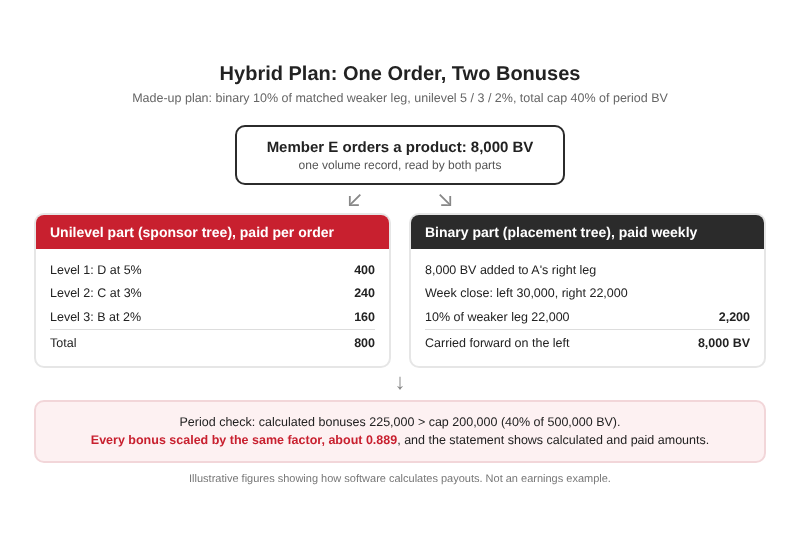
Unilevel part (sponsor tree). The order is paid right away, up three levels:
| Level | Member | Rate | Commission on 8,000 BV |
|---|---|---|---|
| 1 | D | 5% | 400 |
| 2 | C | 3% | 240 |
| 3 | B | 2% | 160 |
| Total | 800 (10% of the order's BV) | ||
Binary part (placement tree). The same 8,000 BV is added to the right leg of everyone above E in the placement tree. Nothing is paid yet. At the weekly close, A has 30,000 new BV on the left and 22,000 on the right. The weaker leg is 22,000, so A's binary bonus is 10% of 22,000 = 2,200. The extra 8,000 on the left carries forward to next week, and the right leg starts again from zero. Our binary carry-forward example follows this over several weeks.
The shared cap. At the end of the period, the company's total BV is 500,000, so the 40% cap allows 200,000 in commissions. The engines have calculated 120,000 binary, 70,000 unilevel and 35,000 rank bonuses, which is 225,000, above the cap. The software scales every commission by the same factor, 200,000 ÷ 225,000, roughly 0.889, so binary becomes 106,667, unilevel 62,222 and rank bonuses 31,111. The total is exactly 200,000. Every member's statement shows both the calculated and the paid amount, so nobody has to guess why a number changed.
Whether you use a cap, and how it works, is a plan decision for the company and its advisers. The point here is that a hybrid needs one place where every bonus is added up and checked, because each engine on its own cannot see the total.
How good software runs a hybrid plan
- One volume record per order. Each order creates its BV once. The binary, unilevel and rank engines all read that record; none of them creates its own copy. This is what stops the same sale being counted twice by mistake.
- Two trees, kept apart. Binary pays through the placement tree and unilevel through the sponsor tree. In plans with spillover, the two trees differ, so the software must store both. Our post on genealogy trees explains why.
- A fixed order of calculation. For example: first unilevel per order, then binary at the weekly close, then ranks at month end, then the cap. The order is written down and the same every period, so results can be repeated and checked.
- Separate bonus lines. Statements, reports and exports show each bonus type on its own line with its own rule, not one combined "earnings" figure.
- Returns reverse everything. When an order is refunded, its BV is removed from every engine that used it, and any commissions already paid on it are clawed back by the same rules.
- A preview before payout. The admin sees the full calculation, including the cap, before approving the payout run. Our security checklist covers approvals for payout runs.
- Plan settings with dates. When a rate changes, the old rate still applies to past periods. Recalculating last month with this month's settings is one of the most common hybrid bugs.
What to test before you launch a hybrid
Ask for a demo or test system with your plan configured, then run these cases. Our demo checklist has more general tests.
- Place one order and check that the unilevel commissions and the binary leg volume both come from the same BV.
- Place an order for a member whose sponsor and placement parent are different people, and check that each bonus goes to the right person.
- Refund that order and check that both the binary volume and the unilevel commissions are reversed.
- Run a period above the cap and check that the scaling matches your plan document to the last rupee.
- Change one rate, then recalculate a past period. It should still use the old rate.
- Export a member statement and check that every bonus type has its own line.
Common hybrid plan mistakes
- Paying twice for one result. Both parts pay on the same sale at the same level. Give each part a different job.
- No total view. Each part looks affordable alone, but nobody adds them up. Model the combined payout at several sales levels before launch.
- Paying for sign-ups. Any part that pays for adding people rather than for product sales raises legal risk, whatever the plan type, because regulators look at where the money comes from. Keep every part tied to real product sales.
- Too many parts. Each extra bonus adds rules, edge cases and support questions. Start with two parts that you can explain clearly.
- Changing the plan with no migration plan. Moving from a single plan to a hybrid changes how history is read. Our migration checklist covers moving volume and rank history safely.
Questions to ask a software vendor
- Does every engine read one shared volume record, or does each bonus keep its own?
- Can the system store a placement tree and a sponsor tree that differ?
- In what order are the bonuses calculated, and can we see that order in writing?
- How is a total payout cap applied, and does the statement show calculated and paid amounts?
- What happens to every bonus when an order is refunded?
- Can we change a rate from a future date without changing past periods?
How we approach this
We build custom MLM software, including hybrid plans, from your written plan document. Before we write code, we turn your plan into worked examples like the one above and agree them with you, so the software is tested against numbers you have already checked. You can see the single-plan versions on our binary plan, unilevel plan and matrix plan pages. If you are planning a hybrid, see our custom MLM software service or send us your plan.
Keep reading
- MLM compensation plans compared — the plan types a hybrid is built from.
- Binary carry-forward and flush-out — the binary part, week by week.
- Unilevel compression and breakaway — worked examples of those rules.
Frequently Asked Questions
What is a hybrid MLM plan?
It is a compensation plan that combines two or more plan types, such as binary and unilevel, so members can be paid in more than one way. Each part has its own rules but reads the same sales volume.
What is the most common hybrid MLM plan?
Binary combined with unilevel is the one buyers ask about most. Binary rewards balanced team volume in two legs, and unilevel pays a set percentage on sales a few levels down the sponsor line.
Does a hybrid plan pay twice on the same sale?
It should not pay twice for the same result. One sale can feed two bonuses that reward different things, but the plan and the software must make sure the parts do not overlap and that the total stays within the company's budget.
Is a hybrid MLM plan legal?
No plan type is legal or illegal by itself. What matters is where the money comes from: pay based on real product sales is safer than pay for adding people. Get legal advice on your specific plan in each country where you operate.
Can existing MLM software handle a hybrid plan?
Only if it can keep one shared volume record, store separate placement and sponsor trees, and calculate bonuses in a fixed order with a shared cap. Many template systems support one plan well and fake the second part with manual work.
How do I test a hybrid plan before launch?
Run real cases in a test system: one order through both parts, a member with different sponsor and placement parents, a refund, a period above the cap, and a rate change. Compare every result with worked examples in your plan document.