In most direct selling businesses, the first order is not where the business is made. It is made when customers come back and buy again: the next month's supplements, the refill, the subscription box. A repurchase plan is the part of a compensation plan that pays commission on those repeat orders. This guide explains how a repurchase plan works, how the software calculates it each month, and what to test before you launch one.
Short answer: A repurchase plan pays commission on repeat product orders, usually as a set percentage of each order's business volume (BV) across a few levels of the sponsor line. Members typically qualify each month by making a minimum personal purchase. The software adds up repeat-order volume per member for the month, checks who qualified, applies the level rates, and reverses commission on any order that is returned.
The figures in this guide are made up to show how the calculation works. They describe how a company's software works out payouts, not what anyone will earn.
What a repurchase plan is
A repurchase plan rewards repeat buying of real products, by members and by their customers. It is often the second part of a hybrid plan: for example, a binary or matrix part that rewards building a team, and a repurchase part that pays on the monthly orders that keep the business running. It can also run on its own.
Some companies pay repurchase commission through a generation plan instead, where a member's rank sets the rate and the commission is the difference (gap) between their rate and the rate of the member below them. Our generation plan MLM software page explains that method with an example. This guide uses fixed level rates, because that is the simpler setup most companies start with.
Because it pays on product orders, a repurchase plan sits on the safer side of where regulators look. They ask where the money comes from, and repeat purchases by real customers are the clearest answer. That only holds if the orders are genuine. A plan that pressures members to buy stock they do not need just to qualify creates its own problems.
| Part of the plan | What it usually does | What the software must handle |
|---|---|---|
| Business volume (BV) | Each product carries a BV value, separate from its price | BV per product, per order and per return |
| Monthly qualification | A member must buy a minimum BV personally that month to earn repurchase commission | Checking each member's personal BV at month end |
| Level commissions | A set percentage of repeat-order BV, paid on a few levels of the sponsor line | Walking up the sponsor tree for every order |
| Unpaid levels | What happens when someone in the line has not qualified | Compression, or keeping the amount, exactly as the plan says |
| Ranks and caps | Some plans unlock more levels at higher ranks, or cap the monthly payout | Rank rules read from the same volume, without counting it twice |
A worked example: one month of repeat orders
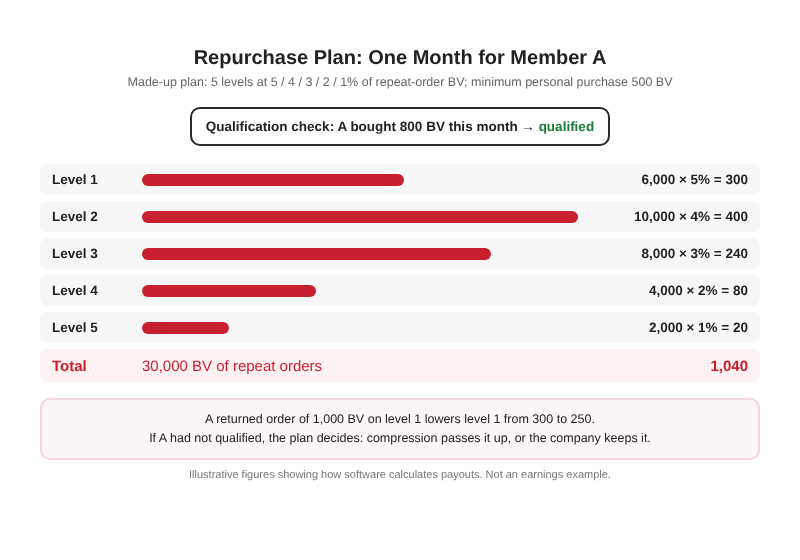
Take one made-up plan. It pays on five levels of the sponsor line, at 5%, 4%, 3%, 2% and 1% of repeat-order BV. To earn repurchase commission in a month, a member must buy at least 500 BV of products personally that month.
Member A bought 800 BV of products this month, so A qualifies. The repeat orders in A's sponsor line this month add up like this:
| Level | Repeat-order BV this month | Rate | Commission |
|---|---|---|---|
| 1 | 6,000 | 5% | 300 |
| 2 | 10,000 | 4% | 400 |
| 3 | 8,000 | 3% | 240 |
| 4 | 4,000 | 2% | 80 |
| 5 | 2,000 | 1% | 20 |
| Total for the month | 1,040 | ||
Now suppose one level-1 member, C, returns an order of 1,000 BV in the same month. The software removes that 1,000 BV, so level 1 becomes 5,000 BV and A's level-1 commission falls from 300 to 250. If the month has already been paid, the 50 is recovered from A's next payout by the same rule, and A's statement shows why.
And if A had bought only 300 BV personally, A would not qualify this month. What happens to A's 1,040 then depends on the plan. With compression, each amount passes up to the next qualified member above A. Without it, the company keeps it. Both are legitimate choices, but the plan document must say which, and the software must do exactly that. Our post on compression and breakaway examples shows how compression changes payouts.
How good software runs a repurchase plan
- BV is stored on every order line. Price and BV are separate, and a price change does not silently change last month's BV.
- A clear monthly close. Orders up to the cut-off time count for the month; later orders count for the next one. The cut-off is fixed and shown to members.
- Qualification is checked once, at the close. The software records whether each member qualified, so later disputes can be settled from the record.
- One volume record, read by every bonus. If the repurchase part runs alongside a binary or rank part, they all read the same order volume. Our hybrid plan guide explains why this stops double payment.
- Returns reverse commission automatically. A returned order removes its BV and claws back the commission paid on it, by written rules.
- Autoship and subscriptions. Repeat orders placed automatically count the same way as manual ones, and a failed payment does not count as an order.
- Statements by level. Members see the BV and commission per level for the month, and the e-wallet shows each credit. Our post on how e-wallets work covers the ledger side.
What to test before you launch
Ask for a test system with your plan configured, then run these cases. Our demo checklist has more general tests.
- Place orders on five levels and check each level's commission against your plan document.
- Place an order one minute before and one minute after the monthly cut-off, and check which month each counts in.
- Run a month where one member is below the qualification amount, and check that compression (or no compression) works exactly as your plan says.
- Return an order after the month has been paid, and check the clawback on the next payout and on the statement.
- Change one product's price and check that last month's BV and commission do not change.
- Run an autoship order with a failed payment and check that it does not count.
Common repurchase plan mistakes
- Qualification that forces stock loading. A monthly minimum that is higher than a real customer would buy pushes members to buy for the plan, not for use. Set it at a level of genuine personal use, and offer a return policy.
- No rule for unqualified members. If the plan does not say what happens to their share, every month ends in a dispute.
- Counting the same order twice. A repurchase part and a team part that both create their own volume from one order pay twice for one sale.
- Returns that never reach the commission engine. If refunds are handled only in the store, commission stays paid on orders that no longer exist.
- Using "repurchase" for something that is not a product purchase. Paying members to "renew" a position, a slot or an ID with no product behind it is not a repurchase plan. We do not build those.
Questions to ask a software vendor
- Is BV stored per order line, separately from price?
- How is the monthly cut-off set, and can members see it?
- Where is each member's qualification result for a month recorded?
- What happens to commission when an order is returned after payout?
- Do autoship orders and manual orders count the same way?
- Can the repurchase part run alongside binary or matrix without counting volume twice?
How we approach this
We build repurchase plans into custom MLM software, on their own or alongside binary, matrix or unilevel plans. Before writing code, we turn your plan into worked months like the one above, including a return and an unqualified member, and agree them with you. For product businesses, we link the plan to an online store so every order creates its volume automatically. Send us your plan or see our custom MLM software service.
Keep reading
- Hybrid MLM plan software — running repurchase alongside another plan.
- MLM software for health and wellness — autoship, batches and returns.
- MLM software for beauty and cosmetics — variants, kits and subscriptions.
Frequently Asked Questions
What is a repurchase plan in MLM?
It is a compensation plan, or part of one, that pays commission on repeat product orders. Commission is usually a set percentage of each order's business volume, paid on a few levels of the sponsor line each month.
How is repurchase commission calculated?
At the monthly close, the software adds up the repeat-order BV on each level of a member's sponsor line, checks that the member qualified with their own minimum purchase, and applies the plan's rate for each level.
What is BV in a repurchase plan?
BV, or business volume, is a value given to each product for commission purposes. It is set separately from the price, so the company can decide how much of each product counts towards commissions.
What happens if a member does not meet the monthly purchase?
They do not receive repurchase commission for that month. Their share either passes up to the next qualified member (compression) or stays with the company, depending on the plan.
Can a repurchase plan be combined with a binary plan?
Yes. Many companies use binary for team volume and repurchase for monthly orders. The software must make both parts read the same order volume, so one sale is not paid twice.
How are returns handled in a repurchase plan?
A returned order removes its BV from the month. If commission on it was already paid, the software recovers it from the next payout under written rules, and shows the change on the member's statement.